
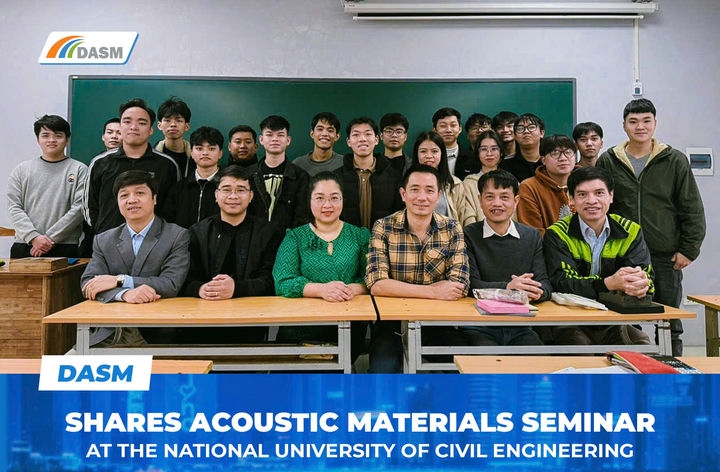
DASM recently delivered a specialized seminar on acoustics and acoustic materials at the Faculty of Building Materials, National University of Civil Engineering in Hanoi, providing students with practical knowledge on sound absorbing material, sound insulation material, measurement methods, and applications in modern construction.
Acoustics in modern architecture and construction
As architecture and construction increasingly prioritize spatial experience and user well-being, acoustics now plays a critical role. Beyond structural durability and aesthetics, buildings are expected to control sound to ensure effective work, learning, and living environments.
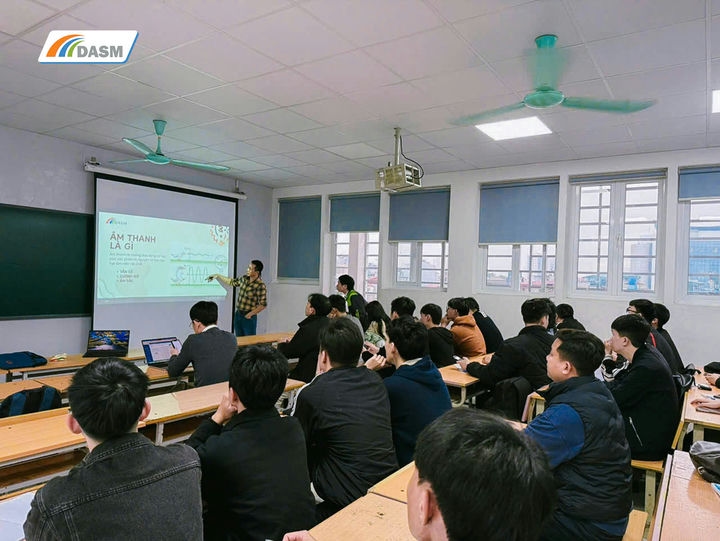
To bring acoustics closer to future materials engineers, DASM Institute for Development and Application of Acoustic Materials hosted an academic seminar presented by Mr. Nguyen Phuong Lam, Director of DASM.
Seminar content: Acoustic science and materials from a technical & applied perspective
The session began with a scientific overview of sound, covering:
- Mechanical vibration and acoustic wave fundamentals
- Key measurement parameters (frequency in Hz, sound pressure level in dB, amplitude)
- Sound propagation and interaction with surfaces (reflection, absorption, transmission)
These fundamentals helped students understand why indoor sound may become echoic, reverberant, noisy, or unintelligible — a common issue in schools, offices, auditoriums, and commercial spaces.
Acousic materials and their role in buildings
The seminar introduced three core categories of acoustic materials:
- Sound Absorption — reducing reflections and reverberation
- Sound Insulation — limiting transmission between spaces
- Sound Diffusion — distributing sound for natural sound fields
This provided a bridge between theory and practical building design and construction.
How sound absorption & sound insulation materials work
A popular section of the discussion focused on the working mechanisms of materials.
Sound absorption materials depend on:
- Porous and interconnected structures
- Fiber size and pore diameter
- Airflow resistivity
- Density and thickness
- Tortuosity
Common examples include:
- Rockwool & glasswool (fibrous media)
- Open-cell acoustic foams
- Micro-perforated wooden panels
- Sonic acoustic panels
Sound insulation materials, by contrast, rely on:
- Mass density
- Elastic rigidity & coincidence frequency
- Internal damping
- Flow resistivity
Examples such as rubber, gypsum partitions, laminated glass, and composite panels demonstrated how acoustic materials are already present across Vietnamese buildings.
Classification of acoustic materials
Materials were classified by:
+ Function: absorption, insulation, diffusion, vibration & noise control
+ Structure: fibrous, porous, membrane, resonant, composite
+ Application: studio, office, residential, industrial, education, healthcare
The seminar emphasized choosing materials based on performance objectives, rather than market habits.
Evolution of acoustic materials
From traditional to advanced solutions, the discussion highlighted:
- Natural fibers (wool, straw, wood, bamboo)
- Industrial materials (mineral wool, fiberglass)
- Polymers & elastomers
- Micro-perforated & composite panels
- Green & recycled solutions for sustainable buildings
The trend toward Green Acoustic Materials aligns with sustainability directions in construction.
Measurement methods and acoustic standards
The technical section introduced standardized testing and measurement:
- Reverberation Chamber — absorption coefficient α
- Transmission Rooms — airborne sound insulation
- STC, Rw, DnT, LnT indices
- ISO, ASTM, and EN standards
Students learned that acoustic performance must be verified by laboratory testing rather than self-claimed specifications.
Interactive session: When materials leave the textbook
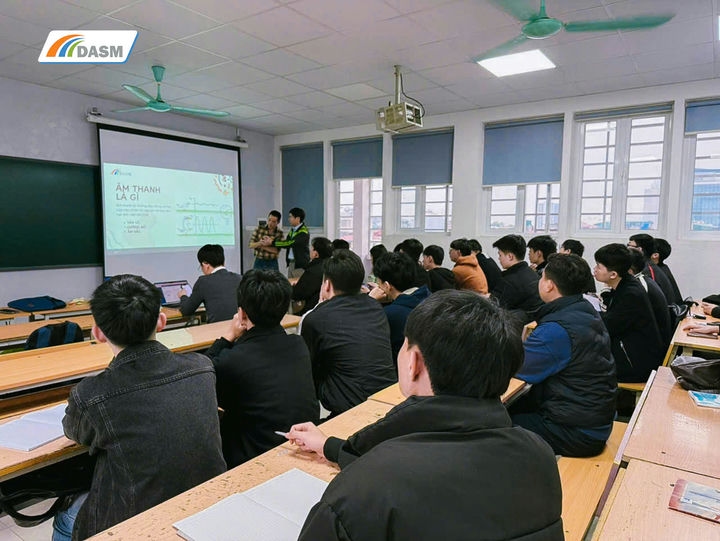
Students actively discussed acoustic performance of everyday materials such as wood, metal, gypsum, glass, textiles, foam, and mineral wool. Real project examples demonstrated how acoustics influences:
- Lecture clarity in classrooms
- Concentration in offices
- Acoustic privacy in hospitals and residences
- Musical experience in concert halls and studios
These exchanges highlighted the interdisciplinary nature of acoustics.
DASM’s role in advancing acoustic materials in Vietnam
With a research-driven and application-oriented strategy, DASM aims to promote acoustic awareness in Vietnam through material research, testing, standard compliance, and knowledge sharing.
Acoustics is increasingly recognized as a core aspect of spatial experience, affecting health, focus, and productivity — opening long-term career opportunities for students in the field.
DASM supports future acoustic engineers
DASM extends appreciation to the Faculty of Building Materials and the students of the National University of Civil Engineering for their active participation. DASM believes that advancing acoustic knowledge will contribute to higher quality buildings in Vietnam.
DASM welcomes young engineers interested in acoustics to explore real-world testing environments, gain experience, and shape career pathways toward future collaboration.