1 Scope
This part of ISO 11546 specifies laboratory methods for determining the sound insulation performance (insertion loss) of enclosures for small machinery.
This standard applies only to complete enclosures and not to individual panels forming such an enclosure.
CHÚ THÍCH
1 Sound insulation for enclosure panels such as wall elements, doors, windows, silencers, etc. should be measured according to other relevant standards.
2 The related standards refer to the measurement of noise reduction of enclosures in situ (ISO 11546-2) and cabins (ISO 11957).
The measurement methods specified in this part of ISO 11546 are based on International Standards in the ISO 3740, ISO 9614 and ISO 11200 series (see Table 1). Depending on the selected method, the sound insulation performance (insertion loss) of the enclosure is determined by the reduction in sound power level or sound pressure level. Methods are provided for measurements where the enclosure surrounds the actual sound source (machinery). When these methods are not feasible, alternative measurements can be made using the reciprocity method (see definition 3.11 and subclause 7.2) or an artificial sound source.
This part of ISO 11546 applies without restriction to freestanding enclosures with a volume of less than 2 m3. If an actual sound source is used, the sound insulation performance of enclosures with a volume exceeding 2 m3 can be determined provided that the requirements relating to the maximum allowable volume in the standard used are met. The actual sound source method applies to all types of enclosure designs, such as enclosures fixed to machinery.
When using the reciprocity method or the artificial sound source method, the maximum volume of the enclosure is limited to 2 m3. These methods do not apply to close-fitting enclosures.
The term "laboratory conditions" used in the title of this part of ISO 11546 indicates that the test conditions and test environment (indoor or outdoor) fully comply with the corresponding International Standards listed in Table 1.
2 Normative references
The following standards contain provisions which, through reference in this text, constitute provisions of this part of ISO 11546. At the time of publication, the editions indicated were valid. All standards are subject to revision, and parties to agreements based on this part of ISO 11546 are encouraged to investigate the possibility of applying the most recent editions of the standards indicated below. Members of IEC and ISO maintain registers of currently valid International Standards.
ISO 140-6:1978, Acoustics — Measurement of sound insulation in buildings and of building elements — Part 6: Laboratory measurements of impact sound insulation of floors.
ISO 717-1:—1), Acoustics — Rating of sound insulation in buildings and of building elements — Part 1: Airborne sound insulation.
ISO 3741:1988, Acoustics — Determination of sound power levels of noise sources — Precision methods for broad-band sources in reverberation rooms.
ISO 3742:1988, Acoustics — Determination of sound power levels of noise sources — Precision methods for discrete-frequency and narrow-band sources in reverberation rooms.
ISO 3743-1:1994, Acoustics — Determination of sound power levels of noise sources — Engineering methods for small, movable sources in reverberant fields — Part 1: Comparison method for hard-walled test rooms.
ISO 3743-2:1994, Acoustics — Determination of sound power levels of noise sources using sound pressure — Engineering methods for small, movable sources in reverberant fields — Part 2: Methods for special reverberation test rooms.
ISO 3744:1994, Acoustics — Determination of sound power levels of noise sources using sound pressure — Engineering methods in an essentially free field over a reflecting plane.
ISO 4871:—2), Acoustics — Declaration and verification of noise emission values of machinery and equipment.
ISO 9614-1:1993, Acoustics — Determination of sound power levels of noise sources using sound intensity — Part 1: Measurement at discrete points.
ISO 9614-2:—3), Acoustics — Determination of sound power levels of noise sources using sound intensity — Part 2: Measurement by scanning.
ISO 11201:1995, Acoustics — Noise emitted by machinery and equipment — Measurement of emission sound pressure levels at a work station and at other specified locations — Engineering method in an essentially free field over a reflecting plane.
ISO 11204:1995, Acoustics — Noise emitted by machinery and equipment — Measurement of emission sound pressure levels at a work station and at other specified locations — Method requiring environmental corrections.
IEC 651:1979, Sound level meters.
IEC 804:1985, Integrating-averaging sound level meters.
IEC 942:1988, Sound calibrators.
IEC 1260:—4), Electroacoustics — Octave-band and fractional-octave-band filters.

Copyrighted standard notice
According to international copyright regulations and DASM policy, only the standard summary and test methodology are displayed. Direct download is not available.
VILAS 1541
DASM conducts testing according to this standard
DASM Acoustic Laboratory has accredited capability to conduct 1 testing method(s) compliant with standard ISO 11546-1:1995:
- Determination of sound insulation performance of enclosures – laboratory measurements(TCVN 7839-1:2007; ISO 11546-1:1995)
VILAS 1541 · ISO/IEC 17025
Need advice on SOUND DESIGN & SIMULATION SERVICES?
Acoustical design services, sound simulation using software for projects specializing in acoustics
Related Articles
Articles from the same category or related topics
- 3 min read
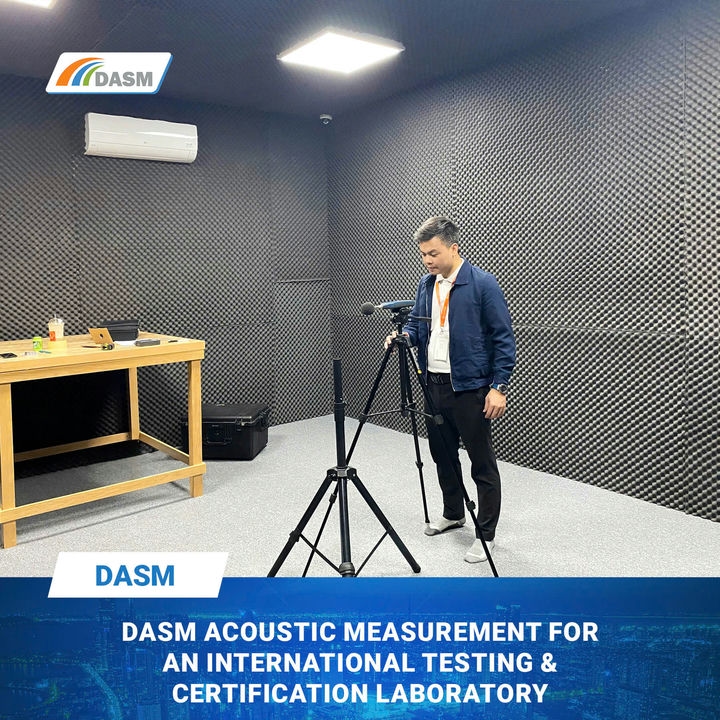
Advanced Acoustic Measurement & Noise Emission Testing for International Testing & Certification Laboratories
DASM provides advanced acoustic measurement and noise emission testing services for Testing & Certification laboratories, ISO-compliant procedures
Read more → - 4 min read
Sound Absorption: Definition, Formula, Measurement & Applications
Learn what sound absorption is, how it works, absorption coefficient (α), testing methods like Kundt’s tube (ISO 10534-2) and reverberation room (ISO 354)
Read more → - 6 min read
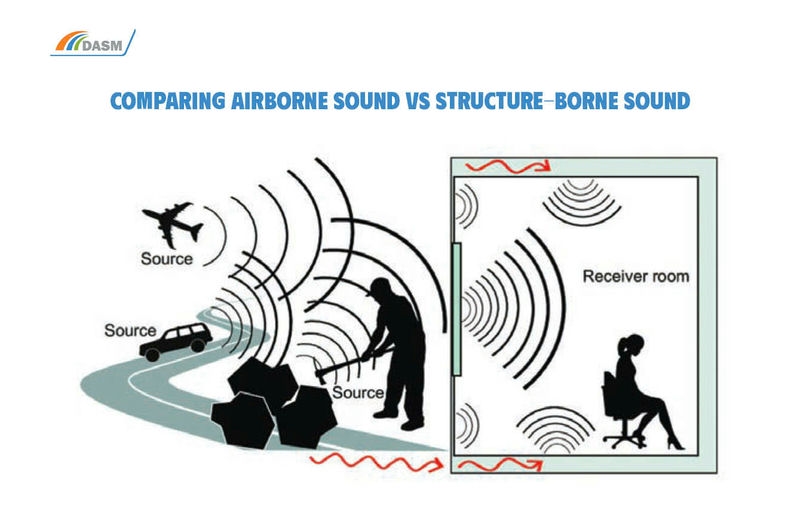
What Is The Difference Between Airborne Sound And Structure-Borne Sound?
Airborne sound and structure-borne sound are different, yet many people still can’t distinguish them clearly.
Read more →