Introduction
Measurements of environmental noise are complicated because there is a great number of variables to consider when planning and performing the measurements. As each measurement occasion is subject to current source and meteorological conditions which cannot be controlled by the operator, it is often not possible to control the resulting uncertainty of the measurements. Instead, the uncertainty is determined after the measurements based on an analysis of the acoustic measurements and collected data on source operating conditions and on meteorological parameters important for the sound propagation.
Because this document has the ambition both to comply with new and stricter requirements on measurement uncertainty calculations and to cover all kinds of sources and meteorological conditions, it has become more complicated than what a standard covering a single, specific source and application could have been. The best use of the standard is to use it as a basis for developing more dedicated standards serving specific sources and aims.
1. Scope
This document describes how sound pressure levels intended as a basis for assessing environmental noise limits or comparison of scenarios in spatial studies can be determined. Determination can be done by direct measurement and by extrapolation of measurement results by means of calculation. This document is primarily intended to be used outdoors but some guidance is given for indoor measurements as well. It is flexible and to a large extent, the user determines the measurement effort and, accordingly, the measurement uncertainty, which is determined and reported in each case. Thus, no limits for allowable maximum uncertainty are set up. Often, the measurement results are combined with calculations to correct for reference operating or propagation conditions different from those during the actual measurement. This document can be applied on all kinds of environmental noise sources, such as road and rail traffic noise, aircraft noise and industrial noise.
2. Normative references
The following documents are referred to in the text in such a way that some or all of their content constitutes requirements of this document. For dated references, only the edition cited applies. For undated references, the latest edition of the referenced document (including any amendments) applies.
ISO 1996-1:2016, Acoustics — Description, measurement and assessment of environmental noise — Part 1: Basic quantities and assessment procedures
ISO 20906:2009/Amd 1:2013, Acoustics — Unattended monitoring of aircraft sound in the vicinity of airports — Amendment 1
ISO/IEC 17025, General requirements for the competence of testing and calibration laboratories
ISO/IEC Guide 98-3, Uncertainty of measurement — Part 3: Guide to the expression of uncertainty in measurement (GUM:1995)
IEC 60942, Electroacoustics — Sound calibrators
IEC 61260, Electroacoustics — Octave-band and fractional-octave-band filters
IEC 61672-1, Electroacoustics — Sound level meters — Part 1: Specifications
Copyrighted standard notice
According to international copyright regulations and DASM policy, only the standard summary and test methodology are displayed. Direct download is not available.
VILAS 1541
DASM conducts testing according to this standard
DASM Acoustic Laboratory has accredited capability to conduct 1 testing method(s) compliant with standard ISO 1996-2:2017:
- Description, measurement and assessment of environmental noise – determination of sound pressure levels(TCVN 7878-2:2018; ISO 1996-2:2017; ASTM E1014-12(2021))
VILAS 1541 · ISO/IEC 17025
Need advice on Noise Survey & Assessment Services?
Measuring ambient environmental, factory and residential noise to support environmental impact assessment (EIA).
Related Articles
Articles from the same category or related topics
- 3 min read
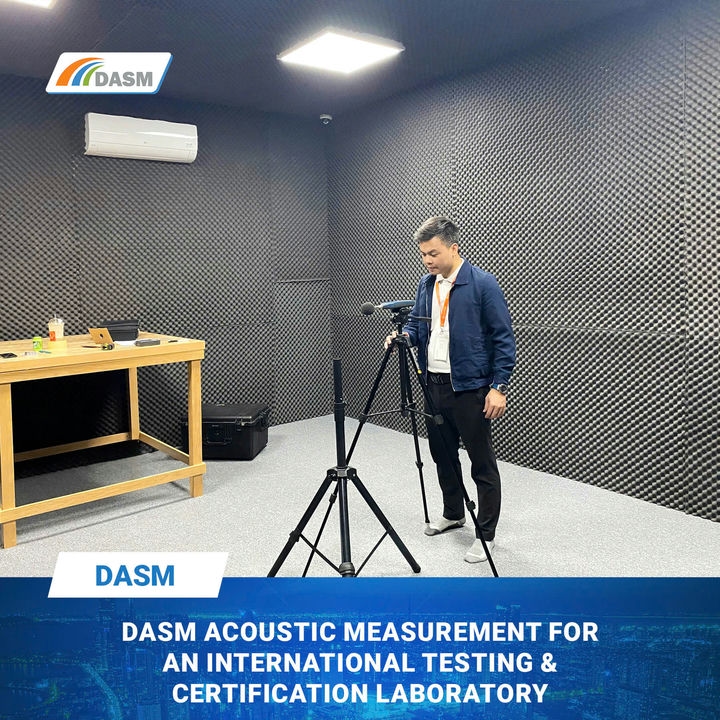
Advanced Acoustic Measurement & Noise Emission Testing for International Testing & Certification Laboratories
DASM provides advanced acoustic measurement and noise emission testing services for Testing & Certification laboratories, ISO-compliant procedures
Read more → - 4 min read
Sound Absorption: Definition, Formula, Measurement & Applications
Learn what sound absorption is, how it works, absorption coefficient (α), testing methods like Kundt’s tube (ISO 10534-2) and reverberation room (ISO 354)
Read more → - 6 min read
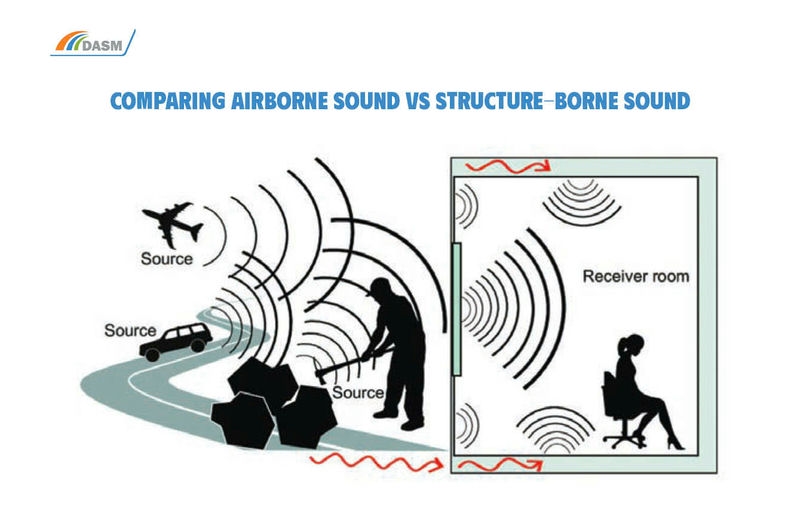
What Is The Difference Between Airborne Sound And Structure-Borne Sound?
Airborne sound and structure-borne sound are different, yet many people still can’t distinguish them clearly.
Read more →