Introduction
This International Standard specifies the substitution method for determining the insertion loss of ducted silencers and a method for determining the transmission loss of air-terminal units.
In the substitution method, the sound pressure level of the transmitted wave is first determined for the test object and then when the test object has been replaced by the substitution duct. The sound pressure level of the transmitted wave can be measured
— in a reverberation room,
— in a test duct after the silencer, or
— in an essentially free field.
The methods are listed in order of preference.
The acoustic performance of silencers depends on the modal composition of the sound field at the inlet and on reflections at the outlet side, on flanking transmission and on level differences between signals and flow noise (or regenerated sound).
This International Standard describes configurations at the inlet side providing for a predominant fundamental mode that suffers the least attenuation. For the outlet side, it describes anechoic terminations and measurement procedures which are not sensitive to reflections or which allow for specified corrections. Furthermore, this International Standard gives guidance on the suppression of flanking transmission and noise signals.
The transmission loss of an air-terminal unit is determined from the results of measurements in a reverberation room and theoretical reflection coefficients of a substitution duct.
The insertion loss of a silencer is generally affected by the airflow. The insertion loss is therefore preferably measured with superimposed airflow if the silencer is to be used in ducts with high flow velocity.
For absorptive silencers where the maximum internal flow velocity falls short of 20 m/s, the flow will hardly have an effect on the insertion loss. In practice, non-uniform flow distributions will occur. Therefore, the limit velocity of 20 m/s may correspond to a design velocity of 10 m/s to 15 m/s.
An airflow through a silencer regenerates noise. This flow noise (or regenerated sound) establishes the lowest sound pressure level that can be achieved after the silencer. It is, therefore, necessary to know the sound power level of the flow noise (or regenerated sound) behind the silencer. This is preferably determined in a reverberation room connected to the object via a transmission element.
In accordance with this International Standard, the total pressure loss of a silencer to be used with flow is to be determined. It is, therefore, useful to equip the test facility with the instruments and devices necessary for the determination of the total pressure loss.
1 Scope
This International Standard specifies methods for determining
— the insertion loss, in frequency bands, of ducted silencers with and without airflow,
— the sound power level, in frequency bands, of the flow noise (or regenerated sound) generated by ducted silencers,
— the total pressure loss of silencers with airflow, and
— the transmission loss, in frequency bands, of air-terminal units.
The measurement procedures are intended for laboratory measurements at ambient temperature. Measurements on silencers in situ are specified in ISO 11820.
It is to be noted that the results determined in a laboratory according to this International Standard will not necessarily be the same as those obtained in situ (installation), as different sound and flow fields will yield different results. For example, the pressure loss will be lower under laboratory conditions than in situ, but will be comparable between different laboratories.
This International Standard is applicable to all types of silencer including silencers for ventilating and air-conditioning systems, air intake and exhaust of flue gases, and similar applications. Other passive air-handling devices, such as bends, air-terminal units or T-connectors, can also be tested using this International Standard.
This International Standard is not applicable to reactive silencers used for motor vehicles.
NOTE 1 Annex A specifies the sound field excitation equipment. Annex B gives requirements for the transition element. Annex C gives details of duct walls and limiting insertion loss. Annex D specifies how to convert one-third-octave band attentuation values to octave band values. Annex E gives requirements for measurements on large parallel-baffle silencers. Annex F specifies a test of longitudinal attenuation. Annex G gives guidelines on anechoic terminations and Annex H shows examples of measurement arrangements.
NOTE 2 Acoustic testing of air-terminal devices and fan-coil units is to be carried out as described for air-terminal units.
NOTE 3 Sound power measurements on air-terminal units are specified in ISO 5135. Measurements of the pressure loss of air-terminal units are described in EN 12238, EN 12239 and EN 12589.
2 Normative references
The following referenced documents are indispensable for the application of this document. For dated references, only the edition cited applies. For undated references, the latest edition of the referenced document (including any amendments) applies.
ISO 3741:1999, Acoustics — Determination of sound power levels of noise sources using sound pressure – Precision methods for reverberation rooms
ISO 3746, Acoustics — Determination of sound power levels of noise sources using sound pressure — Survey method using an enveloping measurement surface over a reflecting plane
ISO 5167-1, Measurement of fluid flow by means of pressure differential devices inserted in circular cross-section conduits running full — Part 1: General principles and requirements
ISO 5221, Air distribution and air diffusion — Rules to methods of measuring air flow rate in an air handling duct
ISO 9614-3, Acoustics — Determination of sound power levels of noise sources using sound intensity — Part 3: Precision method for measurement by scanning
IEC 60651:2001, Sound level meters
IEC 60804:2000, Integrating-averaging sound level meters
IEC 60942:1997, Electroacoustics — Sound calibrators
IEC 61260, Electroacoustics — Octave-band and fractional-octave-band filters
Copyrighted standard notice
According to international copyright regulations and DASM policy, only the standard summary and test methodology are displayed. Direct download is not available.
VILAS 1541
DASM conducts testing according to this standard
DASM Acoustic Laboratory has accredited capability to conduct 1 testing method(s) compliant with standard ISO 7235:2003:
- Determination of insertion loss, flow noise and total pressure loss of silencers(ISO 7235:2003)
VILAS 1541 · ISO/IEC 17025
Need advice on Noise Survey & Assessment Services?
Measuring ambient environmental, factory and residential noise to support environmental impact assessment (EIA).
Related Articles
Articles from the same category or related topics
- 3 min read
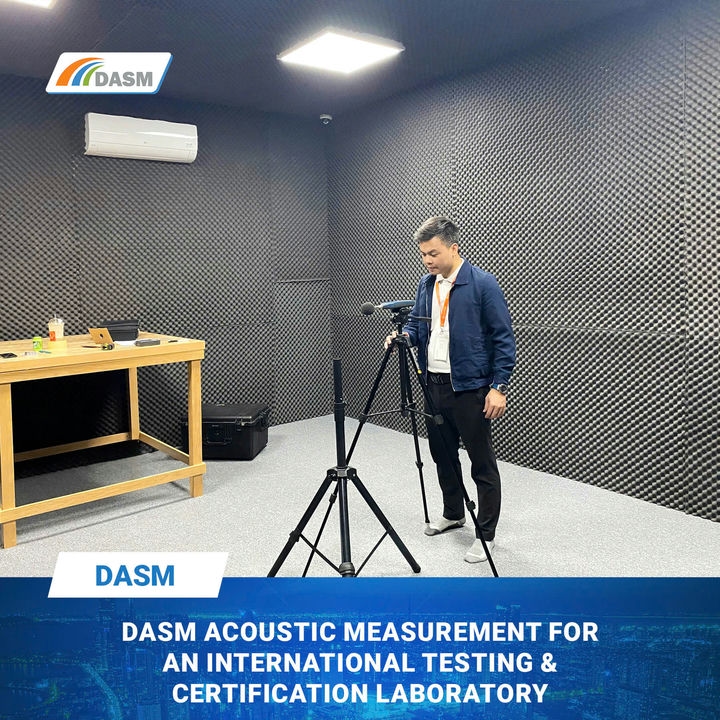
Advanced Acoustic Measurement & Noise Emission Testing for International Testing & Certification Laboratories
DASM provides advanced acoustic measurement and noise emission testing services for Testing & Certification laboratories, ISO-compliant procedures
Read more → - 4 min read
Sound Absorption: Definition, Formula, Measurement & Applications
Learn what sound absorption is, how it works, absorption coefficient (α), testing methods like Kundt’s tube (ISO 10534-2) and reverberation room (ISO 354)
Read more → - 6 min read
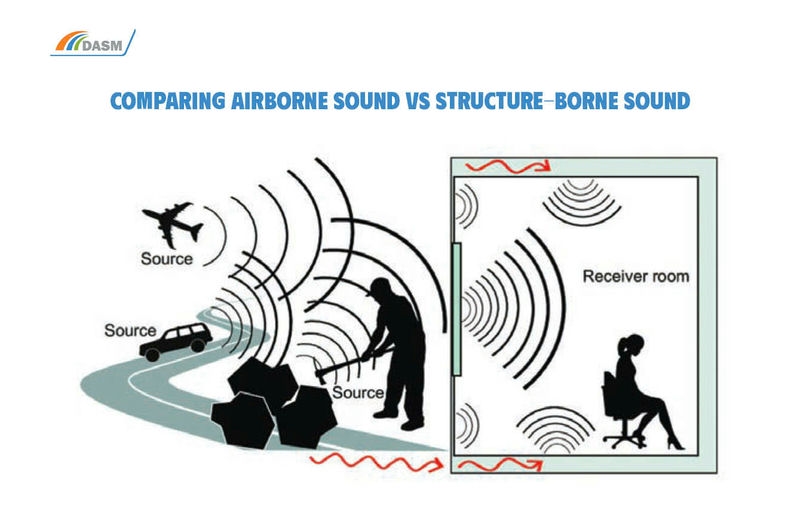
What Is The Difference Between Airborne Sound And Structure-Borne Sound?
Airborne sound and structure-borne sound are different, yet many people still can’t distinguish them clearly.
Read more →