Acoustic scattering characteristics test method – Part 2: Determination of directional diffusion coefficient in free fields
Sound-scattering properties of surfaces – Part 2: Measurement of the directional diffusion coefficient in a free field for the purpose of evaluating the sound quality of a room, providing reliable predictions of room acoustics; determining the characteristics of acoustic materials and calculating, simulating, and designing predictive models – effective acoustic rooms.
Overview of contents Sound-scattering properties of surfaces – Part 2: Measurement of the directional diffusion coefficient in a free field
Name of the test: Acoustics – Sound-scattering properties of surfaces – Part 2: Measurement of the directional diffusion coefficient in a free field.
Test method:
ISO 17497-2:2012: Acoustics – Sound-scattering properties of surfaces – Part 2: Measurement of the directional diffusion coefficient in a free field [1].
Performed at: Sound Absorption Laboratory, DASM Institute of Acoustic Materials Development & Application (DASM).
Objectives, subjects, and testing laboratory
1.1. Scope
This standard specifies the method for measuring the directional diffusion coefficient of a surface.
The diffusion coefficient characterizes the sound reflected from a surface in terms of the uniformity of the polar reflection distribution. The diffusion coefficient is a quality measure designed to inform manufacturers and users of intentionally or unintentionally sound-scattering surfaces. It can also inform developers and users of geometrical room acoustic models. The diffusion coefficient is not suitable for direct use as input for current diffusion algorithms in geometrical room acoustic models.
This part of ISO 17497 details the free-field characterization method.
1.2. Test subjects
Sound-scattering surfaces.
1.3. Sample conditions
When selecting to use part or all of a surface as a test sample, the application of that surface in real rooms and the geometric limitations specified in this part of ISO 17497 shall be considered, specifically requiring that 80% of receivers remain outside the reflection zone. If possible, the test surface should be chosen such that the entire structure applied in the real room is tested. This choice ensures that diffraction due to surface roughness and edge effects is properly characterized.
For large samples, it may not be possible to test the entire structure. In such cases, the following scheme can be applied to reduce the test surface size. For periodic sample test surfaces, at least three complete repetition sequences and, if possible, more stages should be included, so that transverse effects of repetition approach practical conditions as closely as possible.
For periodic or random surfaces, samples representing surface roughness must be tested. These samples must be large enough to ensure that surface effects rather than edge effects predominate in scattering.
The suggested shape for measurement in this part of ISO 17497 can be applied to frequencies up to and including the full one-third octave band of 5 kHz.
Experimental procedure
Steps to perform:
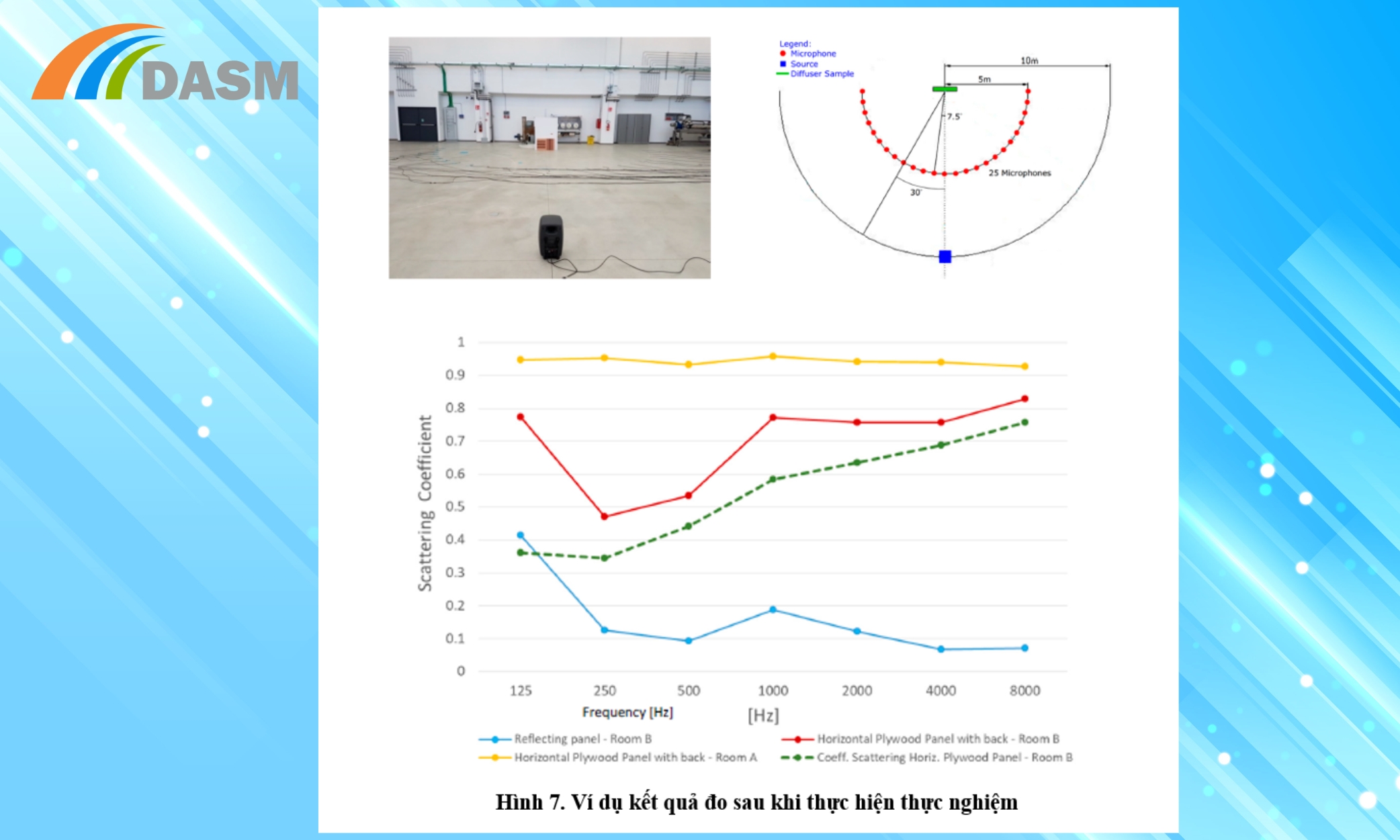
- Equip fully with devices, single microphones or microphone booms to determine sound intensity levels, Sound Absorption Laboratory, turntable, microphone holding frame, received signal processing unit, signal processing software, and the test object.
- Perform sample measurement.
- Process and report results.

Role – importance of Sound-scattering properties of surfaces – Part 2: Measurement of the directional diffusion coefficient in a free field
The test of Sound-scattering properties of surfaces – Part 2: Measurement of the directional diffusion coefficient in a free field performed by the DASM Institute of Acoustic Materials Development & Application helps provide useful information, meeting all practical needs of customers and businesses wishing to:
- Establish a scientific basis and foundation to evaluate the sound quality of a room and provide reliable predictions of room acoustics.
- Serve as a quality measure and determine the characteristics of acoustic materials: in this test, these are the materials forming the diffusing surface.
- Calculate, simulate, and design predictive models and effective acoustic rooms.
- Support the development and use of geometrical room acoustic models.
If previously you had some concerns and worries and had to spend many fees for similar activities abroad, now you only need to contact DASM. The entire remaining process will be proactively carried out by us as a package in the fastest time to complete your customer experience with us: DASM provides acoustic consulting services with truly superior quality, the most competitive prices in the industry along with dedicated and thoughtful customer care policies.
Meaning of acoustic testing services at DASM
Today's globalized commercial life opens up countless new markets and sources of supply across five continents. Accompanied by it are international regulations and standards that help customers easily evaluate quality – trace the origin of product sources, and select suitable/superior items. In particular, they help manufacturers continuously improve and perfect technology, techniques, raw materials, production methods, sales, etc.
The DASM Institute of Acoustic Materials Development & Application is a pioneer, comprehensive, professional, and leading reputable brand in Vietnam in the field of acoustics. On January 12, 2023, DASM was granted testing activity registration certificate No. 114/TĐC – HCHQ by the Directorate for Standards, Metrology and Quality (Ministry of Science and Technology), certifying registered multi-industry testing operations in the Mechanical-Physical field (registration number: 707/TN – TĐC).
Our acoustic material testing services provide customers with practical professional results to ensure sustainability, standard performance, and optimal design solutions, consulting, and calibration for products and services. Consequently, you will update, meet, and adapt to constantly changing international standards to achieve breakthroughs in revenue and profit and elevate your brand.
If you have a need to perform Acoustics – Sound scattering properties of surfaces – Part 2: Measurement of directional diffusion coefficient in a free field please contact via Hotline for detailed consultation!
VILAS 1541 · ISO/IEC 17025
Need advice on Materials Acoustic Testing?
Services of testing, measuring and analyzing acoustic properties of equipment, products, vehicles, acoustic materials, etc.
Related Articles
Articles from the same category or related topics
- 3 min read
DASM Sound Absorption Testing for Noise Barriers According to ISO 354:2024 & EN ISO 11654:1997
DASM sound absorption testing for Noise Barriers in a reverberation room according to ISO 354:2024 and EN ISO 11654:1997 standards at a VILAS-certified laboratory
Read more → - 7 min read
DASM Institute surveyed the acoustics of the recording booth at the Ministry of Public Security according to ISO 3382 standard
DASM Institute conducted an acoustic survey and noise testing in the recording booth at the Ministry of Public Security, including SNR measurement and acoustic characteristic evaluation according to ISO 3382 standard.
Read more → - 3 min read
Advanced Acoustic Measurement & Noise Emission Testing for International Testing & Certification Laboratories
DASM provides advanced acoustic measurement and noise emission testing services for Testing & Certification laboratories, ISO-compliant procedures
Read more →