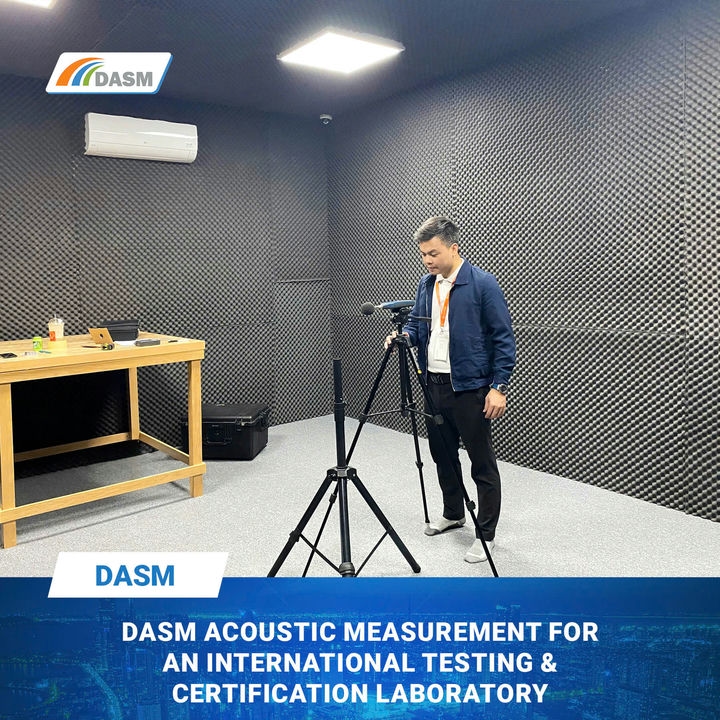
Test of Sound-Scattering Properties – Part 1: Measurement of the Random-Incidence Scattering Coefficient in a Reverberation Room aiming at evaluatingthe sound quality of the room, providing reliable predictions about room acoustics; determining the properties of acoustic materials and calculating, simulating, and designing predictive models – for effective acoustic rooms.

Overview of Sound-Scattering Properties – Part 1: Measurement of the Random-Incidence Scattering Coefficient in a Reverberation Room
Test Name: Acoustics – Sound-scattering properties of surfaces – Part 1: Measurement of the random-incidence scattering coefficient in a reverberation room [1].
Test Method:
ISO 17497-1:2004: Acoustics – Sound-scattering properties of surfaces – Part 1: Measurement of the random-incidence scattering coefficient in a reverberation room [1].
Performed at: Laboratory, Institute of Acoustics Development & Application Materials (DASM).
1. Objectives & Test Objects
– Scope
This part of ISO 17497 specifies a method for measuring the random-incidence scattering coefficient of surfaces caused by surface roughness. The measurements are carried out in a reverberation room, either full-scale or on a physical scale model. The measurement results can be used to describe the degree to which sound is reflected from a surface other than specular reflection. The obtained results can be used for comparison purposes and for calculation and design related to room acoustics and noise control.
This method is not intended to describe the spatial homogeneity of scattering from a surface.
The degree of sound scattering from surfaces is very important in all aspects of room acoustics (e.g., in concert halls, recording studios, industrial halls, and reverberation chambers). Insufficient scattering can cause strong deviations from exponential sound pressure decay. On the other hand, an approximately diffuse sound field can be obtained with highly scattering surfaces in a room. The degree of scattering in a room can be an important factor related to the sound quality of the room.
The scattering coefficient is introduced as a new concept in this part of ISO 17497. Together with the sound absorption coefficient, the scattering coefficient will be useful in room acoustics calculations, simulations, and prediction models. For some time, it has been known that modeling scattering from surfaces is crucial to obtain reliable predictions of room acoustics. This part of ISO 17497 presents a measurement method to quantify the scattering characteristics of a surface to replace previously applied but generally non-accepted estimation methods.
The work has been coordinated with the Audio Engineering Society working group, AES SC-04-02 for Acoustic Material Characteristics. This group emphasizes the development of a measurement method for the directional diffusion coefficient, which differs from (but is related to) the random-incidence scattering coefficient. While the scattering coefficient is a preliminary measure describing the extent of scattered sound, the diffusion coefficient describes the directional uniformity of scattering; that is, the quality of the diffusing surface. Therefore, both concepts are needed and they have different applications.
– Test Object
Surfaces with roughness
2. Experimental Procedure
Steps to perform:
- Equip fully with devices, turntable, microphone, and test object.
- Perform sample measurement.
- Process and report results.
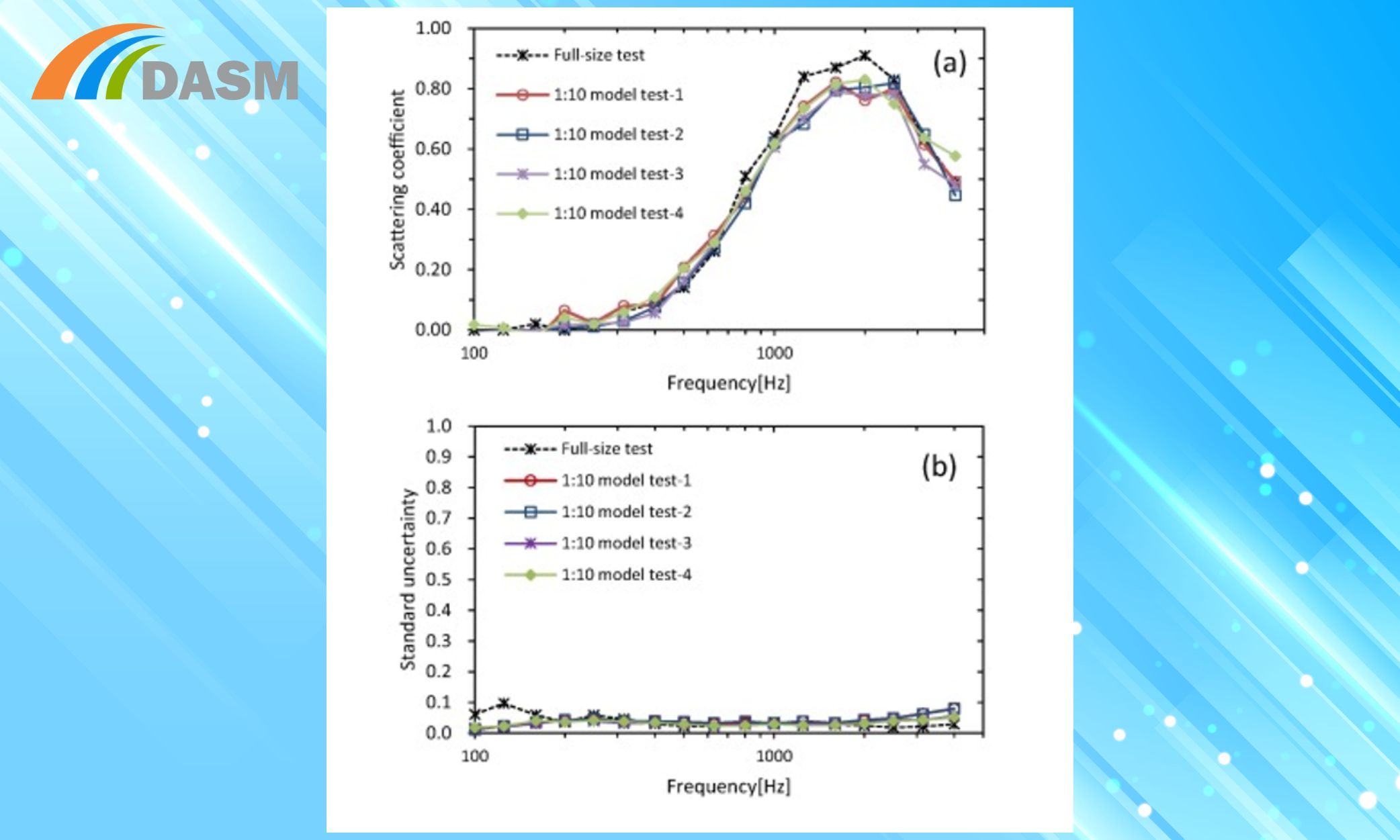

Role – importance of the Test of Sound-Scattering Properties – Part 1: Measurement of the Random-Incidence Scattering Coefficient in a Reverberation Room
The Test of Sound-Scattering Properties – Part 1: Measurement of the Random-Incidence Scattering Coefficient in a Reverberation Room performed by the Institute of Acoustics Development & Application Materials helps provide useful information, meeting all practical needs of customers and businesses wanting to:
- Obtain scientific grounds and bases to evaluate the sound quality of the room, providing reliable predictions about room acoustics.
- Determine the properties of acoustic materials: in this test, these are materials forming rough surfaces.
- Calculate, simulate, and design predictive models and effective acoustic rooms.
If previously you had some concerns, worries, and had to spend many fees for similar activities abroad, now you just need to contact DASM. The entire remaining process will be proactively implemented by us as a turnkey service in the fastest time to complete customer experience about us: DASM provides acoustic consulting services with truly superior quality, the most competitive prices in the industry along with thoughtful and dedicated customer care policies.
Significance of acoustic testing services at DASM
Today's globalized commercial life opens up countless new markets and sources of supply across five continents. Accompanied by international regulations and standards, it helps customers easily assess quality, trace product origin, and select suitable/superior items. In particular, they also support manufacturers to continuously improve and perfect technology, techniques, raw materials, production methods, sales, etc.
The Institute of Acoustics Development & Application Materials (DASM) is a pioneering, comprehensive, professional, and leading prestigious brand in Vietnam in the field of acoustics. On January 12, 2023, DASM was granted certificate No. 114/TĐC – HCHQ by the Directorate for Standards, Metrology and Quality (Ministry of Science and Technology), certifying registered multi-sector testing operations in the Mechanical-Physical field (registration number: 707/TN – TĐC).
Our acoustic material testing services provide clients with practical professional results to meet sustainability, standard performance, and optimal design solutions, consulting, and calibration for products and services. From there, you will update, meet, and adapt to constantly changing international standards to achieve breakthroughs in revenue and profit and elevate your brand.
If you have a need to perform Material testing Acoustics – Measurement of sound scattering properties of surfaces in a room – Part 1: Measurement of random incidence scattering coefficient in a reverberation room, please contact us via Hotline for detailed consultation!
VILAS 1541 · ISO/IEC 17025
Need advice on Materials Acoustic Testing?
Services of testing, measuring and analyzing acoustic properties of equipment, products, vehicles, acoustic materials, etc.
Related Articles
Articles from the same category or related topics
- 3 min read
DASM Sound Absorption Testing for Noise Barriers According to ISO 354:2024 & EN ISO 11654:1997
DASM sound absorption testing for Noise Barriers in a reverberation room according to ISO 354:2024 and EN ISO 11654:1997 standards at a VILAS-certified laboratory
Read more → - 7 min read
DASM Institute surveyed the acoustics of the recording booth at the Ministry of Public Security according to ISO 3382 standard
DASM Institute conducted an acoustic survey and noise testing in the recording booth at the Ministry of Public Security, including SNR measurement and acoustic characteristic evaluation according to ISO 3382 standard.
Read more → - 3 min read
Advanced Acoustic Measurement & Noise Emission Testing for International Testing & Certification Laboratories
DASM provides advanced acoustic measurement and noise emission testing services for Testing & Certification laboratories, ISO-compliant procedures
Read more →