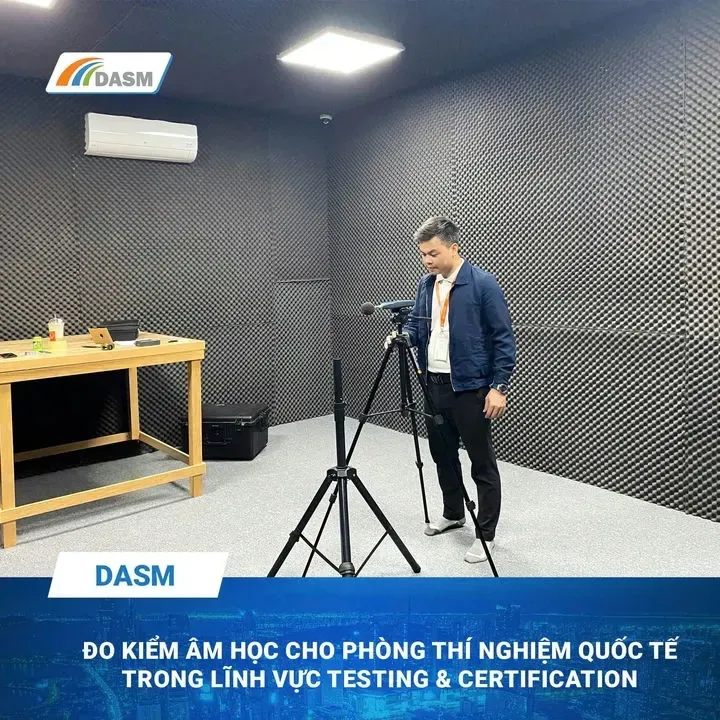
DASM Institute with high reputation and professional capacity was recently invited by the contractor to cooperate in measuring background noise and HVAC noise for S1 studio – a key project of VTV, according to international ISO & VILAS standards.
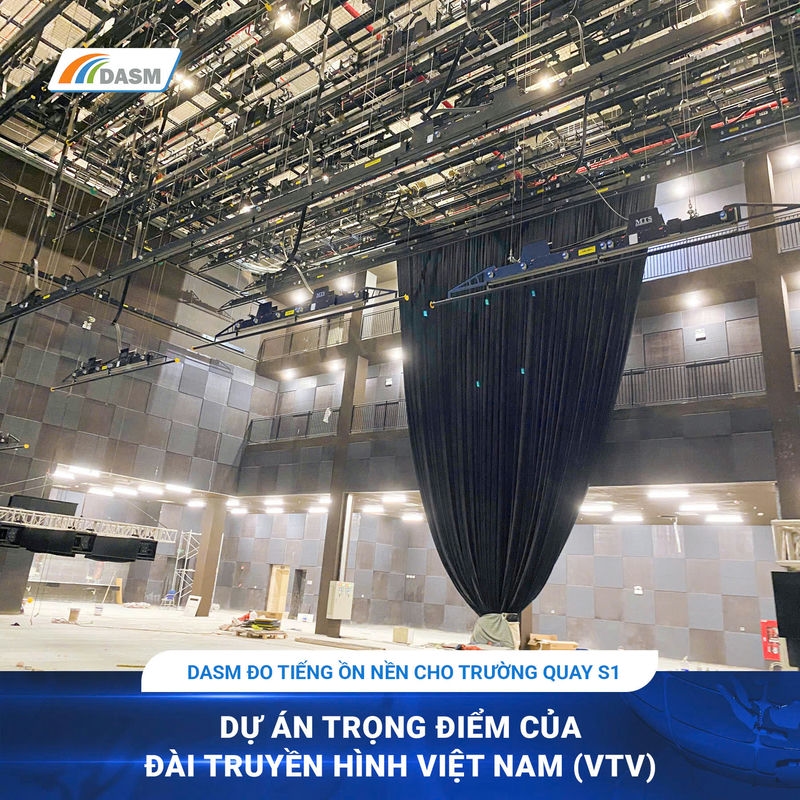
The importance of background noise measurement in studio spaces
In the field of broadcasting and professional content production, a standard acoustic environment in studios plays a decisive role in recording quality, fidelity, and emotion of television products. Any unwanted noise – as small as the sound of an air conditioning fan or structural vibration – can affect the recording and post-production process.
Therefore, background noise measurement is the first and most important step in the overall acoustic quality assessment process of a studio. This activity helps determine the actual background noise level in the space, thereby serving as a basis for design, construction, and adjustment of appropriate sound insulation – sound absorption – acoustic treatment systems.
S1 Studio – key project of Vietnam Television (VTV) – is one of the spaces with the strictest acoustic technical requirements today. DASM Institute is trusted with the task of measuring background noise, HVAC system noise, and assessing acoustic indicators according to international standards, serving the acceptance and calibration phase of the studio.
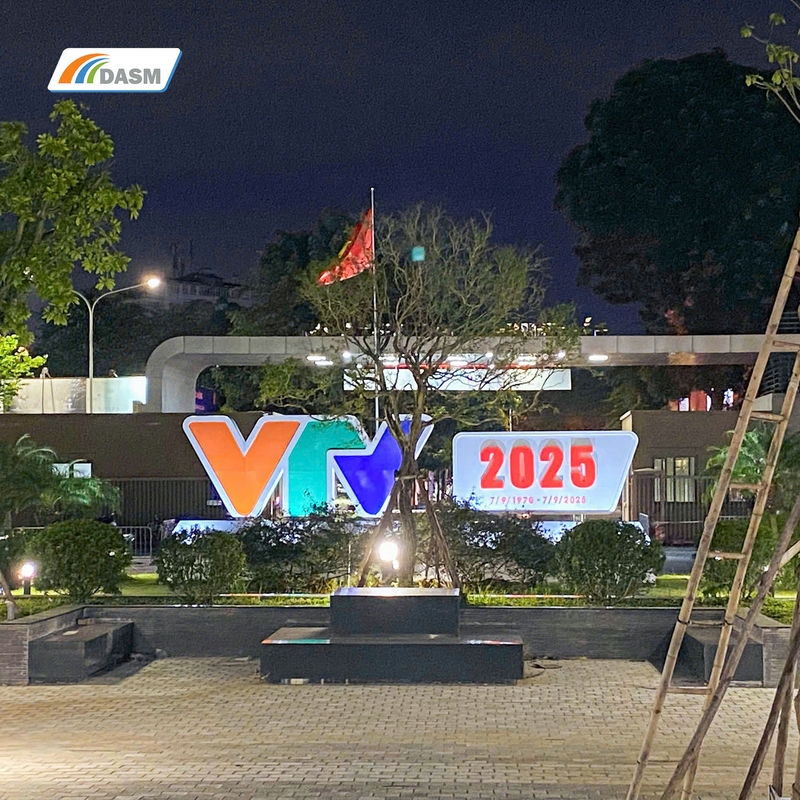
Introduction to S1 studio project – VTV
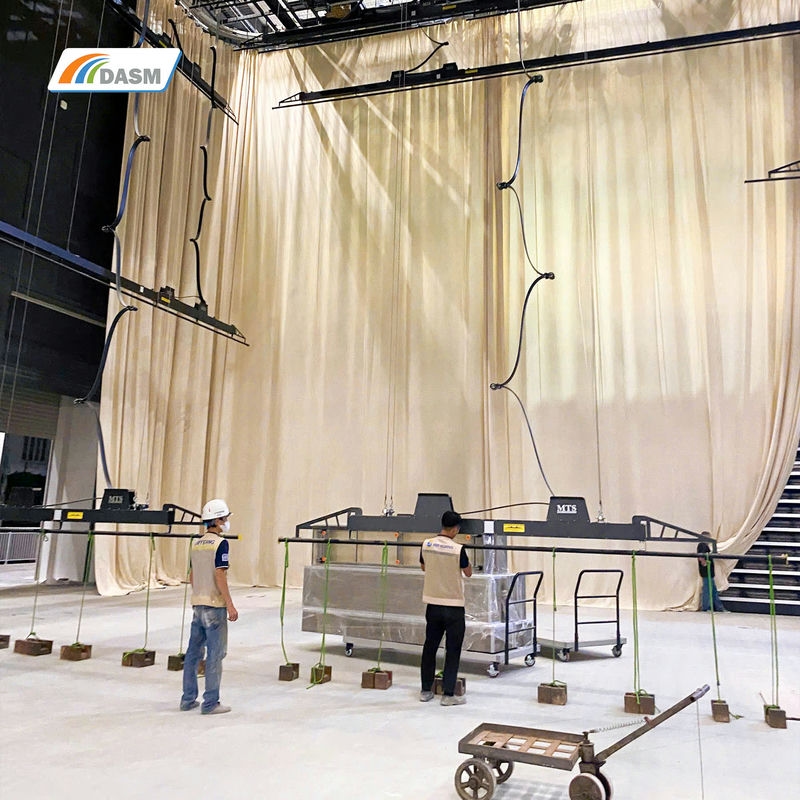
S1 Studio is designed with an area of more than 1,000 m², seating capacity of about 750 seats, being one of the most modern studios in Vietnam. This space is invested to serve large-scale recording programs, gameshows, and talkshows, requiring high acoustic fidelity and absolute noise control.
The studio structure includes multiple layers of sound insulation – sound absorption materials, complex suspended technical ceiling systems, and large-capacity air conditioning and ventilation systems. Therefore, measuring background noise and HVAC noise – mechanical and electrical (M&E) systems becomes especially important to ensure technical indicators meet standards before the studio officially operates.
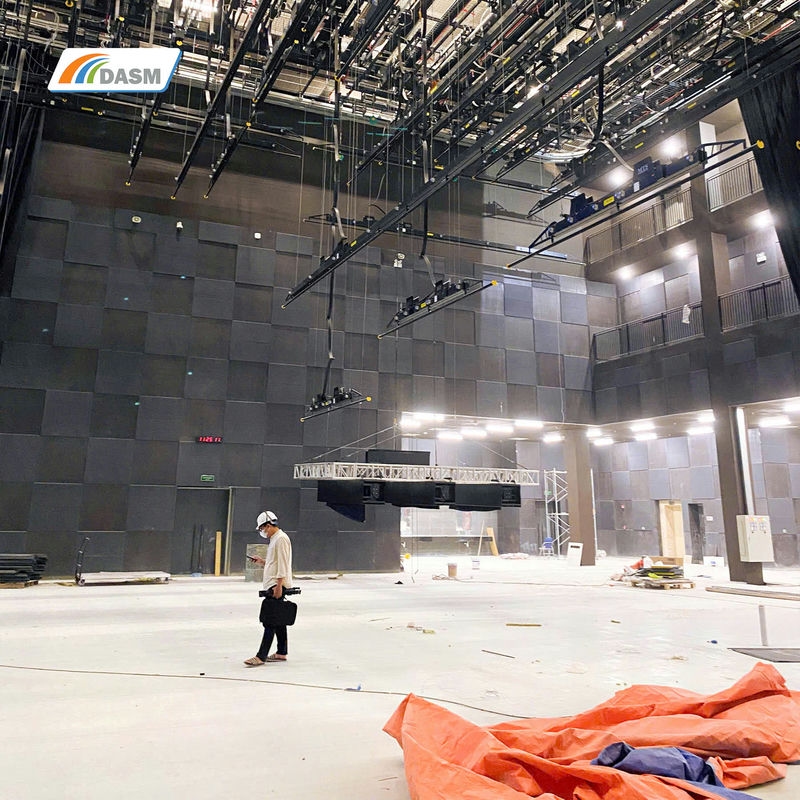
Measurement procedure of DASM Institute
With in-depth experience in acoustic and construction noise measurement, DASM Institute has deployed measurement work at 20 different positions in the S1 studio space, covering the entire auditorium, stage, control room, and related technical areas.
Test measurements are performed at night, when the surrounding environment reaches the lowest noise level, to ensure the highest accuracy for the background measurement results.
The implementation procedure includes:
+ Surveying the current spatial status and measurement locations according to technical drawings.
+ Measuring the background noise level when no equipment is operating.
+ Measuring HVAC noise when the cooling and ventilation system operates stably.
+ Analyzing the 1/3 octave band frequency to determine the noise frequency spectrum.
+ Comparing and evaluating according to international standards (ISO, EBU, NR/NC).
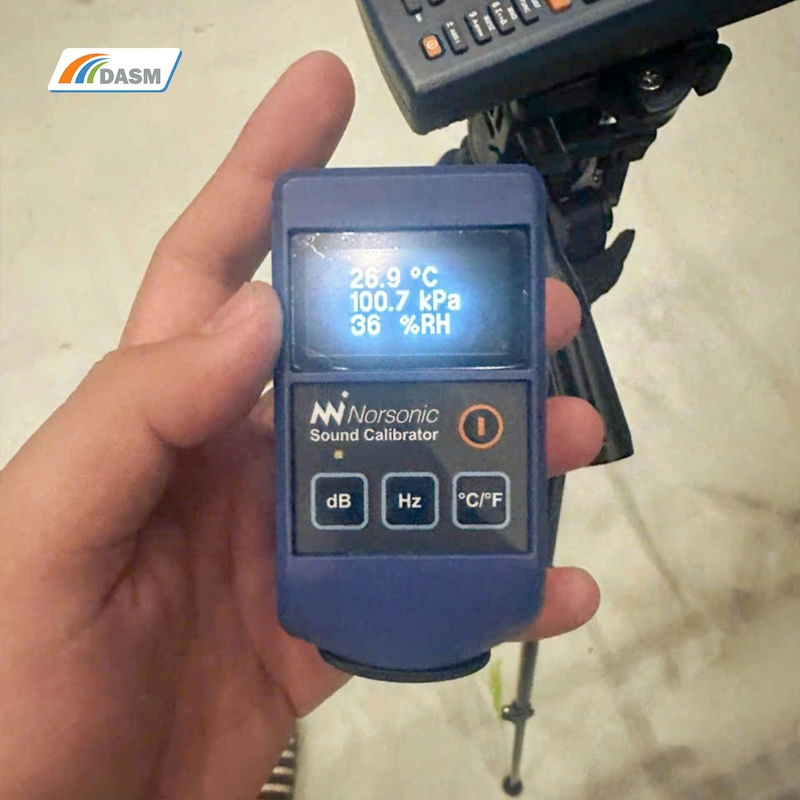
All equipment used in the measurement process meets VILAS calibration standards – ISO/IEC 17025:2017, including
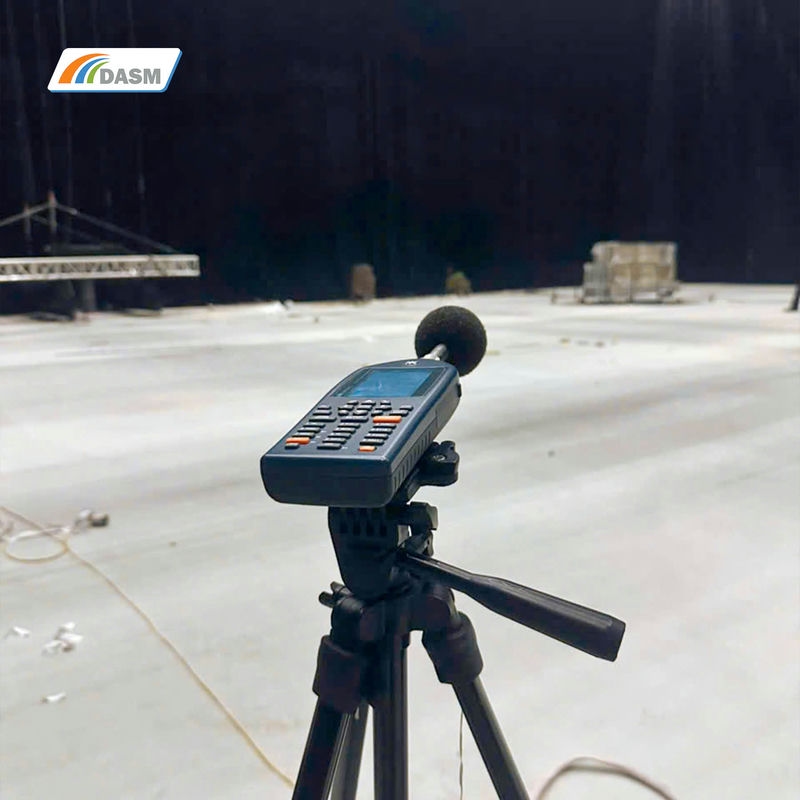
+ Multi-channel sound analyzer
+ Microphone Class 1
+ Sound calibrator
+ Specialized FFT and reverberation time (RT60) analysis software
International measurement standards applied
DASM simultaneously applies multiple sets of ISO, EBU, and TCVN standards to ensure measurement results achieve the highest accuracy and technical value. Some standards applied by DASM include:
4.1 ISO 16032:2004 – Measurement of Sound Pressure Level from Service Equipment
Regulates the method for measuring sound pressure level from technical equipment in buildings, including HVAC systems, fans, air ducts... This standard is used to determine the noise level of the air conditioning system, HVAC noise at the studio.
4.2 ISO 1996 / TCVN 7878-2:2010 – Description and Measurement of Environmental Noise
Provides guidance on measuring and describing environmental noise by measuring equivalent sound pressure level (LAeq), applied to background noise measurement of enclosed and open spaces.
4.3 EBU Tech 3276 / NR15 – Noise Rating for Studio Environments
Provides Noise Criterion (NC) or Noise Rating (NR) limits suitable for recording rooms, studios, and control rooms. For television studios, the NC value is typically required to be ≤ 25–30 to ensure a clean acoustic recording environment.
4.4 ISO 3382 – Acoustics: Measurement of Room Acoustic Parameters
This standard specifies the method for measuring reverberation time (RT60), clarity (C50), speech transmission index (STI)... DASM will apply this standard in the next phase to evaluate the sound reflection – diffusion capability of the S1 studio space.
4.5 ISO 9614 – Measurement of Sound Power by the Intensity Method
Determines the sound power level of noise sources using the sound intensity measurement method. This standard supports determining the noise emission level of HVAC systems or technical equipment.
4.6 ISO 717, ISO 10052, ISO 12354, ISO 16283
This is a group of international standards regulating sound insulation, structural sound transmission, and sound insulation performance between rooms – especially important when evaluating flanking transmission levels between the studio and the control area.
Preliminary results and technical evaluation
These data will serve as the basis for DASM to continue:
+ Measuring reverberation time (RT60) after completing the entire acoustic interior design.
+ Conducting acoustic simulation to optimize speech clarity.
+ Providing a detailed acoustic analysis report and recommending space tuning solutions.
The role of DASM in specialized acoustic projects
As a leading acoustic research and material testing institute in Vietnam, DASM not only performs measurements but also participates in the entire process of consulting, design, evaluation, and inspection in architectural acoustics. DASM is currently the only unit in Vietnam recognized by VILAS in the field of acoustics, with a laboratory management system meeting ISO/IEC 17025:2017 standards.
The main operation areas of DASM include:
+ Noise survey and assessment, environmental noise measurement, and industrial noise measurement.
+ Measuring sound insulation, sound absorption, and reverberation time in rooms.
+ Testing, measuring, and evaluating air conditioning, ventilation, and mechanical equipment noise.
+ Inspection of sound insulation, sound absorption, and anti-vibration materials.
+ Consulting and designing architectural acoustics, providing acoustic solutions for recording studios, theaters, cinemas, hotels, factories, and convention centers.
+ Noise and vibration control…
With a team of highly qualified acoustic engineers, professionally trained domestically and internationally, along with modern measuring equipment meeting international standards, DASM ensures that all measurement results achieve high accuracy, transparency, and reliability.
Aiming at international standards for broadcasting and performance venues in Vietnam
Acoustic measurement and evaluation work for Studio S1 not only holds technical significance but is also an important step forward in raising acoustic standards for the Vietnamese television industry.
When international standards such as ISO 16032, ISO 3382, and EBU Tech 3276 are systematically applied, domestic broadcasting and performance projects will gradually approach international standards for a professional acoustic environment.
DASM Institute commits to continuing its companionship with design units, contractors, and investors on the journey of building spaces that achieve the highest acoustic standards, serving the fields of media, art, science, and technology.
The background noise level measurement activity for VTV's Studio S1 is one of the key technical tasks performed by DASM Institute in 2025, demonstrating professional capacity, reliability, and the position of the number one unit in Vietnam in the field of acoustics and architectural noise.
Customers in need of using DASM's standard acoustic services for measurement, evaluation, and acoustic consulting for recording studios, theaters, hotels, factories, studios, schools, etc., please contact Hotline 0968 018 216 for timely support.
VILAS 1541 · ISO/IEC 17025
Need advice on Materials Acoustic Testing?
Services of testing, measuring and analyzing acoustic properties of equipment, products, vehicles, acoustic materials, etc.
Related Articles
Articles from the same category or related topics
- 6 min read
From Vietnamese Acoustic Knowledge to International Forums: DASM's Research Milestone in Acoustics Australia
A research paper on acoustic materials by DASM was published in Acoustics Australia, a world-renowned acoustic journal, marking a new step forward for DASM in the field of acoustics
Read more → - 3 min read
DASM Sound Absorption Testing for Noise Barriers According to ISO 354:2024 & EN ISO 11654:1997
DASM sound absorption testing for Noise Barriers in a reverberation room according to ISO 354:2024 and EN ISO 11654:1997 standards at a VILAS-certified laboratory
Read more → - 4 min read
DASM Participates in Long-Span Bridge Workshop for High-Speed Railways – Expanding Research Capabilities in Acoustics and Structural Vibration
DASM participates in the long-span bridge workshop for high-speed railways to update structural design trends, control structural vibration and acoustics, and prepare capabilities for projects
Read more →