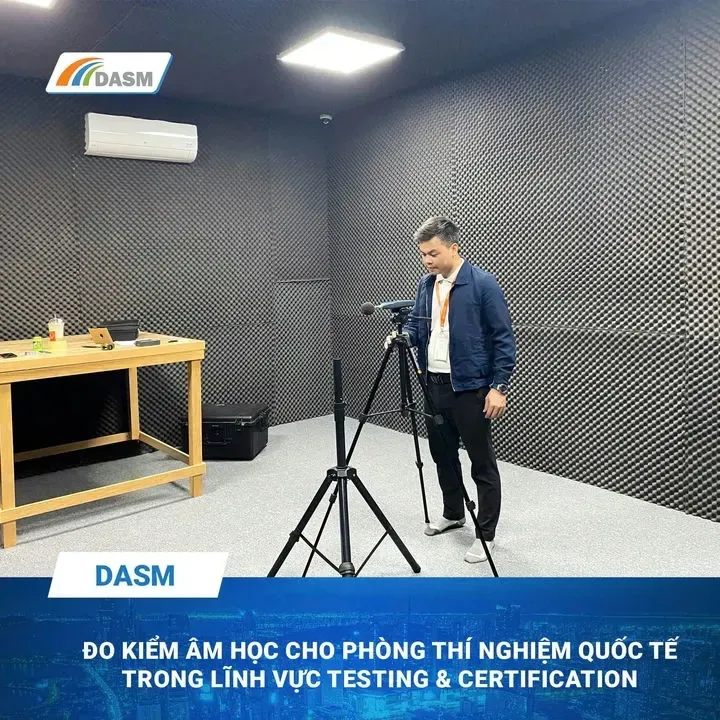
In early March 2022, DASM - Institute for Development and Application of Acoustic Materials received an invitation to conduct noise surveys and consult on sound insulation and sound absorption solutions for several rooms at the Sotetsu Hotel Project in Ho Chi Minh City, with a total area of nearly 800 m2, featuring 120 rooms, 19 above-ground floors, and 2 basement floors, in accordance with international quality standards.
To meet international 4-star hotel quality standards, as requested by the investor SOTETSU Group, one of Japan's major corporations specializing in hotel investment and management, the main contractor Vinata International trusted and selected DASM - Institute for Development and Application of Acoustic Materials as the direct unit to survey noise and consult on sound insulation and sound absorption solutions for this important project.
Although newly established in 2021, DASM - Institute for Development and Application of Acoustic Materials has always been the best choice for inspecting building quality regarding sound insulation and sound absorption capabilities. With the most modern measuring equipment in the world along with a team of experts and engineers thoroughly trained in acoustics, we are confident in providing customers with professional solutions and services in sound and architectural acoustics. Furthermore, we also consult on construction and quality-assured, high-efficiency sound insulation materials and sound absorption materials for sound insulation and sound absorption implementation.
1. Noise Measurement Standards
| Parameter Test | Standard |
| Airborne sound transmission between rooms in a building
|
ISO 16283 ISO 140
ASTM E-336 ISO 354 ISO 717 |
| Calculation of Noise Criterion (NC) | ISO 3382 |

| Parameter Test | Standard |
| Heavy impact floor
|
JIS A 1418
|

According to ISO 16283 and ISO 140 standards, the report includes average sound pressure level measurements L1 and L2 across frequency bands for each measurement. Based on these parameters, the sound insulation performance of partitions, walls, or any location is evaluated. The NC coefficient is determined through the background noise level at each evaluated location. The TL coefficient must be based on the absorption area since the room space has been equipped with certain furnishings that allow an increase in the room's sound insulation capability.
2. Measurement Rooms

Three rooms will be measured for sound to determine the NC and TL coefficients, including Rm. 404, Rm. 406, and Rm. 407 (see floor plan drawing).

Survey reality
| Parameters | Rm 407 | Rm 406 | Rm 404 |
| Calculated volume [m3] | 49.81 | 41.56 | 41.76 |
| Large glass surface area [m2] | 9.126 | 11.61 | 9.018 |
| Drywall area [m2] | 10.9 | N / A | 8.91 |
| Main door area [m2] | 3.86 | 3.86 | 3.86 |
| Large glass door dimensions [m2] | 1.55 x 2.42 | 1.55 x 2.42 | 1.55 x 2.42 |
| Bathroom door dimensions [m2] | 1.94 x 2.4 | 0.8 x 2.4 | 0.8 x 2.4 |
| Main door dimensions [m2] | 0.9 x 2.2 | 0.9 x 2.2 | 0.9 x 2.2 |
3. NC Coefficient
Ambient noise generated from empty spaces or around the building – such as air conditioning systems, traffic noise, etc. – not only causes discomfort, stress, and fatigue for occupants but also reduces productivity and concentration, thereby affecting safety to a certain extent. In severe cases, it even affects communication capability.
NC (Noise Criterion) or NC curves are a way to describe measured noise levels across a frequency spectrum from 63.5Hz to 8kHz. They are useful in determining noise levels caused by mechanical systems such as motors in noise-sensitive environments like hotels and hospitals.
The criterion determines that the upper limits of each octave band spectrum must not be exceeded.
| Classification | Application | Suggested NC Level |
| Residential | Private house or apartment | 25-35 |
| Suburban residence | 25-30 | |
| Bedroom | 20-30 | |
| Living room | 25-35 | |
| Hotel | Individual room or suite | 25-35 |
| Meeting room or banquet room | 25-35 | |
| Service and support area | 45-50 | |
| Auditorium, corridor, lobby | 40-45 | |
| Area
public |
Courtroom | 30-40 |
| Library | 35-40 | |
| Church, Mosque, Temple | 30-35 | |
| Factory | Production area | 40-65 |
| Administrator / Accountant | 40-46 | |
| Office | Meeting / conference room | 25-35 |
| Private room | 30-35 | |
| General office area | 40-45 | |
| Business machine / Computer | 40-45 | |
| Break room / Lounge | 40-45 | |
| Hospital and Clinic | Radiology department | 35-40 |
| Operating theater | 25-30 | |
| Ward | 35-40 | |
| Laboratories | 35-40 | |
| Consultation room / Clinic | 35-40 | |
| Corridor / Public area | 40-45 | |
| Commercial area | Theater | 30-35 |
| Restaurants | 45-50 | |
| Recording studio / Audio broadcasting / TV studio | 15-20 | |
| Performance / Concert / Recital hall | 15-20 | |
| Sports stadium | 45-55 | |
| Spa / Facial treatment / Massage center | 25-35 | |
| Retail store | 40-45 | |
| Gymnasium / Workout room | 40-45 | |
| School | Auditorium | 35-40 |
| Classroom | 35-40 |
4. TL coefficient
TLD: Transmission Loss Difference: The difference in sound energy level lost through a sound insulation wall.
Each sound insulation wall with different materials and structures will have different levels of energy loss. Depending on the intended use, we can design different partition models. Transmission loss tends to increase at high and low frequencies, and sound insulation can be improved by appropriate additional measures.
After an incident sound strikes a barrier (wall, partition), three mechanisms occur simultaneously: Reflection, absorption, and transmission. A part of the incoming sound is reflected back to the source, a part is absorbed by the obstacle, and the remaining sound is transmitted to the space on the opposite side of the obstacle. Transmission loss is the term used to describe the performance of a barrier as sound insulation between two spaces, with transmission loss increasing correspondingly with the increase in performance of the sound barrier. It is given by:
Where WI is the incident sound power (watts) on the wall and WT is the sound power transmitted to the space on the opposite side of the barrier.
5. Measurement method and process
a. Method
In general, we use a sound level meter to measure sound intensity in indoor spaces, next to the sound source. This sound source will generate a spherical wave pole larger than the background noise level to determine the sound insulation capacity of the wall (TLd coefficient). The sound level meter will be used to simultaneously determine the NC and TLd coefficients.
b. Measurement process
Determination of NC coefficient
Equipment: 1 Nor140 Sound Level Meter.
Results: Different noise levels measured by indoor noise.
Procedure:
- Use a Sound Level Meter (SLM) to measure different noise levels at 6 different points for each room.
- The average value of sound intensity in the room will be determined. Based on this average coefficient to determine the NC factor.
Determination of TL coefficient
Equipment: 1 Nor140 Sound Level Meter and 1 OMNI 4” Sound Speaker.
Results: TL result curve over frequency band

Procedure:
- Step 1: Measure the background noise of the receiving room and source room, setting the sound intensity of the source to be greater than the background noise of the room by approximately 20 dB.

- Step 2: Determine the dimensions of the receiving room, source room, and the dimension of the wall for which we want to determine the TLd coefficient. (Sw)
- Step 3: Measure the sound level in the source room at least 6 different points (pay attention to the measuring distance and the distance to the wall) when the OMNI 4” is turned on. (L1)
- Step 4: Measure the sound level in the receiving room at least 6 different points (pay attention to the measuring distance and the distance to the wall) when the OMNI 4” is powered on. (L2)
- Step 5: Measure the reverberation time in the receiving room at at least 6 different points (pay attention to the measuring distance and distance to the wall). (T)
- Step 6: Measurement of the background noise level of the receiving room. (Lb)
6. Measurement positions
Each room will have 6 measurement positions determined at the most acoustically disadvantageous points, where there are unstable fluctuations in sound intensity. A non-uniform environment will affect the determination of the average sound intensity in each room. This is the reason why sound measurements are determined at these positions.

Each measurement position must ensure the requirement of being at least 1m away from the walls and 1m from the floor to ensure accuracy in the sound intensity measurement.
Position 1
This is the position closest to the glass door frame. Due to the structural change consisting of only a single layer of glass, the sound insulation performance will also be unstable and may become weaker.

Positions 2 & 3
These two positions are affected by the internal structural shape of the room where the right angles are located.

Position 4
This is the position next to the entrance door, affected by many factors such as gaps, joints with the wall, and the bottom of the door. These are all acoustically disadvantageous positions where sound easily leaks through.

Position 5
At the intersection between two different shapes of the room, there will be a change in the sound intensity level.

Position 6
This is the center position of the hotel room where the sound intensity level has the highest stability.

Measurement position outside the scaffolding
This is a special position when measuring the sound insulation of the dividing wall between the inside and outside of the room. In this case, the sound source will be placed on the scaffolding and activate a sufficiently large sound source, much higher than the background noise level. When there is a difference in sound intensity, we can determine the sound insulation of the wall or partition.

7. MEASUREMENT EQUIPMENT
Two instruments are used to empirically determine the two coefficients NC and TL: 1- Sound level meter Norsonic 140 and 2- Sound Source OMNI 4’’.
While the sound source performs the task of generating a noise level higher than the background noise for the purpose of determining the TL coefficient, the sound level meter allows the determination of sound intensity at each measurement position across the 1/1 octave or 1/3 octave frequency bands.


8. RESULTS
The results for NC and TL will be exported separately. Each result is a measurement result confirmation sheet accompanied by this calculation description report.
The results were analyzed after in-situ measurements. The NC value meets the requirement at the NC 24 level. With drywall or glass doors, the requirement of 50dB at high frequencies is met, but at low frequencies, it does not reach the desired level.
Especially at the main door position, it does not meet the requirement due to the structure and improper sound insulation method.
VILAS 1541 · ISO/IEC 17025
Need advice on Noise Survey & Assessment Services?
Measuring ambient environmental, factory and residential noise to support environmental impact assessment (EIA).
Related Articles
Articles from the same category or related topics
- 6 min read
From Vietnamese Acoustic Knowledge to International Forums: DASM's Research Milestone in Acoustics Australia
A research paper on acoustic materials by DASM was published in Acoustics Australia, a world-renowned acoustic journal, marking a new step forward for DASM in the field of acoustics
Read more → - 3 min read
DASM Sound Absorption Testing for Noise Barriers According to ISO 354:2024 & EN ISO 11654:1997
DASM sound absorption testing for Noise Barriers in a reverberation room according to ISO 354:2024 and EN ISO 11654:1997 standards at a VILAS-certified laboratory
Read more → - 4 min read
DASM Participates in Long-Span Bridge Workshop for High-Speed Railways – Expanding Research Capabilities in Acoustics and Structural Vibration
DASM participates in the long-span bridge workshop for high-speed railways to update structural design trends, control structural vibration and acoustics, and prepare capabilities for projects
Read more →