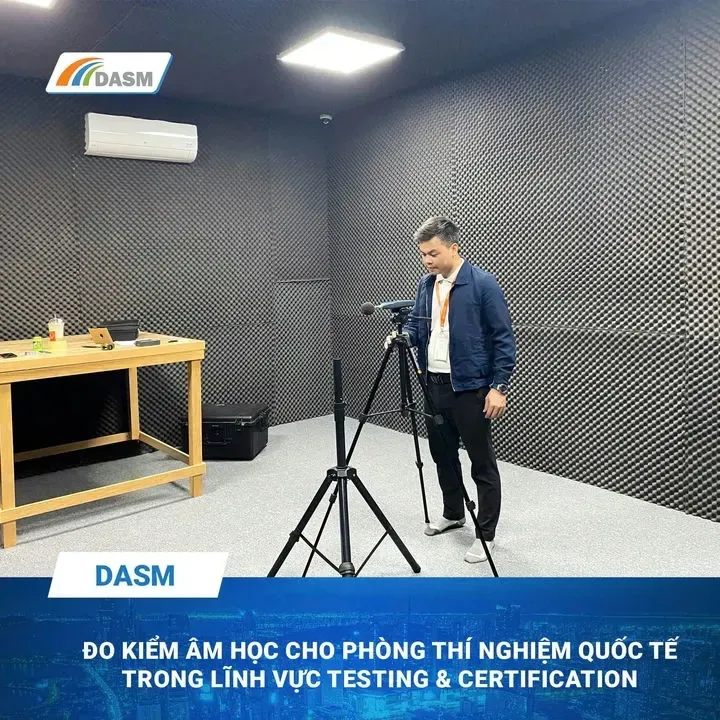
DASM shared acoustics & materials topics at Hanoi University of Civil Engineering, providing practical knowledge on sound absorption – sound insulation materials, measurement methods, and applications in modern construction projects.
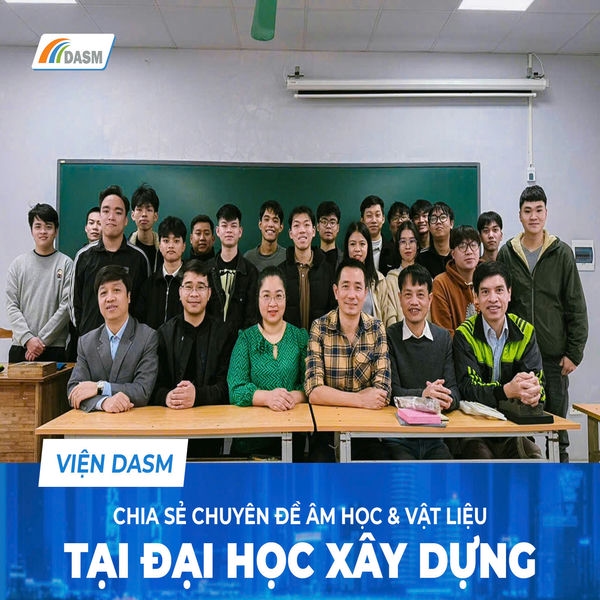
In the context of architecture and construction developing towards a direction that prioritizes spatial experience and user health, acoustics is playing an increasingly important role. A project needs not only structural sustainability and aesthetic form but also sound control to create an effective working, studying, and living environment.
To bring acoustic knowledge closer to students – the future materials engineers, this morning the DASM Institute for Development and Application of Acoustic Materials organized a seminar at the Faculty of Building Materials – Hanoi University of Civil Engineering, directly presented by Mr. Nguyen Phuong Lam – Director of DASM.
Seminar content: Acoustics & materials knowledge from a scientific – applied perspective
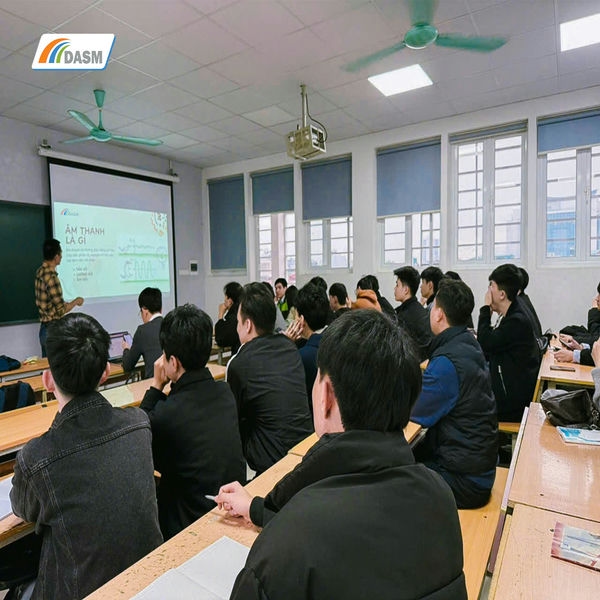
- What is sound? Analysis of physical characteristics and propagation in the environment
The seminar began with the scientific definition of sound, including:
- The nature of mechanical vibration
- Important measurement quantities such as frequency (Hz), intensity (dB), amplitude, sound pressure
- Propagation process and interaction with objects (reflection – sound absorption – transmission)
These foundations help students understand why sound in space can cause echo, reverberation, noise, or reduced communication quality – a common problem in open offices, classrooms, auditoriums, and shopping centers.
- Acoustic materials and their role in projects
Next, the seminar introduced acoustic materials with three main functional groups:
- Sound Absorption: reducing sound reflection, limiting reverberation
- Sound Insulation: reducing sound transmission between two spaces
- Sound Diffusion: scattering sound waves to create a natural sound field
This is the foundation for students to approach acoustics not only on theoretical models but also in the context of modern project design and construction.
- Working principles of sound absorption & sound insulation materials
The in-depth section of most interest to students revolved around the operating mechanism of materials, in which:
Sound absorption materials depend on factors such as:
- Interconnected pore structure
- Pore/fiber size
- Airflow resistivity
- Bulk density
- Material thickness
- Airflow tortuosity
Common examples:
+ Mineral wool, fiberglass (fibrous)
+ Acoustic foam (open-cell)
+ Micro-perforated wooden panels
+ Sonic acoustic panels
Sound insulation materials are based on:
- Density and specific gravity
- Elastic stiffness and coincidence frequency
- Internal damping coefficient
- Pore structure and flow resistance
Practical examples such as non-vulcanized rubber, mineral wool, double-layer gypsum walls, laminated glass, composite panels, show that acoustic materials have been widely present in Vietnamese projects.
- Classification of acoustic materials by function – structure – application
The seminar went deep into how to classify materials according to technical criteria:
- By function: sound absorption materials – sound insulation materials – sound diffusion – vibration damping
- By structure: fibrous – porous – membrane – resonant – composite
- By application: studio – office – residential – industrial – educational – medical
Classification helps students understand that a good acoustic material must match the project's goals, rather than just choosing based on market habits.
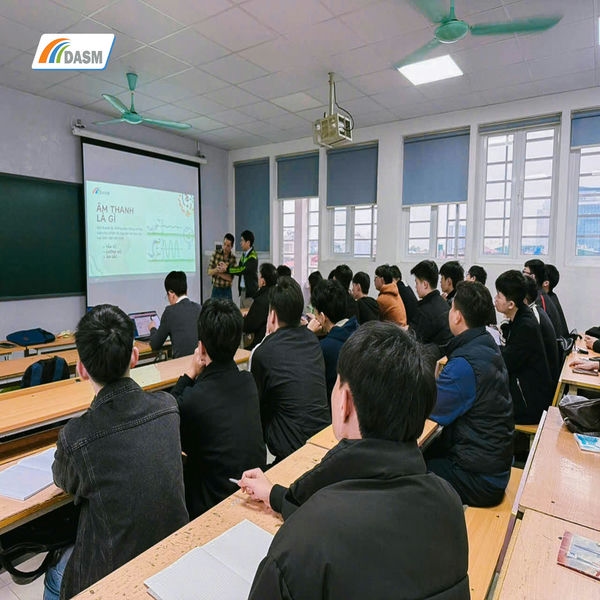
- The development journey of acoustic materials
From history to modern times, the seminar showed that sound absorption – sound insulation materials have evolved through many generations:
Natural materials: wool, straw, wood, bamboo fibers
Industrial materials: mineral wool, fiberglass
Polymer & elastomer
Micro-perforated & composite
Green & recycled materials for sustainable construction
The trend of Green Acoustic Materials was emphasized, fitting the sustainable development orientation in the construction industry.
- Measurement methods for sound absorption coefficient – sound insulation and testing standards system
This is the technical – laboratory part, including:
- Reverberation Chamber – measuring sound absorption coefficient α
- Transmission Room – Receiving Room – measuring sound transmission
- STC, Rw, DnT, LnT – sound insulation evaluation indices
- ISO – ASTM – EN standards
This part also helps students understand why materials cannot "self-proclaim" sound absorption – sound insulation but must be tested using international standards in a lab.
Direct interaction: When materials step out of books
The seminar atmosphere became lively as students discussed the sound absorption and sound insulation characteristics of familiar materials such as wood, metal, gypsum, glass, fabric, foam, and mineral wool. Practical building examples show that acoustic effects can determine:
- Lecture quality in classrooms
- Concentration levels in offices
- Acoustic privacy in hospitals & residences
- Musical experience in concert halls & studios
These exchanges make knowledge more applicable & interdisciplinary rather than stopping at theory.
The pioneering role of DASM in acoustic material research & application
With a scientific-applied orientation, DASM is promoting awareness of architectural acoustics in Vietnam through material research, material testing and standardized measurement, and sharing knowledge with the technical community.
Acoustics is considered a constitutive element of spatial experience, directly affecting health, concentration, and work performance. Early access to this field will open up many career opportunities for students.
DASM always accompanies the future generation of material engineers
At the end of the seminar, DASM sends thanks to the Faculty of Construction Materials and the students of Hanoi University of Civil Engineering for their warm welcome and open exchange. DASM believes that spreading acoustic knowledge will contribute to improving the quality of buildings in Vietnam in the future.
DASM creates conditions for young people passionate about acoustic engineering to experience the actual environment, accumulate experience, and shape their career paths, aiming for sustainable cooperation opportunities after graduation.
VILAS 1541 · ISO/IEC 17025
Need advice on Materials Acoustic Testing?
Services of testing, measuring and analyzing acoustic properties of equipment, products, vehicles, acoustic materials, etc.
Related Articles
Articles from the same category or related topics
- 6 min read
From Vietnamese Acoustic Knowledge to International Forums: DASM's Research Milestone in Acoustics Australia
A research paper on acoustic materials by DASM was published in Acoustics Australia, a world-renowned acoustic journal, marking a new step forward for DASM in the field of acoustics
Read more → - 3 min read
DASM Sound Absorption Testing for Noise Barriers According to ISO 354:2024 & EN ISO 11654:1997
DASM sound absorption testing for Noise Barriers in a reverberation room according to ISO 354:2024 and EN ISO 11654:1997 standards at a VILAS-certified laboratory
Read more → - 4 min read
DASM Participates in Long-Span Bridge Workshop for High-Speed Railways – Expanding Research Capabilities in Acoustics and Structural Vibration
DASM participates in the long-span bridge workshop for high-speed railways to update structural design trends, control structural vibration and acoustics, and prepare capabilities for projects
Read more →