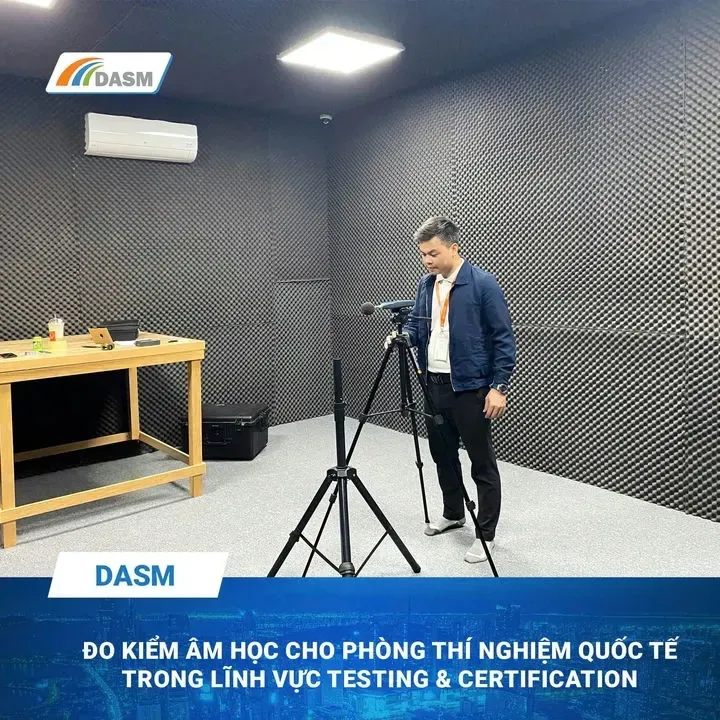
Factory noise measurement service – noise survey and evaluation is conducted by DASM acoustics experts in accordance with QCVN, ISO, TCVN standards using international calibration equipment, providing fast – accurate – reliable results.
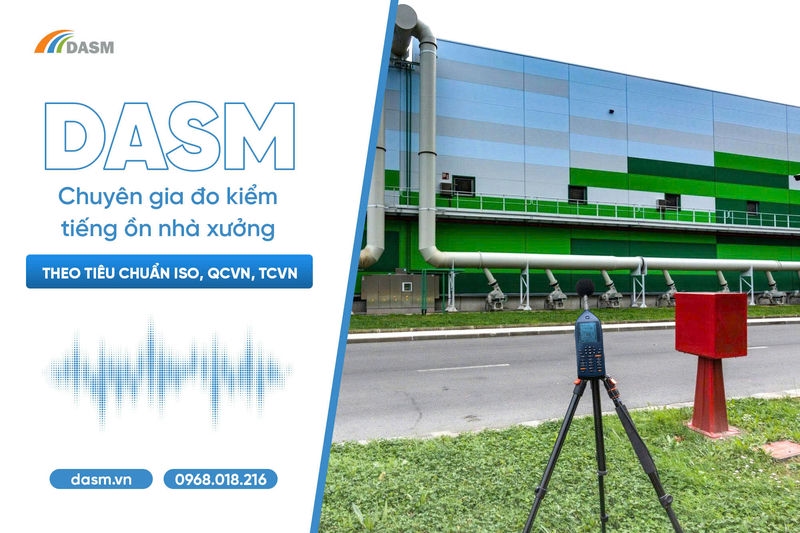
Why is factory noise measurement necessary?
Noise is one of the significant harmful factors in the industrial working environment. Not only affecting workers' health (especially hearing and psychology), noise also reduces productivity, causes fatigue, reduces concentration, and can lead to occupational accidents.
Why Must Manufacturing Plants Control Noise?
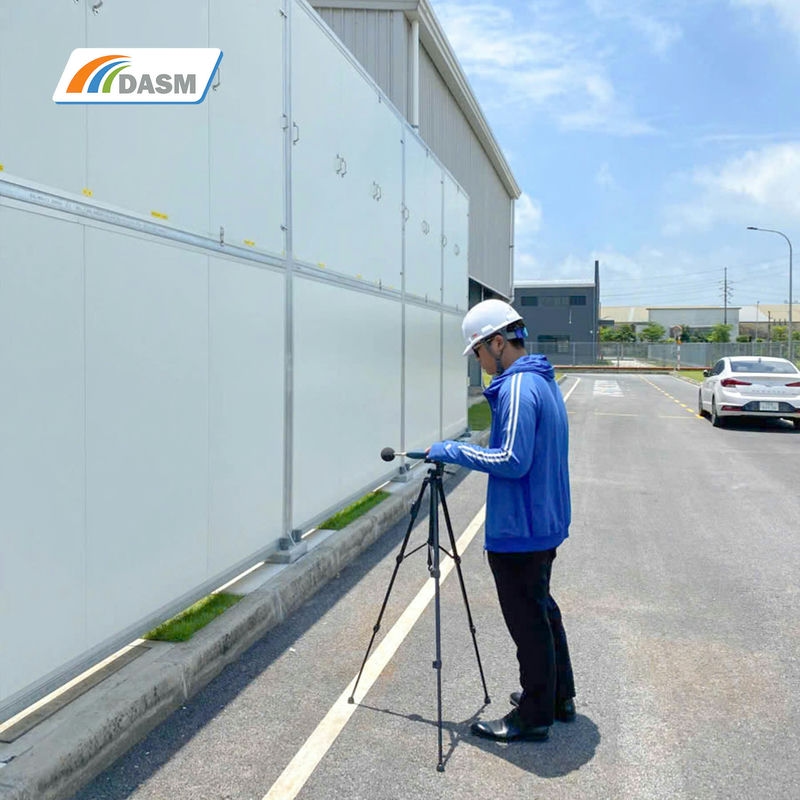
DASM Institute determines chiller noise for a leading Japanese manufacturing plant in Thai Binh
In addition, according to current regulations in Vietnam, enterprises have the obligation to assess and control noise in the working environment and around the factory in order to ensure compliance with laws on labor safety and environmental protection.
Regulations and standards for industrial noise measurement
Currently, noise measurement in workshops, factories, and industrial zones must comply with the following technical standards:
- QCVN 24:2016/BLĐTBXH: National technical regulation on noise at the workplace
- QCVN 26:2010/BTNMT: National technical regulation on environmental noise
- ISO 9612: Acoustics – Determination of occupational noise exposure – Engineering method
- ISO 11690: Acoustics – Recommended practice for the design of low-noise workplaces containing machinery
- TCVN 7878-1:2018 (ISO 1996-1:2016): Acoustics – Description, measurement and assessment of environmental noise – Part 1: Basic quantities and assessment procedures
The above standards require measurement at the correct locations and times, using calibrated equipment and complete reporting for comparison with permissible limits.
When is it necessary to measure factory noise and industrial noise?
Enterprises should carry out factory noise measurement in the following cases:
- When constructing or operating a new workshop
- When there are complaints from workers or surrounding residents
- Before and during environmental and labor safety inspections
- According to the factory's periodic monitoring plan
- When changing production lines or machinery that may increase noise levels
Proactive noise measurement helps businesses prevent risks, improve the working environment, and demonstrate professionalism in management.
DASM's factory noise measurement process
DASM is a leading prestigious unit in the field of acoustic measurement, owning a VILAS-standard laboratory, international calibration equipment systems, and an experienced team of engineers. Below is the noise measurement process implemented by DASM:
Preliminary survey
DASM specialists will survey the current status of the workshop, determine the areas to be measured, and propose a number of measurement points suitable for the area and structure.
Determine the number of measurement points
According to standards, on average every 10m² corresponds to 1 measurement point. However, the number of points can be adjusted according to specific requirements and actual conditions (machinery locations, high noise areas, etc.).
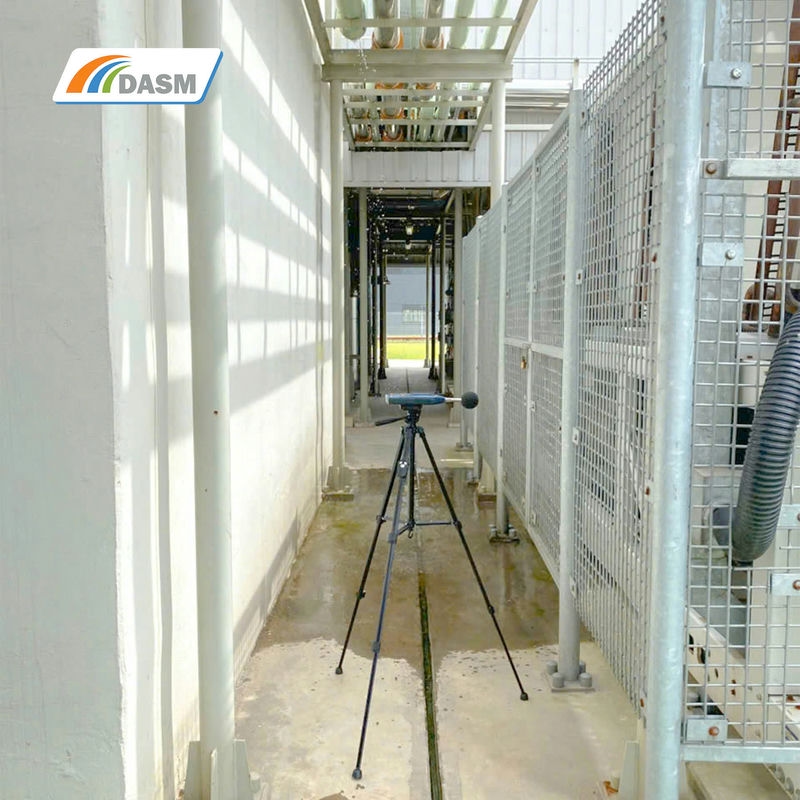
Noise measurement
- Measurement time per point: at least 10 minutes or more to ensure representative data
- Equipment used: specialized sound level meters calibrated periodically
Data processing and analysis
After measurement, data will be analyzed to assess the level of standard exceeding (if any) and provide characteristic acoustic parameters such as: LAeq, Lmax, Lmin, LA90, etc.
Reporting and consulting
DASM's measurement result report includes complete:
- Location, time, and measurement results of each point
- Noise level chart
- Comparison with limits in standards
- Proposing sound solutions for noise reduction with appropriate types of sound insulation – sound absorption materials (if thresholds are exceeded)
How much does factory noise measurement cost?
The noise measurement cost of DASM Institute depends on:
- Number of measurement points
- Survey location (inner city or suburbs)
- Complexity of the space (multi-floor, many machines, etc.)
- Reporting requirements (English required, in-depth, etc.)
DASM will conduct a survey and provide a detailed quotation before implementation. Committed to reasonable – optimal – transparent costs.
Why choose DASM?
DASM is not only a unit performing international-standard factory noise measurement, but also a comprehensive consulting partner for professional acoustics services for factories:
- International standard equipment (Bruel & Kjaer, Svantek, etc.)
- Engineers with acoustic measurement certificates, 10+ years of experience
- Practical experience in major industrial zones such as Bac Ninh, Hai Phong, Long An, VSIP IP, AMATA, etc.
- Complete Vietnamese – English reports, suitable for ISO files and environmental inspections
- Architectural acoustic design consulting, effective noise remediation and treatment
If you have a need to measure noise for your factory, production area or need consultation on noise reduction solutions, professional acoustics services, please contact DASM immediately – we are always ready to support quickly and accurately.
VILAS 1541 · ISO/IEC 17025
Need advice on Noise Survey & Assessment Services?
Measuring ambient environmental, factory and residential noise to support environmental impact assessment (EIA).
Related Articles
Articles from the same category or related topics
- 6 min read
From Vietnamese Acoustic Knowledge to International Forums: DASM's Research Milestone in Acoustics Australia
A research paper on acoustic materials by DASM was published in Acoustics Australia, a world-renowned acoustic journal, marking a new step forward for DASM in the field of acoustics
Read more → - 3 min read
DASM Sound Absorption Testing for Noise Barriers According to ISO 354:2024 & EN ISO 11654:1997
DASM sound absorption testing for Noise Barriers in a reverberation room according to ISO 354:2024 and EN ISO 11654:1997 standards at a VILAS-certified laboratory
Read more → - 4 min read
DASM Participates in Long-Span Bridge Workshop for High-Speed Railways – Expanding Research Capabilities in Acoustics and Structural Vibration
DASM participates in the long-span bridge workshop for high-speed railways to update structural design trends, control structural vibration and acoustics, and prepare capabilities for projects
Read more →