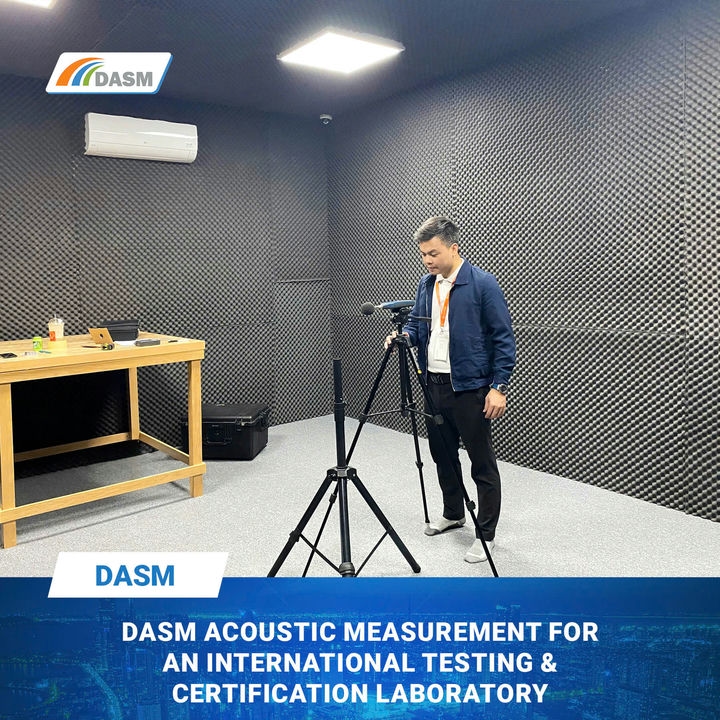
Field measurements of airborne sound insulation of facade elements and facades for the purpose of estimating the sound reduction index of the facade element; estimating the outdoor/indoor sound level difference under real traffic conditions...

Content overview Field measurements of airborne sound insulation of facade elements and facades
Test name: Acoustics – Field measurements of airborne sound insulation of facade elements and facades
Test method:
ISO 140-5:1998: Acoustics – Measurement of sound insulation in buildings and of building elements. Part 5: Field measurements of airborne sound insulation of facade elements and facades.
Performed at: Field.
1. Objective & test objects
1.1. Test objective
This part of ISO 140 specifies two series of methods (element methods and global methods) to measure correspondingly the airborne sound insulation of facade components and entire facades. The element methods aim to estimate the sound reduction index of a facade element, such as a window. The most accurate element method uses loudspeakers as an artificial sound source. Different and less accurate, the element method uses available traffic noise. The global methods aim to estimate the outdoor/indoor sound level difference under real traffic conditions. The most accurate global methods use actual traffic flow as the sound source. In addition, loudspeakers can be used as artificial sound sources. An overview of the methods is given in Table 1.
The element loudspeaker method yields an apparent sound reduction index which, under certain circumstances [e.g. taking into account the precision of measurement (see 7.1)], can be compared with the sound reduction index measured in laboratories according to ISO 140-3 or ISO 140-10. This method is the preferred method when the purpose of the measurement is to evaluate the performance of a specified facade element in relation to its laboratory performance.
The road traffic method will serve similar purposes as the element loudspeaker method. It is particularly useful when, for various practical reasons, it is not possible to use the element loudspeaker method. These two methods will generally yield slightly different results. The road traffic method tends to lead to lower values of the sound reduction index compared to the loudspeaker method. In this Annex D, the road traffic method is supplemented by railway and aircraft traffic methods respectively.
The global road traffic method yields the actual sound reduction of the facade at a given position relative to the 2m in front of the facade position. This method is the preferred method when the purpose of the measurement is to evaluate the performance of the entire facade, including all flanking paths, at a defined position relative to nearby roads. The results cannot be compared with the results of laboratory measurements.
The global loudspeaker method yields the sound reduction of the facade relative to the 2m in front of the facade position. This method is particularly useful when, for various practical reasons, the real noise source cannot be used. The results cannot be compared with the results of laboratory measurements.

1.2. Test object
Facade elements and building facades
1.3. Sound source objects
4 main sound source objects of the standard:
+ Noise from artificial sound sources
+ Noise from street traffic
+ Noise from railway traffic
+ Noise from aircraft
1.4. Laboratory equipment
+ Microphones
+ Loudspeakers
2. Test procedure
The element loudspeaker method will yield an estimate of the apparent sound reduction index, in specific cases, which can be compared with the sound reduction index for corresponding facade elements obtained in laboratories.
The global loudspeaker method will quantify the airborne sound insulation of the entire facade or even an entire building in a defined situation. This result cannot be compared with laboratory measurements
Corresponding methods for railway and aviation traffic noise are described. The road traffic method will yield an estimate of the apparent sound reduction index, according to specific cases, which can be compared with the corresponding sound reduction index obtained in laboratories.
2.1. Implementation steps:
+ Measurement with loudspeakers
+ Measurement with outdoor traffic noise
2.2. Data processing and reporting result
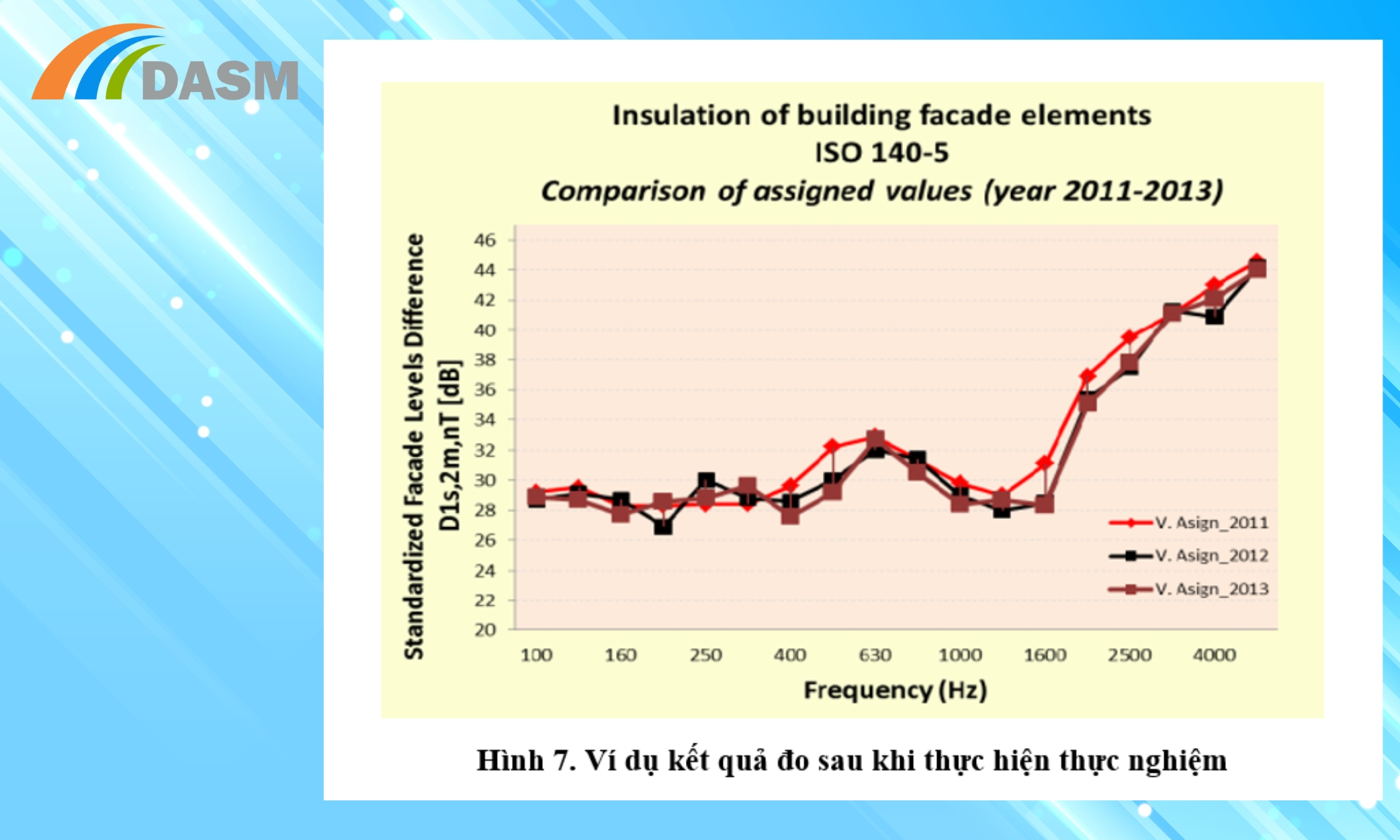

Role – importance of Field measurements of airborne sound insulation of facade elements and facades
Field measurements of airborne sound insulation of facade elements and facades performed by DASM Institute help provide useful information, meeting all practical needs of customers and businesses wishing to:
- Estimate the sound reduction index of the facade element, to evaluate the performance of a specified facade element in relation to its laboratory performance
- Estimate the outdoor/indoor sound level difference under real traffic conditions to evaluate the performance of the entire facade...
- Proactively control noise and implement sound insulation solutions for facade elements – building facades effectively and optimally...
If previously you still had some concerns, worries and had to spend many fees for similar activities abroad, now you just need to contact DASM. The entire remaining process will be proactively implemented by us as a package in the fastest time to complete customer experience about us: DASM provides acoustic consulting services with truly superior quality, most competitive prices in the industry along with dedicated and attentive customer care policies.
Significance of acoustic testing services at DASM
Today's globalized commercial life opens up countless new markets and supply sources across five continents. Accompanied by this are international regulations and standards that help customers easily evaluate quality, trace product origins, and select suitable or superior items. In particular, they also support manufacturers in continuously improving and perfecting technology, techniques, raw materials, production methods, sales, etc.
The DASM Institute is a pioneering, comprehensive, professional, and leading prestigious brand in Vietnam in the field of acoustics. On January 12, 2023, DASM was granted testing activity registration certificate number 114/TĐC - HCHQ by the Directorate for Standards, Metrology and Quality (Ministry of Science and Technology), certifying registered multi-industry testing activities in the field of Mechanics and Physics (registration number: 707/TN - TĐC).
Our acoustic material testing services provide customers with practical professional results to meet sustainability, standard performance, and optimal solutions - consulting - design adjustments for products and services. From there, you will update, meet, and adapt to constantly changing international standards to achieve breakthroughs in revenue, profit, and brand elevation.
If you have a need to perform on-site measurements of airborne sound insulation of facade elements and building facades please contact us via Hotline for detailed consultation!
VILAS 1541 · ISO/IEC 17025
Need advice on SOUND DESIGN & SIMULATION SERVICES?
Acoustical design services, sound simulation using software for projects specializing in acoustics
Related Articles
Articles from the same category or related topics
- 3 min read
DASM Sound Absorption Testing for Noise Barriers According to ISO 354:2024 & EN ISO 11654:1997
DASM sound absorption testing for Noise Barriers in a reverberation room according to ISO 354:2024 and EN ISO 11654:1997 standards at a VILAS-certified laboratory
Read more → - 7 min read
DASM Institute surveyed the acoustics of the recording booth at the Ministry of Public Security according to ISO 3382 standard
DASM Institute conducted an acoustic survey and noise testing in the recording booth at the Ministry of Public Security, including SNR measurement and acoustic characteristic evaluation according to ISO 3382 standard.
Read more → - 3 min read
Advanced Acoustic Measurement & Noise Emission Testing for International Testing & Certification Laboratories
DASM provides advanced acoustic measurement and noise emission testing services for Testing & Certification laboratories, ISO-compliant procedures
Read more →