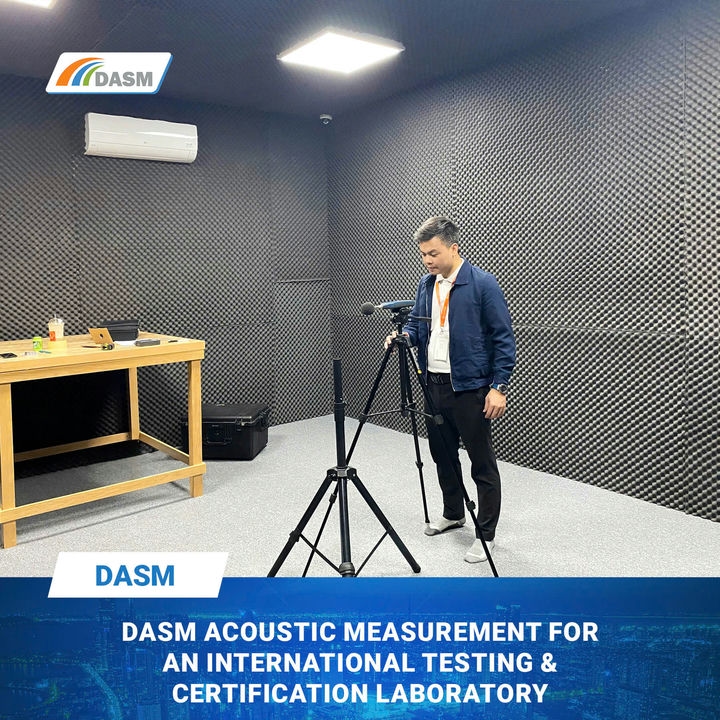
Test method for determination of airborne sound insulation of urban road noise barriers aims to measure and determine the airborne sound insulation characteristics of noise-reducing devices installed along roads under laboratory and in situ conditions...


Overview of the Test Method for Determination of Airborne Sound Insulation of Urban Road Noise Barriers
Test method name: Road traffic noise reducing devices – Test method for determining the acoustic performance – Part 6: Intrinsic characteristics – In situ values of airborne sound insulation under direct sound field conditions.
Test method:
BS EN 1793-6:2012: Road traffic noise reducing devices – Test method for determining the acoustic performance – Part 6: Intrinsic characteristics – In situ values of airborne sound insulation under direct sound field conditions [1].
Performed at:
- In situ.
- Laboratory, DASM Institute of Acoustic Materials Development and Application.
1. Objectives and test objects
– Scope:
This European Standard describes a test method for measuring a quantity representing the intrinsic characteristics of airborne sound insulation for road traffic noise reducing devices: the sound insulation index.
The test method is intended for the following applications:
- Determination of the intrinsic characteristics of airborne sound insulation of noise-reducing devices installed along roads, measured in situ or under laboratory conditions;
- Determination of the in situ intrinsic characteristics of airborne sound insulation of noise-reducing devices in practical use;
- Comparison of design specifications with actual performance data after completion of construction work;
- Verification of the long-term performance of noise-reducing devices (with repeated application of the method);
- Interactive design process of new products, including the development of installation instructions.
The test method is not intended to determine the intrinsic characteristics of airborne sound insulation of noise-reducing devices installed in reverberant conditions, e.g., inside a tunnel or deep trench or under a cover.
Results are expressed as a function of frequency in one-third octave bands, if possible, between 100Hz and 5kHz. If valid measurement results cannot be obtained over the entire specified frequency range, the results must be presented in a restricted frequency range and the reason(s) for the restriction must be clearly reported.
– Test object:
Road traffic noise reducing devices.
2. Experimental procedure
– Implementation steps:
- Equip fully with measurement devices, microphones, and test objects.
- Perform sample measurement.
- Process and report results.

– Laboratory equipment
The standard specifies two test conditions
- Laboratory testing: bringing the material to the laboratory and installing it completely identical to the requirements of ISO 10140 standard. The laboratory ensures a volume of 200m3.
- In situ testing: this is the most accurate test, compatible with the working conditions of highway noise barriers when there is an open edge above.
Role – importance of the Test Method for Determination of Airborne Sound Insulation of Urban Road Noise Barriers
The Test Method for Determination of Airborne Sound Insulation of Urban Road Noise Barriers performed by DASM Institute of Acoustic Materials Development and Application helps provide useful information, meeting all practical needs of customers and businesses wishing to:
- Measure and determine the airborne sound insulation characteristics of noise-reducing devices installed along roads under laboratory and in situ conditions.
- Compare design specifications with actual performance data.
- Verify the long-term performance of noise-reducing devices.
- Establish an interactive design process for new products, including the development of installation instructions.
- Proactively control noise and minimize road traffic noise.
- Control and monitor quality during production, optimize research and development of superior and more effective devices.
- Obtain certificates and test results to enhance competitiveness and sales, or bring products into major projects, promote, and sell them to the market conveniently, transparently, and compliantly.
At the same time, DASM will conduct consulting and design work to create shape/structure/material solutions to optimize the sound insulation and noise reduction functions of the test sample in a streamlined, effective, and cost-saving manner (in case standards are not yet met).
If previously you had lingering concerns and had to spend substantial fees for similar activities abroad, now you just need to contact DASM. The entire remaining process will be proactively implemented by us as a turnkey service in the shortest time to complete customer experience with us: DASM provides acoustic consulting services with truly superior quality, highly competitive prices in the industry, and thoughtful, dedicated customer care policies.
Significance of acoustic testing services at DASM
Today's globalized commercial life opens up countless new markets and supply sources across five continents. Accompanied by international regulations and standards that help customers easily evaluate quality – trace product origin, and select suitable/superior items. In particular, they support manufacturers in continuously improving and perfecting technology, techniques, raw materials, production and sales methods, etc.
DASM Institute of Acoustic Materials Development and Application is a pioneering, comprehensive, professional, and leading prestigious brand in Vietnam in the field of acoustics. On January 12, 2023, DASM was granted certificate No. 114/TĐC – HCHQ by the Directorate for Standards, Metrology and Quality (Ministry of Science and Technology), certifying registered testing activities for multidisciplinary integration in the Mechanical-Physical field (registration number: 707/TN – TĐC).
Our acoustic material testing services provide clients with practical professional results to meet sustainability, standard performance, and optimal solutions - consulting - design calibration for products and services. From there, you will update, meet, and adapt to constantly changing international standards to break through in revenue, profit, and elevate your brand.
If you have a need to perform material testing to determine the sound insulation of urban road sound barrier walls, please contact us via Hotline for detailed consultation!
VILAS 1541 · ISO/IEC 17025
Need advice on Materials Acoustic Testing?
Services of testing, measuring and analyzing acoustic properties of equipment, products, vehicles, acoustic materials, etc.
Related Articles
Articles from the same category or related topics
- 3 min read
DASM Sound Absorption Testing for Noise Barriers According to ISO 354:2024 & EN ISO 11654:1997
DASM sound absorption testing for Noise Barriers in a reverberation room according to ISO 354:2024 and EN ISO 11654:1997 standards at a VILAS-certified laboratory
Read more → - 7 min read
DASM Institute surveyed the acoustics of the recording booth at the Ministry of Public Security according to ISO 3382 standard
DASM Institute conducted an acoustic survey and noise testing in the recording booth at the Ministry of Public Security, including SNR measurement and acoustic characteristic evaluation according to ISO 3382 standard.
Read more → - 3 min read
Advanced Acoustic Measurement & Noise Emission Testing for International Testing & Certification Laboratories
DASM provides advanced acoustic measurement and noise emission testing services for Testing & Certification laboratories, ISO-compliant procedures
Read more →