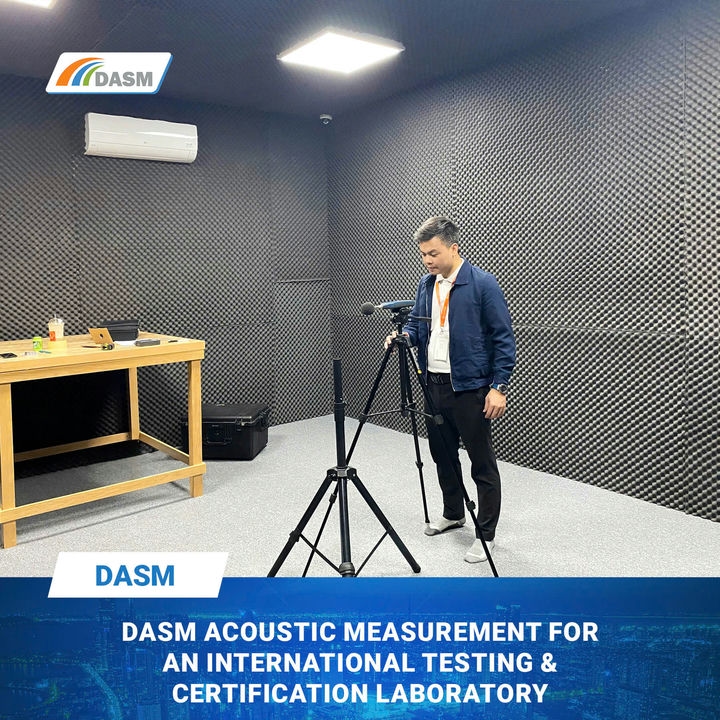
Determination of sound absorption coefficient, reflection coefficient and surface impedance – Standing wave ratio method & transfer-function method help control quality during production, optimize the research and development of sound absorption and sound insulation materials and effectively compare, calculate and design acoustic rooms.

Overview of the Test Determination of sound absorption coefficient, reflection coefficient and surface impedance
Test name: Determination of sound absorption coefficient, reflection coefficient and surface impedance – Standing wave ratio method & transfer-function method.
Test method:
ISO 10534-1 1996: Acoustics – Determination of sound absorption coefficient and impedance in an impedance tube. Part 1: Method using standing wave ratio [1].
ISO 10534-2 1998: Acoustics – Determination of sound absorption coefficient and impedance in impedance tubes – Part 2: Transfer-function method
Performed at: Laboratory, Institute of Acoustic Materials Development and Application (DASM).
1. Objectives and test subjects
Laboratory testing of the acoustic properties of materials:
- Sound absorption coefficient
- Acoustic impedance
Subjects: Sound absorption materials or sound insulation materials.
2. Experimental procedure
The experimental procedure uses an impedance tube.
Steps to perform:
- Prepare all equipment and test samples thoroughly.
- Perform sample measurement.
- Process and report results.

3. Notes:
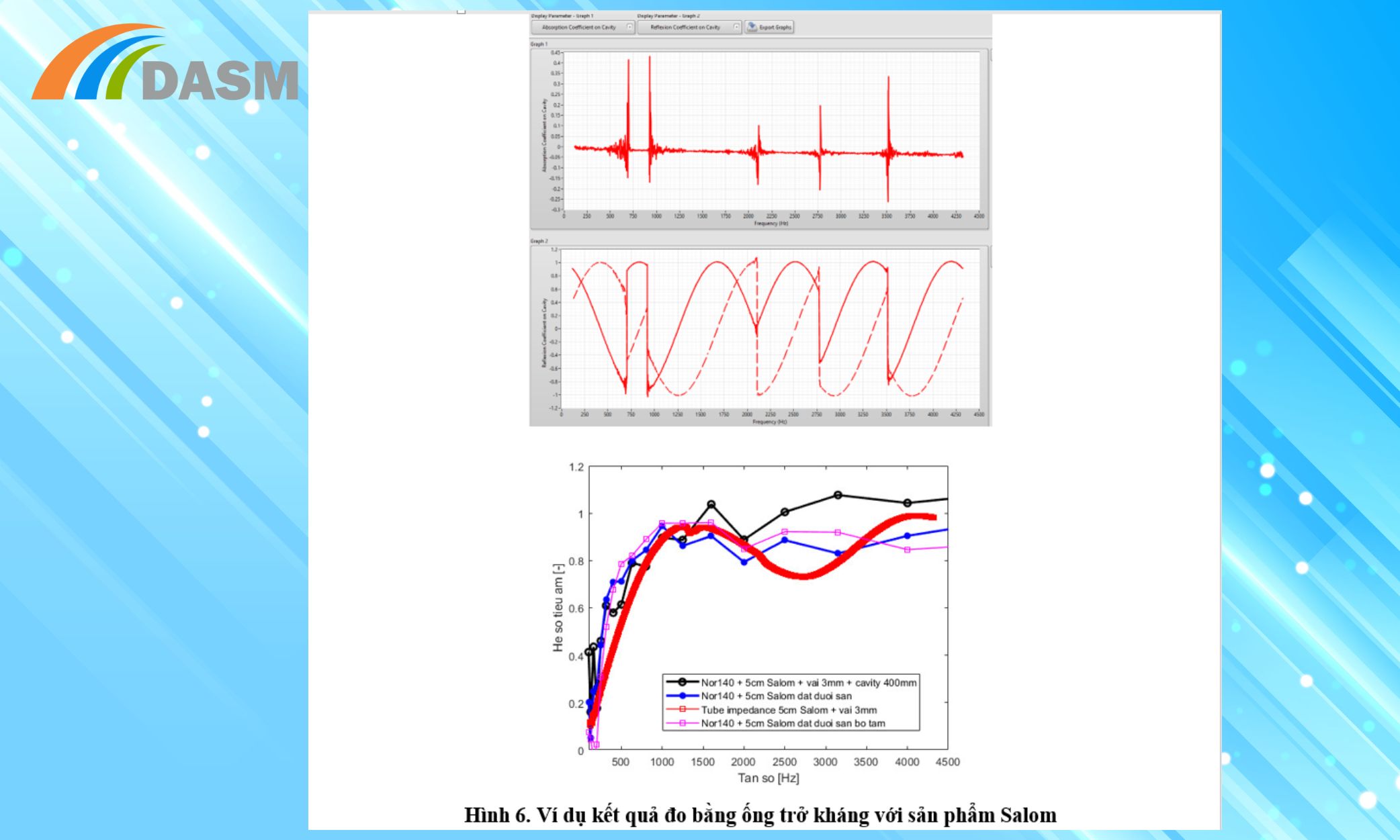
The test for Determination of sound absorption coefficient, reflection coefficient and surface impedance by the transfer-function method involves using an impedance tube, two microphone locations and a digital frequency analysis system to determine the sound absorption coefficient of the sound absorber for normal sound incidence. It can also be applied to determine the acoustic surface impedance or acoustic admittance of sound absorbing materials. The impedance ratios of sound absorbing materials are related to their physical properties such as airflow resistance, porosity, elasticity and density. Therefore, the measurements described in this test method are useful for basic research and product development.
The transfer-function method is similar to the standing wave ratio method in that it uses an impedance tube with a sound source connected at one end and the test sample mounted in the tube at the other end. However, the measurement techniques in the two methods are different.
In the transfer-function method, plane waves are generated in the tube by a noise source; decomposition of the interference field is achieved by measuring sound pressure at two fixed positions using wall-mounted microphones or traversing microphones in the tube and subsequent calculation of the complex acoustic transfer function, normal incidence absorption, and impedance ratio of the acoustic material. The transfer-function method provides an alternative measurement technique and is often much faster than that of the standing wave ratio method.
Compared to the sound absorption measurement in a reverberation room specified in ISO 354:2003: Acoustics – Measurement of sound absorption in a reverberation room, there are several characteristic differences. The reverberation room method (under ideal conditions) determines the sound absorption coefficient for diffuse sound incidence and can be used to test materials with pronounced structural orientation in horizontal and normal directions. However, the reverberation room method requires fairly large test samples, which is inconvenient for research and development when only small samples are available. The impedance tube method is limited to parametric studies at normal incidence but requires test sample sizes matching the cross-section of the impedance tube. For locally reacting materials, the diffuse-field sound absorption coefficient can be estimated from measurement results obtained by the impedance tube method. To convert test results from the impedance tube method (normal incidence) to diffuse sound incidence, see Annex F.
Role – importance of the Test Determination of sound absorption coefficient, reflection coefficient and surface impedance
The test Determination of sound absorption coefficient, reflection coefficient and surface impedance – Standing wave ratio method & transfer-function method performed by the Institute of Acoustic Materials Development and Application helps meet practical needs such as:
- Customers wishing to control noise.
- Enterprises needing to control quality during production, optimizing the research and development of sound absorption and sound insulation materials.
- Users having a basis to compare, calculate and design acoustic rooms effectively.
- Obtaining certificates and test results to increase competitiveness and sales, or to bring products into installation, use and construction in projects conveniently, transparently and in compliance with regulations.
In addition, if the test sample does not meet standards, DASM will consult and design shapes, structures and materials to optimize the design efficiently at a reasonable cost.
If previously you had some concerns and had to spend many fees for similar activities abroad, now you just need to contact DASM. All remaining processes will be proactively implemented by us as a package in the shortest time to complete your customer experience with us: DASM provides acoustic consulting services with truly superior quality, the most competitive prices in the industry along with dedicated and attentive customer care policies.
Significance of acoustic testing services at DASM
Today's globalized commercial life opens up countless new markets and supply sources across five continents. Accompanied by this are international regulations and standards that help customers easily evaluate quality – trace product origin and source, and select suitable or superior items. In particular, they assist manufacturers in continuously improving and perfecting technology, techniques, raw materials, production methods, sales, etc.
The Institute of Acoustics Science and Materials (DASM) is a pioneering, comprehensive, professional, and leading reputable brand in Vietnam in the field of acoustics. On January 12, 2023, DASM was granted registration certificate No. 114/TĐC – HCHQ by the Directorate for Standards, Metrology and Quality (Ministry of Science and Technology), certifying registered testing operations for multi-sector synthesis in the Mechanical-Physical field (registration number: 707/TN – TĐC).
Our acoustic testing services provide customers with practical professional results to meet sustainability, standard performance, and optimal solutions – consulting – design adjustments for products and services. From there, you will update, meet, and adapt to constantly changing international standards to achieve breakthroughs in revenue and profit and elevate your brand.
At the same time, they signify promoting the optimization of production processes – rapid and economical product marketing; contributing to enhancing value, expanding markets, and spreading the advantages of enterprises' products and services in Vietnam, the region, and internationally.
Customers who need to perform Testing method for determining sound absorption coefficient, reflection coefficient, and surface impedance – Standing wave tube method & transfer function method please contact via Hotline for detailed consultation!
VILAS 1541 · ISO/IEC 17025
Need advice on Materials Acoustic Testing?
Services of testing, measuring and analyzing acoustic properties of equipment, products, vehicles, acoustic materials, etc.
Related Articles
Articles from the same category or related topics
- 3 min read
DASM Sound Absorption Testing for Noise Barriers According to ISO 354:2024 & EN ISO 11654:1997
DASM sound absorption testing for Noise Barriers in a reverberation room according to ISO 354:2024 and EN ISO 11654:1997 standards at a VILAS-certified laboratory
Read more → - 7 min read
DASM Institute surveyed the acoustics of the recording booth at the Ministry of Public Security according to ISO 3382 standard
DASM Institute conducted an acoustic survey and noise testing in the recording booth at the Ministry of Public Security, including SNR measurement and acoustic characteristic evaluation according to ISO 3382 standard.
Read more → - 3 min read
Advanced Acoustic Measurement & Noise Emission Testing for International Testing & Certification Laboratories
DASM provides advanced acoustic measurement and noise emission testing services for Testing & Certification laboratories, ISO-compliant procedures
Read more →