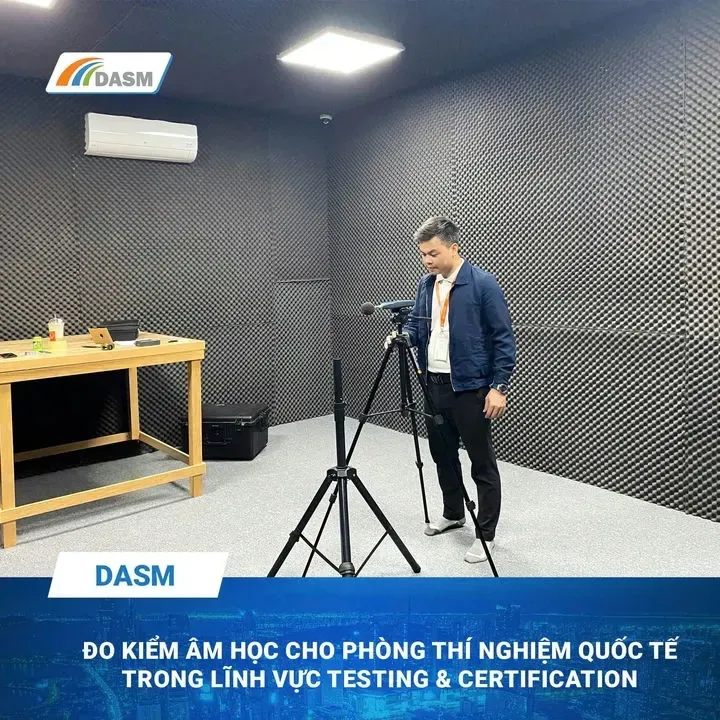
Sound Absorption Room Design
An anechoic room is a special room, characteristic of the acoustic field studying materials and the acoustic environment. It creates a unique one-dimensional sound field, meaning waves only travel forward and there are no reflected waves inside the anechoic room. Due to such special requirements, the walls of the anechoic room are also specially constructed. In addition to resisting fluctuating sound sources at low frequencies, the room also completely absorbs the energy of existing sound sources inside at frequencies of 100 Hz and higher.
The anechoic room is a closed room with walls constructed of assembled single pyramid foam wedges made of PE or Melamine Foam material.

This PE or Melamine Foam material allows cutting or shaping into desired forms simply and easily. It is used as material in almost all Full Anechoic rooms worldwide, both in universities and major sound companies such as B&K, Siemens, Boeing, Airbus, etc. The acoustic characteristics of the material determined from experiments or using modeling include porosity, flow resistivity, viscous length, thermal length, etc.
Determining the sound absorption capacity of this structure is based on the JCA model, PTMM, FEM, and material acoustic characteristics.

Any questions or feedback should be sent via email to the Institute for answers.
VILAS 1541 · ISO/IEC 17025
Need advice on SOUND DESIGN & SIMULATION SERVICES?
Acoustical design services, sound simulation using software for projects specializing in acoustics
Related Articles
Articles from the same category or related topics
- 6 min read
From Vietnamese Acoustic Knowledge to International Forums: DASM's Research Milestone in Acoustics Australia
A research paper on acoustic materials by DASM was published in Acoustics Australia, a world-renowned acoustic journal, marking a new step forward for DASM in the field of acoustics
Read more → - 3 min read
DASM Sound Absorption Testing for Noise Barriers According to ISO 354:2024 & EN ISO 11654:1997
DASM sound absorption testing for Noise Barriers in a reverberation room according to ISO 354:2024 and EN ISO 11654:1997 standards at a VILAS-certified laboratory
Read more → - 4 min read
DASM Participates in Long-Span Bridge Workshop for High-Speed Railways – Expanding Research Capabilities in Acoustics and Structural Vibration
DASM participates in the long-span bridge workshop for high-speed railways to update structural design trends, control structural vibration and acoustics, and prepare capabilities for projects
Read more →