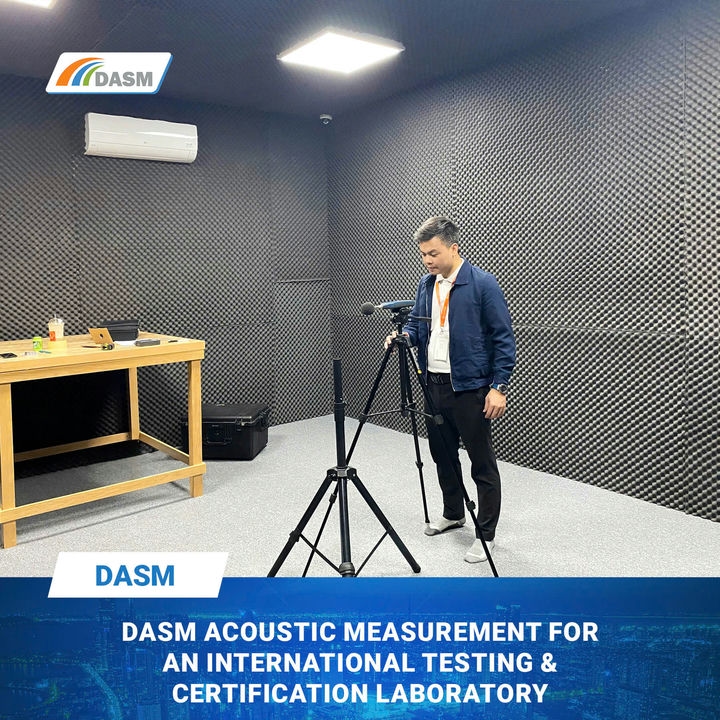
Standard Test Method for Airborne Sound Attenuation Between Rooms Sharing a Common Ceiling Plenum for the purposeof studying additional sound insulation solutions through materials and ceiling structures; actively controlling and minimizing noise in rooms and buildings; and calculating and designing effective acoustic rooms...


Overview of Content Standard Test Method for Airborne Sound Attenuation Between Rooms Sharing a Common Ceiling Plenum
Name of test method: Standard Test Method for Airborne Sound Attenuation Between Rooms Sharing a Common Ceiling Plenum.
Test method: ASTM E1414-2016: Standard Test Method for Airborne Sound Attenuation Between Rooms Sharing a Common Ceiling Plenum [1].
Performed at: Laboratory, Institute of Acoustics Materials Science and Development (DASM).
1. Objectives & test subjects
– Scope of testing
-
This test method uses a laboratory space arranged so that it simulates a pair of small adjacent offices horizontally or rooms separated by a partition and sharing a common plenum space. Partitioning or extending to the underside of a common plenum space or through it. In the specified configuration, the special design feature of the facility ensures that the only significant sound transmission path is by way of the ceiling and plenum.
-
Within the limits stated in the significance statement, the primary quantity measured by this test method is the ceiling attenuation class of a suspended ceiling installed in a laboratory environment. By accounting for receiving room sound absorption, normalized ceiling attenuation can be determined.
-
The test method can also be used to evaluate the attenuation of composite ceiling systems comprising ceiling materials and other components such as lighting fixtures and ventilation systems.
-
Field performance of ceiling systems may differ significantly from results obtained by this test method (see Section 5: Significance, Use, and Test Method E336).
-
The procedures can also be used to study additional sound insulation achievable by other attenuation measures. This would include materials used as plenum barriers or as backings for all or part of the ceiling.
-
The facility can also be used to study the performance of an integrated system comprising the plenum, ceiling, and partition, tested as a single assembly.
-
Values stated in either SI units or inch-pound units are to be regarded separately as standard. The values stated in each system may not be exact equivalents; therefore, each system shall be used independently of the other. Combining values from the two systems may result in non-conformance with the standard.
– Test subjects
Rooms sharing a common ceiling plenum.
2. Experimental procedure
Implementation steps:
- Equip fully with devices, microphones, and test subjects.
- Perform sample measurement.
- Process and report results.
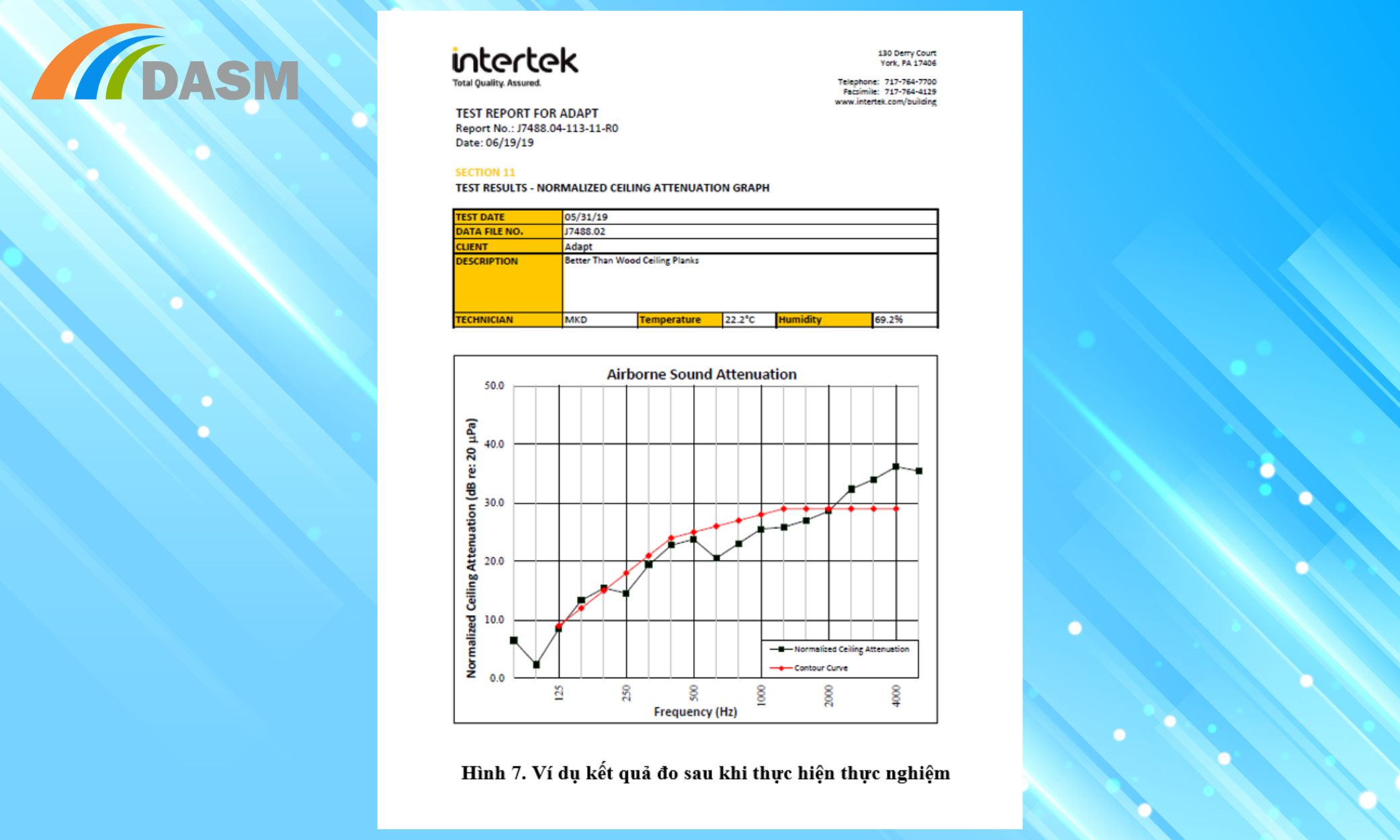

3. Notes
– Test room structure
The total length of each wall edge including damping parts if any shall be 7.5 ± 1.5m, the room width shall be 4.65 ± 0.23m, and the height shall be approximately 3.65 ± 0.15m.
– Test room dimensions
The dividing wall shall be designed so that transmitted sound is not less than 10dB compared to the total wave energy penetrating through the ceiling.
The plenum depth shall be 30 ± 1 inch [760 ± 25mm] at the dividing wall. At other locations in the room, the plenum depth tolerance may be reduced to 62.5 inch [±64mm].
The plenum width shall be 14.1 ± 0.1 ft [4.3 ± 0.02m] at the dividing wall (Figure 3). At other points in the room, the width of the plenum space shall be equal to the width of the plenum room. Limitation of the plenum space width at the dividing wall can be achieved by installing appropriate pads from floor to roof or from the underside of the ceiling to the roof.
Plenum lining: all side walls of the plenum shall be lined with a suitable sound absorption material of a thickness not less than 76mm (3 inches).
– Measurement sample
In cases where usual practice would result in custom-fitted ceiling pieces with a length of less than 4 inches [10cm] installed between the wall molding opposite the partition and the adjacent parallel grid component, filler material with a higher transmission loss than the test sample may be substituted. Filler material shall be used only at the laboratory end walls furthest from the common dividing partition. Filler material shall not be used in grid areas adjacent to the side walls or common partition.
The area of the ceiling system tested shall be the area formed by the length and width of the room minus:
-
The perimeter molding area
-
The area of adapter covers when the ceiling is interrupted
-
The area of any fillers
Role – importance of the Standard Test Method for Airborne Sound Attenuation Between Rooms Sharing a Common Ceiling Plenum
The Standard Test Method for Airborne Sound Attenuation Between Rooms Sharing a Common Ceiling Plenum performed by the Institute of Acoustics Materials Science and Development provides useful information, meeting practical needs of customers and businesses wishing to:
-
Measure, determine, and check standard requirements for airborne sound attenuation between rooms sharing a common ceiling plenum, and evaluate sound attenuation of composite ceiling systems.
-
Study additional sound insulation solutions through materials and ceiling structures.
-
Study the performance of an integrated system comprising the ceiling plenum and partition.
-
Actively control and minimize noise in rooms and buildings.
-
Calculate and design effective acoustic rooms.
Neu nhu truoc day, ban con vuong-mac mot so ban-khoan, lo-lang va phai chi nhieu khoan phi cho cac hoat-dong tuong-tu tai nuoc ngoai thi hien gio chi can lien-he den DASM. Toan-bo quy-trinh con lai se duoc chung toi chu-dong thuc-hien tron-goi trong thoi-gian nhanh nhat de hoan-thien trai-nghiem khach-hang ve chung toi: DASM cung-cap dich-vu tu-van am-thanh voi chat-luong thuc-su vuot-troi, muc gia duoc coi la canh-tranh nhat trong nganh cung cac chinh-sach cham-soc khach-hang chu-dao, tan-tam.
The significance of the acoustic material testing service at DASM
Cuoc-song thuong-mai toan-cau-hoa ngay nay mo ra vo-so thi-truong moi va nguon cung-cap khap nam chau. Diem kem voi no la cac quy-dinh va tieu-chuan quoc-te giup khach-hang de dang danh-gia chat-luong – truy-xuat nguon-goc xu-xuat san-pham, lua-chon duoc nhung mat-hang phu-hop/vuot-troi. Dac-biet, chung con ho-tro cac nha san-xuat khong ngung cai-tien va hoan-thien ve cong-nghe, ky-thuat, nguyen-vat-lieu, phuong-thuc san-xuat, ban-hang… v.v…
Vien Phat-trien & Ung-dung Vat-lieu am-thanh (DASM) la thuong-hieu tien-phong, toan-dien, chuyen-nghiep, uy-tin hang-dau o Viet-Nam trong linh-vuc am-hoc. Ngay 12/1/2023, DASM duoc Tong-cuc Tieu-chuan Đo-luong Chat-luong (Bo Khoa-hoc & Cong-nghe) cap giay chung-nhan so 114/TĐC – HCHQ, chung-nhan da dang-ky hoat-dong thu-nghiem doi voi tong-hop da-nganh trong linh-vuc Co-ly (so dang-ky: 707/TN – TĐC).
Dich-vu cac phep thu-nghiem am-hoc cua chung toi cung-cap den khach-hang ket-qua chuyen-mon thiet-thuc de dap-ung duoc tinh ben-vung, hieu-suat tieu-chuan, cac giai-phap – tu-van – hieu-chinh thiet-ke… toi-uu cho san-pham, dich-vu. Tu do, ban se cap-nhat, dap-ung va thich-nghi voi nhung tieu-chuan quoc-te thay-doi khong ngung de dot-pha ve doanh-thu, loi-nhuan va nang-tam thuong-hieu.
Quy khach co nhu-cau thuc-hien Phep thu-nghiem Phuong-phap kiem-tra tieu-chuan ve do suy-giam am-thanh trong khong-khi giua cac phong co chung tran nha xin vui long lien-he qua Hotline de duoc tu-van chi-tiet!
VILAS 1541 · ISO/IEC 17025
Need advice on SOUND DESIGN & SIMULATION SERVICES?
Acoustical design services, sound simulation using software for projects specializing in acoustics
Related Articles
Articles from the same category or related topics
- 3 min read
DASM Sound Absorption Testing for Noise Barriers According to ISO 354:2024 & EN ISO 11654:1997
DASM sound absorption testing for Noise Barriers in a reverberation room according to ISO 354:2024 and EN ISO 11654:1997 standards at a VILAS-certified laboratory
Read more → - 7 min read
DASM Institute surveyed the acoustics of the recording booth at the Ministry of Public Security according to ISO 3382 standard
DASM Institute conducted an acoustic survey and noise testing in the recording booth at the Ministry of Public Security, including SNR measurement and acoustic characteristic evaluation according to ISO 3382 standard.
Read more → - 3 min read
Advanced Acoustic Measurement & Noise Emission Testing for International Testing & Certification Laboratories
DASM provides advanced acoustic measurement and noise emission testing services for Testing & Certification laboratories, ISO-compliant procedures
Read more →