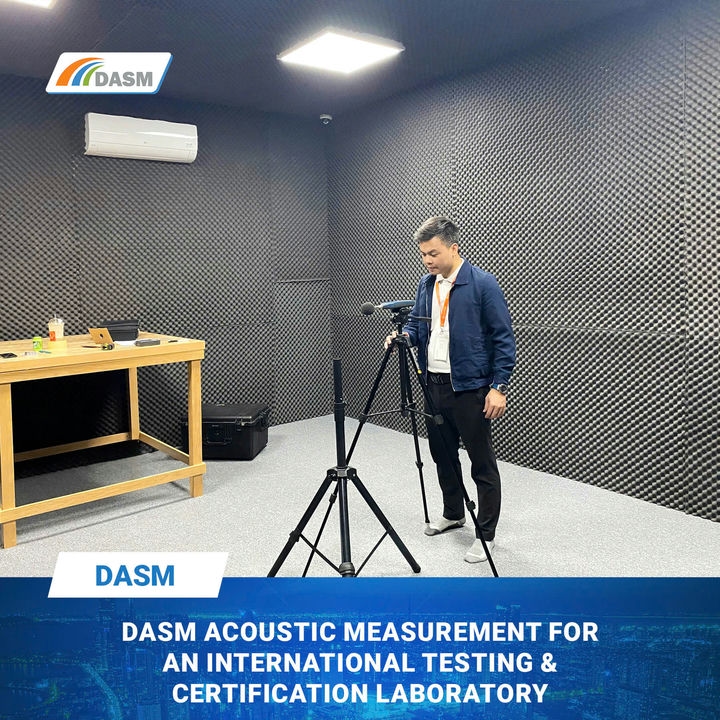
The test method for Determination of noise emitted by motor vehicles provides useful information to meet regulatory certification requirements; compare different vehicle models; check the in-cabin sound comfort experience; and proactively control noise and quality during the automotive manufacturing process...

Overview of the test procedure for Determination of noise emitted by motor vehicles
Name of the test procedure: National Standard TCVN 7880:2008 on road vehicles – Noise emitted by motor vehicles – Requirements and test methods for type approval.
Test methodology:
ISO 16254:2016: Acoustics – Measurement of sound emitted by road vehicles of category M and N at standstill and low speed operation – Engineering method [1]
Performed at: Test track site.
1. Objectives and test objects
– Test objective
The standard specifies the engineering method for measuring sound emitted by road vehicles of category M and N under standstill and low-speed operating conditions. The technical parameters reproduce the sound level generated by the main sound sources of the vehicle consistent with vehicle operating conditions at standstill and low speed related to pedestrian safety. This method is designed to meet the requirements for simplicity insofar as they are consistent with the reproducibility of results under vehicle operating conditions.
The test method requires an acoustic environment that can only be obtained in an open, spacious space. Such conditions generally exist during the following times:
- Vehicle measurements for regulatory certification;
- Measurements at the production stage;
- Measurements at official testing stations.
The results obtained by this method provide an objective measure of the sound emitted under specified test conditions. The fact must be considered that the subjective evaluation of annoyance, perceptibility and/or detectability of different motor vehicles or vehicle types due to their sound emission is not simply related to the indicators of the sound measurement system. Because annoyance, perceptibility and/or detectability are closely related to human personal perception, human physiological state, culture and environmental conditions, there are large differences and therefore, these terms are not useful as parameters to describe a specific vehicle condition.
Spot checks of randomly selected vehicles rarely occur in an ideal acoustic environment. If measurements are made on roads in acoustic environments that do not meet the requirements specified in this standard, the results obtained may deviate significantly from those obtained using the specified conditions.
– Test object
- The test vehicle shall be unladen and without a trailer or semi-trailer except in the case of vehicles which are inseparable.
- The tires used for testing shall be selected by the vehicle manufacturer and shall correspond to commercial practice and be available on the market. They shall correspond to one of the tire sizes specified for the vehicle by the vehicle manufacturer and meet a minimum tread depth of 1.6 mm in the main grooves of the tread surface. The tires shall be inflated to the pressure appropriate to the mass of the test vehicle.
- Before starting the measurements, the vehicle shall be brought into normal operating condition… etc…
- If the vehicle has more than two driven wheels, it shall be tested on the driven wheels that will be used on normal roads.
- If the vehicle is fitted with a fan having an automatic activation mechanism, this system shall not interfere during the measurement process.
- If the vehicle is fitted with an exhaust system containing fibrous materials, this system shall be conditioned before testing in accordance with Annex B.
Table of vehicle mass during testing
|
Vehicle type |
Test vehicle mass |
|
M1 |
mt = mro |
|
N1 |
mt = mro |
|
N2, N3 |
mt = 50kg/kW of engine rated power Additional loads required to reach the test mass shall be placed on the rear driven axle. The mass limit of these loads is 75% of the maximum permissible mass placed on the rear axle. The test mass shall reach the specified mass with a tolerance of ± 5%. If the center of gravity of the load is not aligned with the center of the rear axle, the test mass of the vehicle shall not exceed the total load on the front and rear axles when the vehicle is unladen plus the load. The test mass of a vehicle with more than two axles is the same as that of a vehicle with two axles. |
|
M2, M3 |
mt = mro – mass of the crew (if any) |
– Noise limits
Noise limits are stated in the table below:
|
No. |
Vehicle Type |
Noise limit value |
|
1 |
Passenger car |
74 |
|
2
|
Bus with a maximum permissible mass greater than 3500kg and having: |
|
|
– Engine power less than 150kW |
78 |
|
|
– Engine power not less than 150kW |
80 |
|
|
3
|
Buses and trucks having: |
|
|
Maximum permissible mass ≤ 2000kW |
76 |
|
|
200kg < Maximum permissible mass ≤ 3500kg |
77 |
|
|
4
|
Trucks with a maximum permissible mass greater than 3500kg and having: |
|
|
Engine power < 75kW |
77 |
|
|
75kW ≤ Engine power < 150kW |
78 |
|
|
Engine power ≥ 150kW |
80 |
- For vehicle types mentioned in item 1 and item 3 in Table 1 using compression-ignition and direct-injection engines, the noise limit shall be increased by 1dB(A);
- For vehicles designed for off-road use3) and having a maximum permissible mass greater than 2000kW, the noise limit values shall be increased as follows:
- 1 dB(A) for vehicles using engines with power less than 150kW (ECE);
- 2 dB(A) for vehicles using engines with power not less than 150kW (ECE).
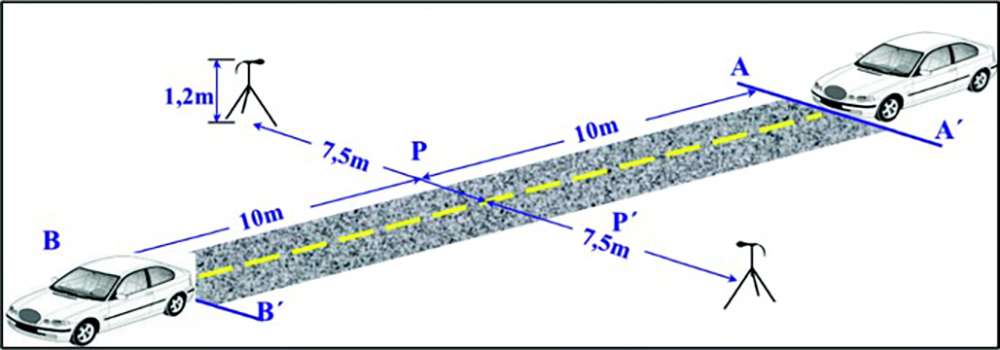
- For passenger cars mentioned in item 1, Table 1 fitted with a transmission having more than four forward gears, an engine with a maximum power greater than 140kW (ECE) and having a maximum power-to-maximum mass ratio greater than 75kW/t, the limit value shall be increased by 1 dB(A) if in third gear, the vehicle speed is greater than 61km/h when the rear of the vehicle passes the line BB’ in the figure below.
2. Experimental procedure
Steps to perform:
- Fully equipped with test vehicle locations, equipment, tools, microphones, and measurement samples.
- Perform sample measurement.
+ Measurement with the vehicle stationary
+ Measurement with the vehicle in motion
- Process and report results

Role and importance of the test for determination of vehicle noise emission
The test for determination of vehicle noise emission performed by DASM Institute provides useful information, meeting the practical needs of customers and enterprises wishing to:
- Achieve certification according to regulations.
- Compare different vehicle models.
- Check the experience of vehicle sound comfort.
- Test vehicle operating conditions while stationary and at low speeds related to pedestrian safety.
- Control noise, control quality during production, and optimize research and development of products, materials, spare parts, etc., related to vehicle noise emission.
- Have a verified basis to propose and implement solutions prioritizing components, details, products, etc., with improved engineering and technology for vehicle noise emission.
At the sameening, DASM will conduct consulting and design work to create shape/structure/material solutions to fine-tune customer test samples in a streamlined, efficient, and cost-effective manner (in case they do not meet standards).
If previously you had some concerns and worries and had to spend a lot of fees for similar activities abroad, now you just need to contact DASM. The entire remaining process will be proactively and comprehensively carried out by us in the fastest time to complete the customer experience of us: DASM provides sound consulting services with truly superior quality, the most competitive prices in the industry, along with thoughtful and dedicated customer care policies.
Significance of the acoustic testing service at DASM
Today's globalized commercial life opens up countless new markets and sources of supply across five continents. Accompanied by international regulations and standards, it helps customers easily evaluate quality – trace product origin, and select suitable/superior items. Especially, they support manufacturers to continuously improve and perfect technology, engineering, raw materials, production methods, sales methods, etc.
DASM Institute is a pioneering, comprehensive, professional, and leading prestigious brand in Vietnam in the field of acoustics. On January 12, 2023, DASM was granted certificate No. 114/TĐC – HCHQ by the Directorate for Standards, Metrology and Quality (Ministry of Science and Technology), certifying registered testing operations for multi-sector synthesis in the Mechanical-Physical field (registration number: 707/TN – TĐC).
Our acoustic testing services provide customers with practical professional results to meet sustainability, standard performance, and optimal design consulting - correction solutions for products and services. From there, you will update, meet, and adapt to constantly changing international standards to make a breakthrough in revenue, profit, and elevate your brand.
Customers in need of performing the test for determination of vehicle noise emission please contact via Hotline for detailed consultation!
VILAS 1541 · ISO/IEC 17025
Need advice on Vibration & Noise Control?
Measure, test, and consult solutions to reduce the amount of noise and vibration transmitted from the source to the surrounding environment.
Related Articles
Articles from the same category or related topics
- 3 min read
DASM Sound Absorption Testing for Noise Barriers According to ISO 354:2024 & EN ISO 11654:1997
DASM sound absorption testing for Noise Barriers in a reverberation room according to ISO 354:2024 and EN ISO 11654:1997 standards at a VILAS-certified laboratory
Read more → - 7 min read
DASM Institute surveyed the acoustics of the recording booth at the Ministry of Public Security according to ISO 3382 standard
DASM Institute conducted an acoustic survey and noise testing in the recording booth at the Ministry of Public Security, including SNR measurement and acoustic characteristic evaluation according to ISO 3382 standard.
Read more → - 3 min read
Advanced Acoustic Measurement & Noise Emission Testing for International Testing & Certification Laboratories
DASM provides advanced acoustic measurement and noise emission testing services for Testing & Certification laboratories, ISO-compliant procedures
Read more →