Test method for Determination of noise from military small arms and heavy weapons
Test method Determination of noise from military shooting with the purpose of using the results as input data for sound propagation programs; allowing the prediction of shooting noise in the vicinity of shooting ranges; comparing the sound emitted from different types of weapons/ammunition used for the same type of weapon…
Overview of the test method Determination of noise from military shooting
Test method name: Determination of noise from military shooting
Test method:
ISO 17201-1:2005: Acoustics – Noise from shooting ranges – Part 1: Determination of muzzle blast by measurement [1].
Performed at: Field.
Objectives & test subjects
1.1. Test objective
Determine the noise generated by military shooting.
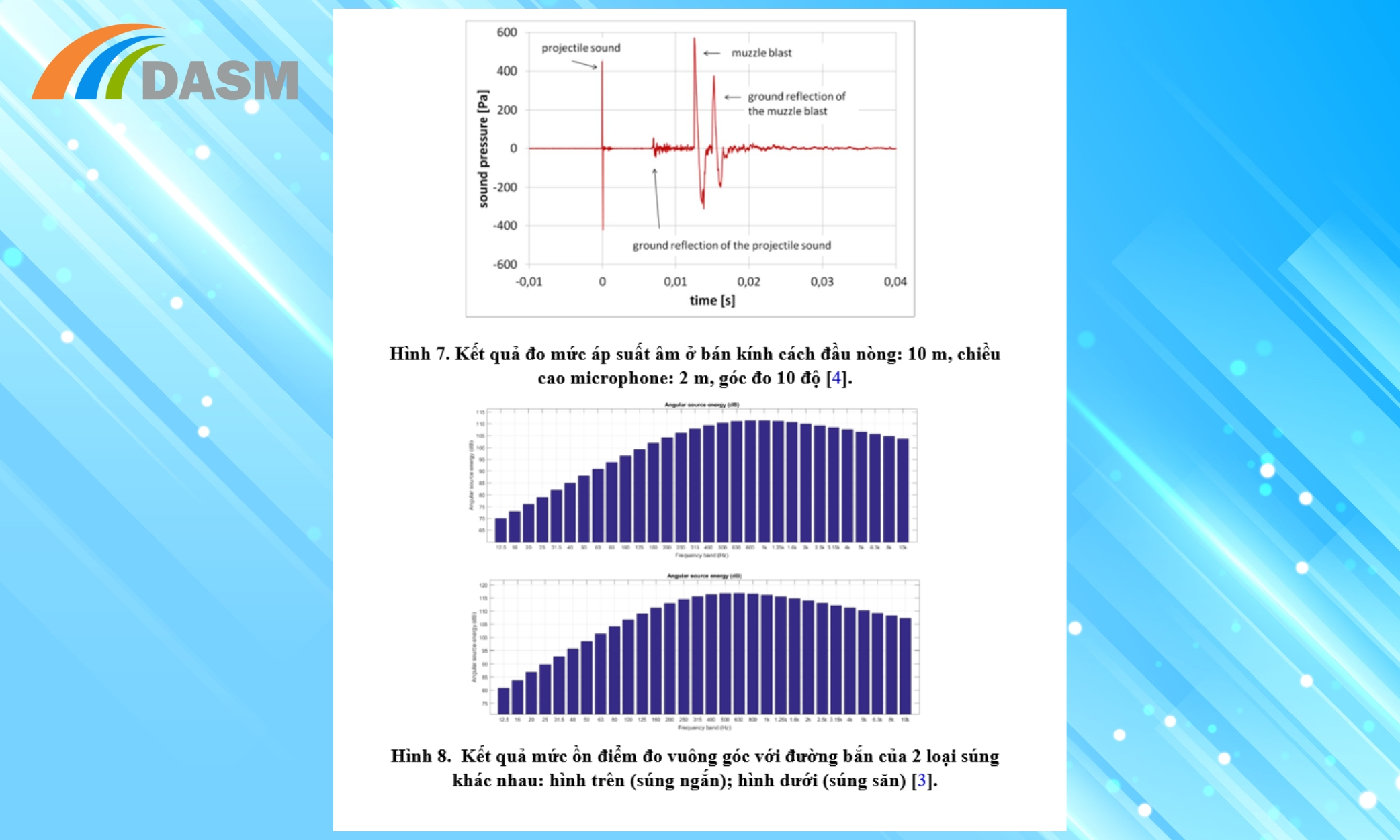
Source energy, source directivity, and their spectral structure determined by this test procedure can be used as input data for sound propagation programs, allowing the prediction of shooting noise in the vicinity of shooting ranges. In addition, the data can be used to compare the sound emitted from different types of weapons or different types of ammunition used for the same type of weapon.
ISO 17201-1:2005 applies to weapons used in civilian shooting ranges but can also be applied to military weapons. It does not apply to the assessment of hearing damage or sound levels in the non-linear region.
1.2. Subject
– Military shooting noise caused by bullets or explosives.
– ISO 17201-1:2005 is used to determine the muzzle blast of weapons with a caliber of less than 20mm, equivalent explosion of TNT explosive blocks of less than 50g.
– Applied at distances where the peak pressure is observed to be less than 1kPa (equivalent to a peak sound pressure level of 154dB).
Figure 1. Images of some types of weapons [2].
Test procedure
+ Field setup for muzzle blast measurement according to ISO 17201
+ Processing and reporting results

Detailed test conditions
3.1. Test equipment and environment
+ This is a field experiment, the tools and equipment used include:
– Microphone
– Signal converter
– Computer for data acquisition and processing
+ Place the microphone at the standard position
3.2. Some notes on test conditions
+ Shooting range conditions:
The measurement location must be flat, uniform in terms of ground impedance, and free of objects that can cause reflections affecting the accuracy of the measurement. Examples of uniform substrates are: concrete, water, asphalt, grass, or sand.
+ Climate:
The average wind speed at a height of 10m should be less than 3m/s. The relative humidity must be less than 95%. The background level of wind-generated sound at the microphone must not be so large as to interfere with the measured signal at any frequency of interest.
Role – importance of the test method Determination of noise from military shooting
The test method Determination of noise from military shooting performed by the Institute of Acoustics and Sound Materials Development provides useful information, meeting all practical needs of customers, businesses, agencies, and organizations wishing to:
- Determine the noise generated by military shooting.
- Use the results as input data for sound propagation programs, allowing the prediction of shooting noise in the vicinity of shooting ranges.
- Compare the sound emitted from different types of weapons or different types of ammunition used for the same type of weapon.
If previously you still had some worries and concerns and had to spend a lot of fees for similar activities abroad, now you just need to contact DASM. The entire remaining process will be proactively implemented by us as a package in the fastest time to complete the customer experience about us: DASM provides acoustic consulting services with truly outstanding quality, prices considered the most competitive in the industry along with thoughtful and dedicated customer care policies.
The significance of acoustic material testing services at DASM
Today's globalized commercial life opens up countless new markets and supply sources across five continents. Accompanied by international regulations and standards that help customers easily evaluate quality – trace product origin, choose suitable/outstanding items. In particular, they support manufacturers to constantly innovate and improve in technology, techniques, raw materials, production methods, sales, etc.
The Institute of Acoustics and Sound Materials Development (DASM) is a pioneering, comprehensive, professional, and leading prestigious brand in Vietnam in the field of acoustics. On January 12, 2023, DASM was granted certificate No. 114/TĐC – HCHQ by the Directorate for Standards, Metrology and Quality (Ministry of Science and Technology), certifying that it has registered testing activities for a multi-industry combination in the Mechanical-Physical field (registration number: 707/TN – TĐC).
Our acoustic testing service portfolio provides customers with practical professional results to meet sustainability, standard performance, optimal solutions – consulting – design adjustments for products and services. From there, you will update, meet, and adapt to constantly changing international standards to make a breakthrough in revenue, profit, and elevate your brand.
If you have a need to perform the test method Determination of noise from military shooting please contact via Hotline for detailed advice!
VILAS 1541 · ISO/IEC 17025
Need advice on Vibration & Noise Control?
Measure, test, and consult solutions to reduce the amount of noise and vibration transmitted from the source to the surrounding environment.
Related Articles
Articles from the same category or related topics
- 3 min read
DASM Sound Absorption Testing for Noise Barriers According to ISO 354:2024 & EN ISO 11654:1997
DASM sound absorption testing for Noise Barriers in a reverberation room according to ISO 354:2024 and EN ISO 11654:1997 standards at a VILAS-certified laboratory
Read more → - 7 min read
DASM Institute surveyed the acoustics of the recording booth at the Ministry of Public Security according to ISO 3382 standard
DASM Institute conducted an acoustic survey and noise testing in the recording booth at the Ministry of Public Security, including SNR measurement and acoustic characteristic evaluation according to ISO 3382 standard.
Read more → - 3 min read
Advanced Acoustic Measurement & Noise Emission Testing for International Testing & Certification Laboratories
DASM provides advanced acoustic measurement and noise emission testing services for Testing & Certification laboratories, ISO-compliant procedures
Read more →