The test method for Determination of vibrations and their effects on structures aims to proactively control, monitor, and report the effects of vibrations; to warn about the overall condition of building structures; and to serve as a basis for new design parameters ensuring that building structures can withstand the applied loads...


Overview of the test method content: Determination of vibrations and their effects on structures
Test method name: Mechanical vibration and shock – Vibration of structures – Guidelines for the measurement of vibrations and evaluation of their effects on structures.
Test method:
TCVN 7191:2002: Mechanical vibration and shock – Vibration of structures – Guidelines for the measurement of vibrations and evaluation of their effects on structures [1].
ISO 4866:2010: Mechanical vibration and shock Vibration of fixed structures – Guidelines for the measurement of vibrations and evaluation of their effects on structures [2].
Performed at: Field area.
1. Objectives and test subjects
– Test objectives
To measure vibrations and evaluate their effects on structures (see also Test method 43 regarding vibrations caused by road traffic).
– Test subjects
The vibration source (traffic, geological shocks, or blast waves, see Table 1, page 11 of TCVN 7191 [1]) or the subject subjected to vibration (building structures).
According to TCVN 7191, the purposes of using the test include:
- To identify annoyance
When reports are received that structures are vibrating at levels causing anxiety to residents, it may or may not be necessary to establish a vibration warning level regarding the overall structural integrity of the building.
- To monitor and control
When maximum permissible vibration levels have been established by competent authorities and these vibrations must be measured and reported.
- To document
When dynamic loads are recognized in design and measurements are carried out to verify response predictions and provide new design parameters. This can utilize ambient or applied loads. Highly sensitive seismographs are an example, which can be installed so that they indicate whether responses to earthquakes warn of upcoming changes in the operational process of the building structure.
- To diagnose
When it is determined that vibration levels require further investigation, vibration measurements are conducted to provide information for methods to mitigate structural vibrations.


Image of vibrations caused by pile driving for the construction of CT4 apartment building, causing wall cracks in several households in group 17, Yen Nghia ward, Ha Dong district, Hanoi. Photo taken in March 2023. Source: Tuoi Tre Online Newspaper
2. Experimental procedure
Execution steps:
- Fully equip with devices, transducers, and test samples.
- Perform sample measurement.
- Process and report results.

3. Notes
- Each type of structure has different vibration characteristics, so the number of measurement points depends on the size and complexity of the building.
- Measurement locations should preferably be chosen at the building foundation; otherwise, select measurement points on the main load-bearing exterior walls at ground floor slab height.
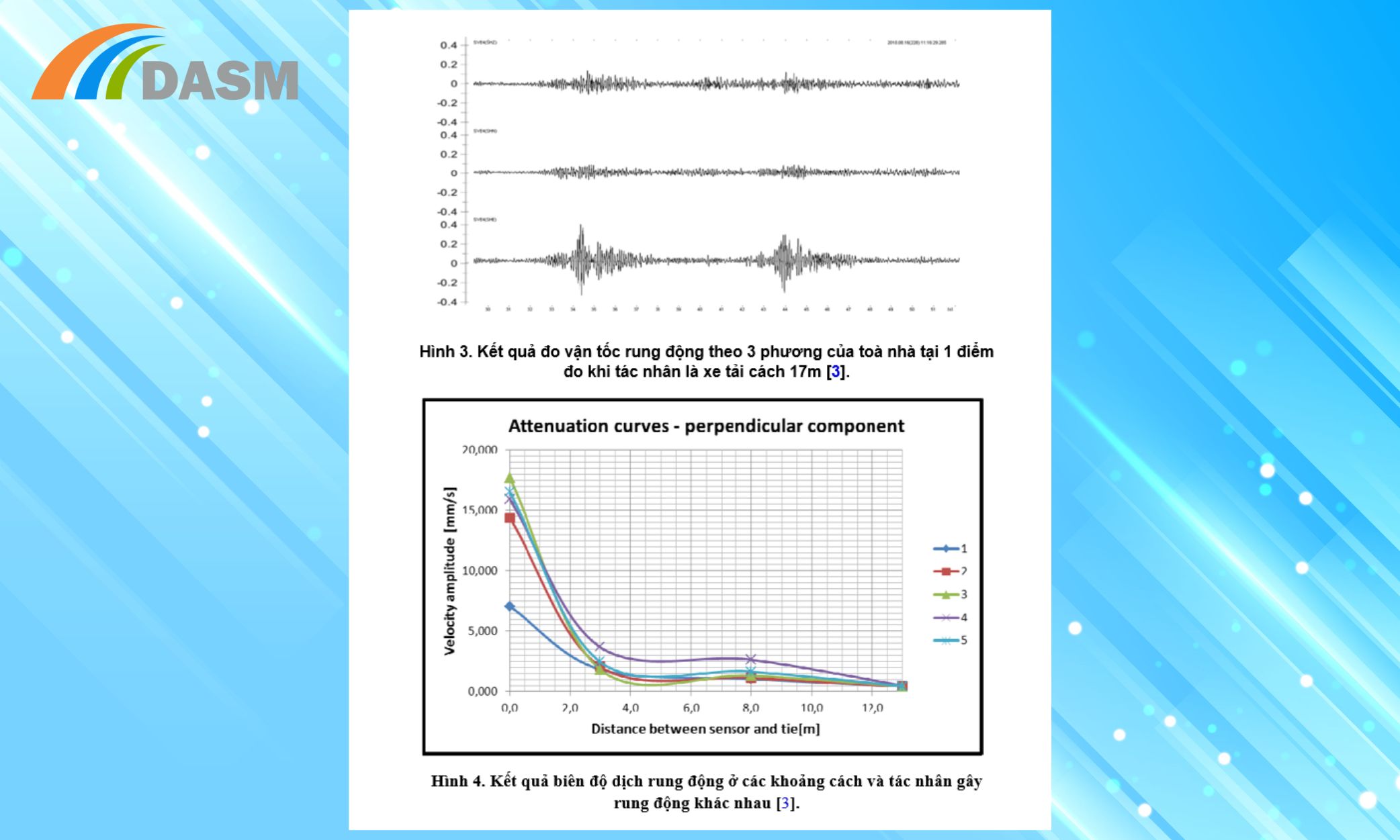
- For vibrations caused by traffic, pile drivers, or special blast loads at long distances, vibrations can be amplified inside the building and are proportional to the building height. Therefore, it is necessary to measure several points simultaneously within the structure. Simultaneous measurements on the foundation and the ground outside the building should be made to establish the transfer function.
- For buildings higher than 4 floors (~12m), measurements must also be taken at intermediate floors and the topmost floor of the building.
- For buildings with a length >10m, measurement points must be placed horizontally, spaced 10m apart.
- Note that measuring vibrations above or below ground level may be affected by the amplitude of surface waves with depth. Building foundations may be subject to different movements depending on wavelength, foundation depth, and geological conditions.
- For wind-induced vibrations, the vertical component can be neglected, and testing equipment should be arranged to check for rotational and translational oscillations.
Role – Importance of the test method for Determination of vibrations and their effects on structures
The test method for Determination of vibrations and their effects on structures conducted by the Institute of Acoustic Materials Development and Application helps provide useful information, meeting the practical needs of customers and businesses wishing to:
- Proactively control and monitor vibrations.
- Report the effects of vibrations.
- Provide warnings regarding the overall structural integrity.
- Use as a basis for new design parameters ensuring the building structure can withstand applied loads.
- Serve as a basis for proposing safety measures and methods to mitigate vibrations and their effects on structures.
- Support legal dispute issues, lawsuits, forensic appraisal requests, sample measurement, and analysis in cases where vibration violations exceed technical standards or cause negative impacts.
Additionally, DASM will carry out consulting and design work to create innovative solutions regarding shape, form, structure, and materials used to adjust anti-vibration and damping functions; minimizing the effects of vibrations from traffic, geological shocks, or blast waves on building structures.
If previously you had lingering concerns, worries, and had to spend significant fees on similar activities abroad, now you only need to contact DASM. The entire remaining process will be proactively executed by us as a complete package in the shortest time to perfect your customer experience with us: DASM provides acoustic consulting services with truly superior quality, pricing considered the most competitive in the industry, along with thoughtful and dedicated customer care policies.
Significance of acoustic testing services at DASM
Today's globalized commercial life opens up countless new markets and supply sources across five continents. Along with it are international regulations and standards that help customers easily evaluate quality – trace product origin, and select suitable/superior items. In particular, they also support manufacturers in continuously improving and perfecting technology, techniques, raw materials, production methods, sales, etc.
The DASM Institute is a pioneering, comprehensive, professional, and leading prestigious brand in Vietnam in the field of acoustics. On January 12, 2023, DASM was granted certificate No. 114/TĐC – HCHQ by the Directorate for Standards, Metrology and Quality (Ministry of Science and Technology), certifying the registration of testing activities for multi-sector synthesis in the field of Mechanics (registration number: 707/TN – TĐC).
Our acoustic testing services provide customers with practical professional results to meet sustainability, standard performance, optimal solutions – consulting – design calibration… for products and services. From there, you will update, meet, and adapt to constantly changing international standards to achieve breakthroughs in revenue, profit, and elevate your brand.
If you have a need to perform Testing method Determination of vibration and their effects on construction works please contact us via Hotline for detailed consultation!
VILAS 1541 · ISO/IEC 17025
Need acoustic engineering advice?
Get in touch with DASM specialists for on-site surveys, VILAS 1541 testing, and optimized solutions for your facility.
Related Articles
Articles from the same category or related topics
- 3 min read
DASM Sound Absorption Testing for Noise Barriers According to ISO 354:2024 & EN ISO 11654:1997
DASM sound absorption testing for Noise Barriers in a reverberation room according to ISO 354:2024 and EN ISO 11654:1997 standards at a VILAS-certified laboratory
Read more → - 7 min read
DASM Institute surveyed the acoustics of the recording booth at the Ministry of Public Security according to ISO 3382 standard
DASM Institute conducted an acoustic survey and noise testing in the recording booth at the Ministry of Public Security, including SNR measurement and acoustic characteristic evaluation according to ISO 3382 standard.
Read more → - 3 min read
Advanced Acoustic Measurement & Noise Emission Testing for International Testing & Certification Laboratories
DASM provides advanced acoustic measurement and noise emission testing services for Testing & Certification laboratories, ISO-compliant procedures
Read more →