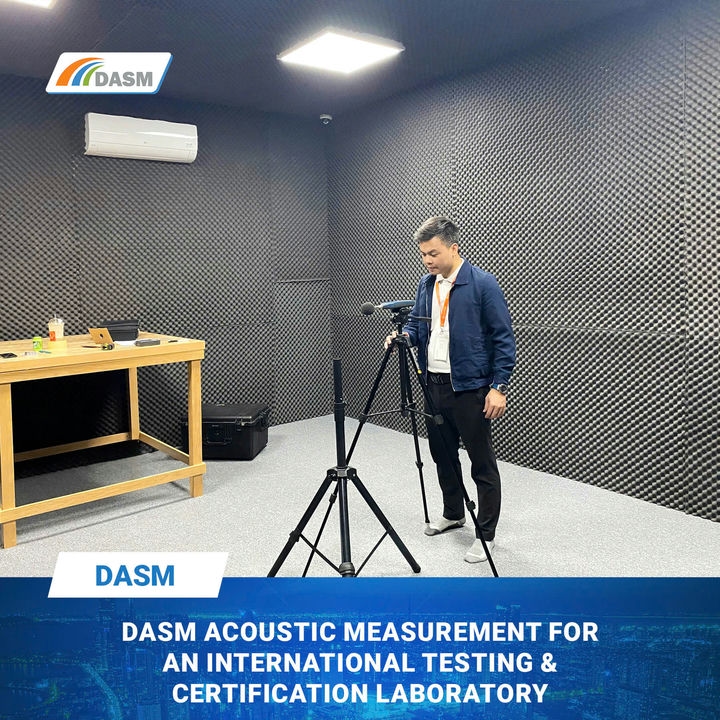
Material vibration energy dissipation properties determination testing method – Poisson's ratio helps control vibration, control quality during the production process, and optimize the research and development of damping materials.

Overview of Material vibration energy dissipation properties determination testing method – Poisson's ratio
Test name: Standard test method for determining vibration damping properties of materials – Poisson's ratio
Test method: ASTM E756 – 05 Standard Test Method for Measuring Vibration – Damping Properties of Materials [1].
Performed at: Laboratory, DASM Institute of Applied Acoustics.
1. Objectives and test objects
– Objective
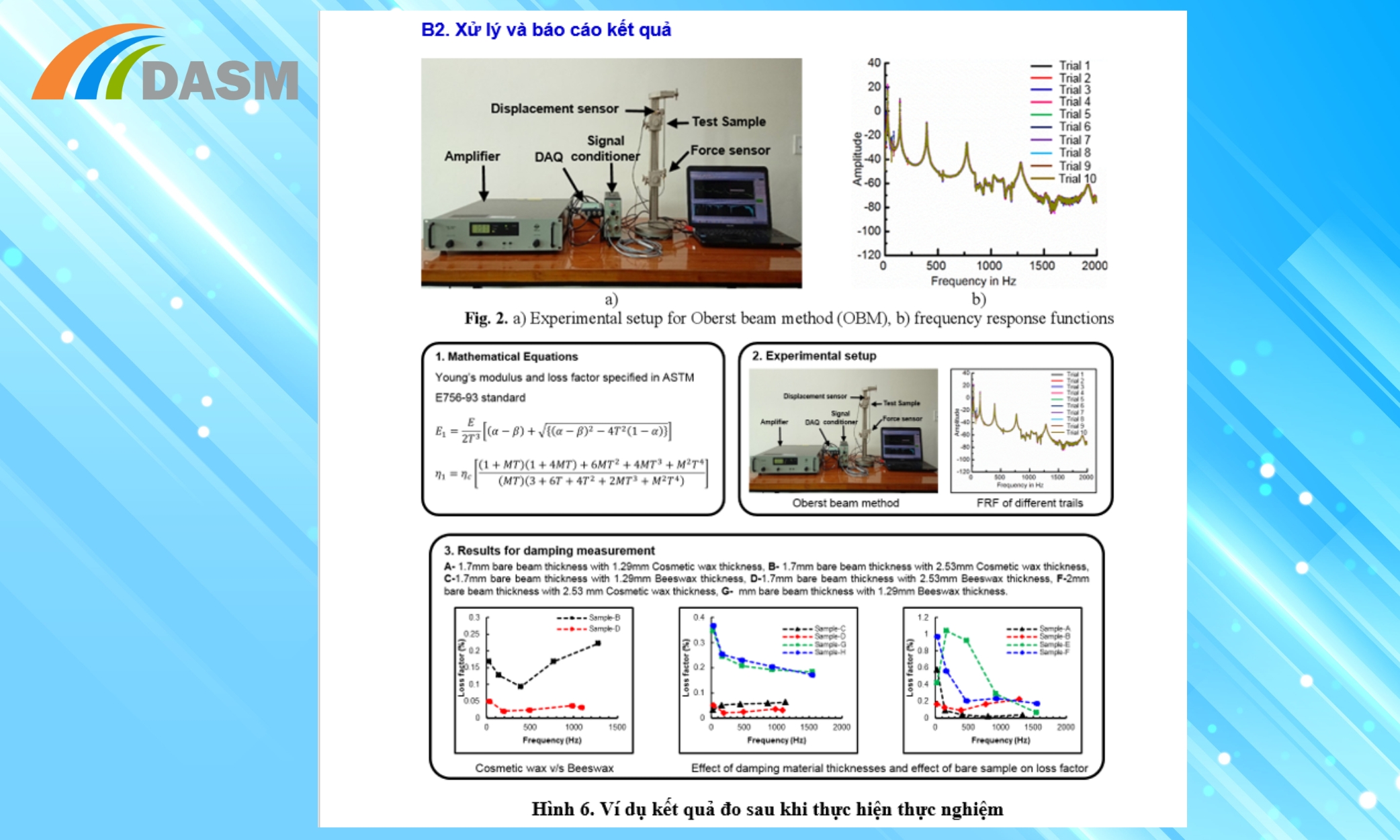
This test method measures the vibration-damping characteristics of materials: loss factor (η) and Young's modulus (E) or shear modulus (G). Accurate over a frequency range of 50 to 5000Hz and over the useful temperature range of the material, this method is useful in evaluating materials with applications in structural vibration, building acoustics, and audible noise control.
This standard does not purport to address all of the safety concerns, if any, associated with its use. It is the responsibility of the user of this standard to establish appropriate safety and health practices and determine the applicability of regulatory limitations prior to use.
– Object:
Materials with applications in structural vibration, building acoustics, and audible noise control such as metals, enamels, ceramics, rubbers, plastics, fiber-reinforced epoxy matrices, and woods can be formed to test cantilever beam specimen configurations.
2. Experimental procedure
The experimental procedure uses an impedance tube.
Steps to perform:
- Prepare all necessary equipment and measurement samples.
- Perform sample measurement.
- Process and report results.

3. Notes
Measurement samples include 3 types:
- Self-supporting damping materials are evaluated by forming a single, homogeneous test beam from the damping material itself.
- Non-self-supporting damping materials are evaluated for their extended damping characteristics in a two-step procedure.
- Measure the shear damping properties of non-self-supporting damping materials.
Role – Importance of Material vibration energy dissipation properties determination testing method – Poisson's ratio
Material vibration energy dissipation properties determination testing method – Poisson's ratio performed by DASM Institute helps meet various practical needs such as:
- Customers wishing to control vibration and noise.
- Businesses needing quality control during production, optimizing the research and development of damping materials.
- Users having a basis for comparison, calculation, and design of effective anti-vibration materials, machinery, products, and structures.
- Controlling equipment status, early detection of signs and causes of damage… to proactively maintain machinery.
- Customers needing test certificates and results to increase competitiveness and sales, or to install, use, and construct materials and products in projects smoothly, transparently, and compliantly.
In addition, if the test sample does not meet standards, DASM will provide consulting and design services for shapes, structures, and materials to adjust the design efficiently and cost-effectively.
Previously, if you had concerns and worries and had to pay many fees for similar activities abroad, now you just need to contact DASM. The entire remaining process will be proactively implemented by us as a complete package in the shortest time to complete your customer experience with us: DASM provides acoustic consulting services with truly superior quality, highly competitive prices in the industry, and attentive, dedicated customer care policies.
Significance of acoustic material testing services at DASM
Today's globalized commercial life opens up countless new markets and sources of supply across five continents. Accompanied by international regulations and standards, it helps customers easily evaluate quality – trace product origin, and select suitable/superior items. In particular, they also support manufacturers in continuously improving and perfecting technology, techniques, raw materials, production methods, sales, etc.
DASM Institute of Applied Acoustics is a pioneering, comprehensive, professional, and leading prestigious brand in Vietnam in the field of acoustics. On January 12, 2023, DASM was granted certificate No. 114/TĐC – HCHQ by the Directorate for Standards, Metrology and Quality (Ministry of Science and Technology), certifying registered multi-sector testing operations in the field of Mechanics – Physics (registration number: 707/TN – TĐC).
Our acoustic material testing services provide customers with practical professional results to meet sustainability, standard performance, and optimal design consulting – adjustment solutions for products and services. From there, you will update, meet, and adapt to constantly changing international standards to achieve breakthroughs in revenue, profit, and elevate your brand.
At the same time, they also promote the optimization of production processes and rapid, cost-effective product marketing; contributing to improving value, expanding markets, and spreading the advantages of the enterprise's products and services in Vietnam, the region, and internationally.
If you have a need to perform Material vibration energy dissipation properties determination testing method – Poisson's ratio please contact via Hotline for detailed consultation!
VILAS 1541 · ISO/IEC 17025
Need advice on Materials Acoustic Testing?
Services of testing, measuring and analyzing acoustic properties of equipment, products, vehicles, acoustic materials, etc.
Related Articles
Articles from the same category or related topics
- 3 min read
DASM Sound Absorption Testing for Noise Barriers According to ISO 354:2024 & EN ISO 11654:1997
DASM sound absorption testing for Noise Barriers in a reverberation room according to ISO 354:2024 and EN ISO 11654:1997 standards at a VILAS-certified laboratory
Read more → - 7 min read
DASM Institute surveyed the acoustics of the recording booth at the Ministry of Public Security according to ISO 3382 standard
DASM Institute conducted an acoustic survey and noise testing in the recording booth at the Ministry of Public Security, including SNR measurement and acoustic characteristic evaluation according to ISO 3382 standard.
Read more → - 3 min read
Advanced Acoustic Measurement & Noise Emission Testing for International Testing & Certification Laboratories
DASM provides advanced acoustic measurement and noise emission testing services for Testing & Certification laboratories, ISO-compliant procedures
Read more →