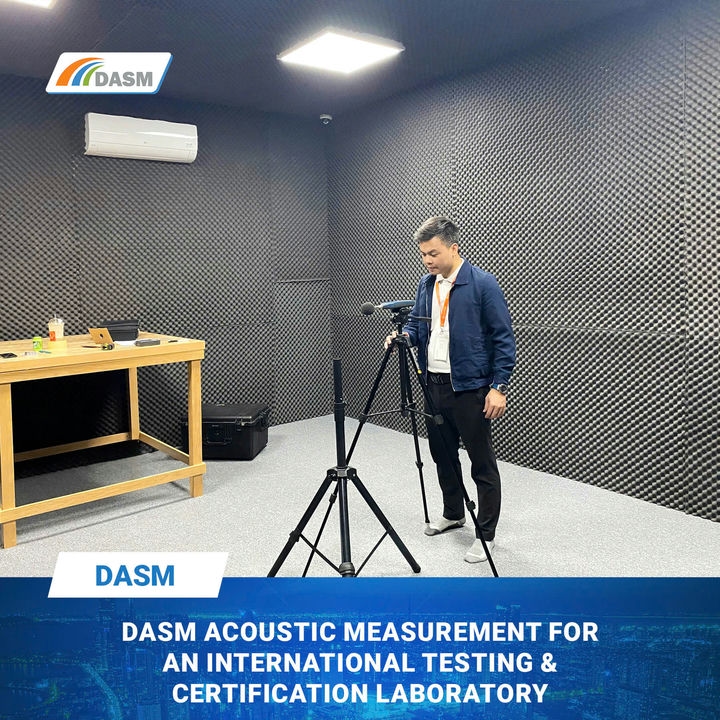
The material testing for the determination of sound pressure level of service equipment in buildings helps to actively control noise and sound; toptimize research and development; and control quality during product manufacturing.
Overview of the determination of sound pressure level of service equipment in buildings
Test name: Acoustics – Measurement of sound pressure level from service equipment in buildings – Engineering method [1].
Test method:
ISO 16032:2004: Acoustics – Measurement of sound pressure level from service equipment in buildings – Engineering method [1].
Performed at: On-site

1. Objectives and test objects
– Test objectives
This standard specifies methods for measuring sound pressure levels from service equipment in buildings installed in building structures. This standard covers measurements characteristic of equipment using sanitary installations, mechanical ventilation, heating and cooling systems, lifts, rubbish chutes, boilers, blowers, pumps, and other auxiliary equipment, and motor-driven car park doors, but can also be applied to other equipment attached to or installed in buildings. The method is suitable for rooms with volumes of approximately 300m3 or less, such as dwellings, hotels, schools, offices, and hospitals.
This standard is not intended for measurements in auditoriums and large concert halls. However, operating conditions and operating cycles given in Annex B may be used in such cases. The sound pressure level of service equipment in buildings is determined as the maximum A-weighted sound pressure level and optional C-weighted sound pressure level occurring during the specified operating cycle of the service equipment in buildings under test, or as the equivalent continuous sound pressure level determined with a specified integration time. A-weighted and C-weighted values are calculated from octave band measurements.
– Test objects
- Equipment using sanitary installations, mechanical ventilation, heating and cooling systems, lifts, rubbish chutes, boilers, blowers, pumps.
- Other auxiliary equipment.
- Motor-driven car park doors.
- Other equipment attached to or installed in buildings.
– Test method
The sound pressure level of service equipment in buildings is measured in octave bands with frequency ranges from 31.5 Hz/63 Hz to 8000 Hz considered as line spectrum (unweighted), corresponding to the maximum A-weighted sound pressure level and maximum C-weighted sound pressure level occurring during the specified operating cycle of the service equipment in buildings under test. To measure the sound pressure level of service equipment in buildings, recording the A-weighted or C-weighted sound pressure level and octave band sound pressure levels is carried out simultaneously (multi-spectrum recording). To estimate the sound pressure level of the equipment, take the octave band spectrum at the time of occurrence of the A-weighted or C-weighted sound pressure level. Use time weightings slow "S" and fast "F".
Equivalent continuous sound pressure levels with a specified integration time may also be used. The octave band results are corrected for background noise level and, if required, normalized to a reverberation time (RT60) of 0.5 s or normalized to an equivalent sound absorption area of 10m2. Finally, the A-weighted and C-weighted sound pressure levels are calculated from the correction of the octave band results. A-weighted and C-weighted values must always be calculated from octave band results, as well as in cases where normalization is not carried out. Table 1 gives single-number quantities determined according to this standard (calculated from octave band values defined in 3.6.1 to 3.6.9). Use the symbols in the table to report test results. Different quantities may be combined according to, for example, requirements in national building regulations.
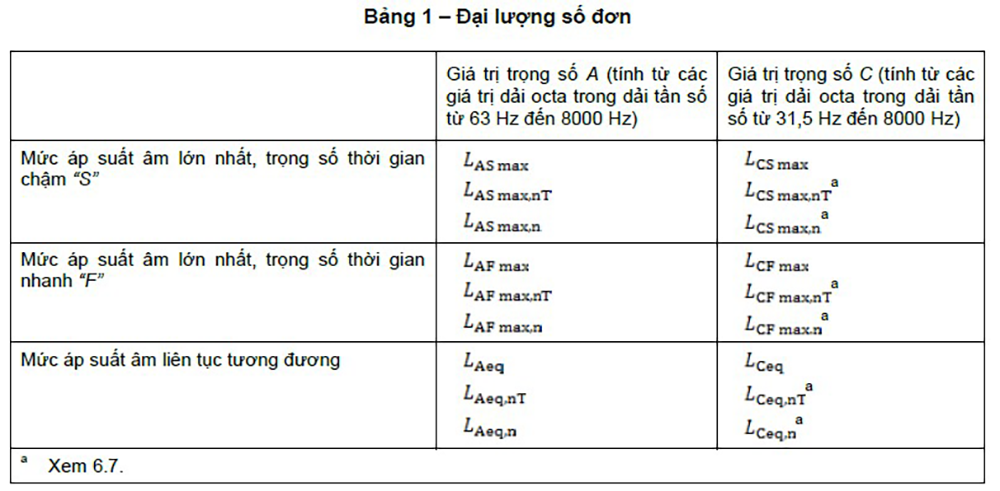
The various single-number quantities given in Table 1 are not comparable. Only test results obtained by applying the same method are comparable. When comparing test results with legal requirements, it must be ensured that both follow the same quantity. If the sound contains clearly audible tonal components, this must be stated in the report. Windows and doors must be closed during measurements. The person performing the tests must be outside the room.
2. Experimental procedure
Steps to perform:
- Preparation, arrangement of equipment, microphones, objects for testing.
- Determine microphone placement locations.
- Perform testing.
- Processing and reporting results.
Role – importance of the determination of sound pressure level of service equipment in buildings
The material testing for the determination of sound pressure level of service equipment in buildings performed by DASM helps meet the practical needs of customers, manufacturing enterprises, and research and development (R&D) desiring to:
- Actively control noise and sound.
- Compare and classify the acoustic characteristics of service equipment in buildings.
- Help design building products requiring certain sound insulation and sound absorption characteristics.
- Control quality during the manufacturing process.
- Optimize research and development.
- Provide certificates and test results to enhance competitiveness and sales, or to bring equipment into installation and construction in buildings, structures, and projects conveniently, transparently, and compliantly.
In addition, in case the sample does not meet standards, DASM will provide consulting and design services for shapes, structures, and materials to adjust the design efficiently, compactly, and cost-effectively.
If previously you still had some worries and concerns and had to spend a lot of fees for similar activities abroad, now you just need to contact DASM. The entire remaining process will be proactively implemented by us as a full package in the fastest time to complete the customer experience of us: DASM provides sound consulting services with truly superior quality, the price is considered the most competitive in the industry along with thoughtful and dedicated customer care policies.
The significance of material testing services at DASM
Today's globalized commercial life opens up countless new markets and supply sources across five continents. Accompanied by it are international regulations and standards that help customers easily evaluate quality – trace product origin, and select suitable/superior items. Especially, they also support manufacturers to continuously improve and perfect technology, techniques, raw materials, production methods, sales… etc…
The Institute of Acoustics Science and Materials (DASM) is a pioneering, comprehensive, professional, and leading prestigious brand in Vietnam in the field of acoustics. On January 12, 2023, DASM was granted the certificate No. 114/TĐC – HCHQ by the Directorate for Standards, Metrology and Quality (Ministry of Science and Technology), certifying that it has registered testing operations for multi-sector synthesis in the Mechanical and Physical field (registration number: 707/TN – TĐC).
Our acoustic testing service provides customers with practical professional results to meet sustainability, standard performance, optimal solutions – consulting – design calibration… for products and services. From there, you will update, meet, and adapt to constantly changing international standards to break through in revenue, profit, and elevate your brand.
At the same time, they also have the meaning of promoting the optimization of the production process – fast and economical product marketing; contributing to improving value, expanding the market, and spreading the advantages of the enterprise's products – services in Vietnam, the region, as well as internationally.
Customers who need to perform material testing: Determine the sound pressure level of equipment used in buildings please contact via Hotline for detailed consultation!
VILAS 1541 · ISO/IEC 17025
Need advice on SOUND DESIGN & SIMULATION SERVICES?
Acoustical design services, sound simulation using software for projects specializing in acoustics
Related Articles
Articles from the same category or related topics
- 3 min read
DASM Sound Absorption Testing for Noise Barriers According to ISO 354:2024 & EN ISO 11654:1997
DASM sound absorption testing for Noise Barriers in a reverberation room according to ISO 354:2024 and EN ISO 11654:1997 standards at a VILAS-certified laboratory
Read more → - 7 min read
DASM Institute surveyed the acoustics of the recording booth at the Ministry of Public Security according to ISO 3382 standard
DASM Institute conducted an acoustic survey and noise testing in the recording booth at the Ministry of Public Security, including SNR measurement and acoustic characteristic evaluation according to ISO 3382 standard.
Read more → - 3 min read
Advanced Acoustic Measurement & Noise Emission Testing for International Testing & Certification Laboratories
DASM provides advanced acoustic measurement and noise emission testing services for Testing & Certification laboratories, ISO-compliant procedures
Read more →