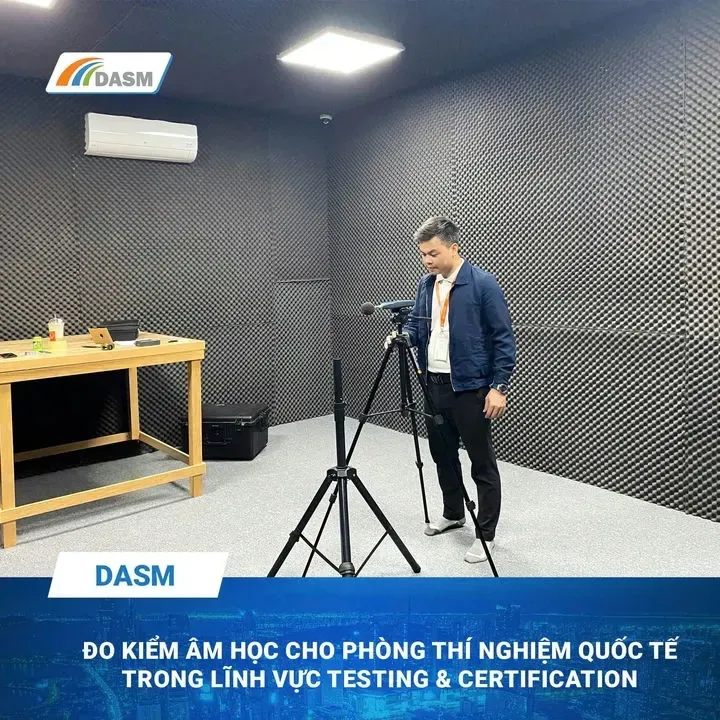
Sound is not only a medium for transmitting information but also directly affects the quality of spatial experience. In architectural design, construction, or material manufacturing, sound control plays an important role in ensuring an optimal acoustic environment. One of the key factors is sound absorption capacity – also known as the acoustic absorption of materials.
This article will help you clearly understand: what sound absorption is, its operating principles, sound absorption coefficient (α), common measurement methods such as the Kundt tube (ISO 10534-2) and reverberation room (ISO 354), as well as the practical application of sound-absorbing materials. At the same time, it introduces you to DASM – a leading unit in acoustic testing and measurement in Vietnam – providing services material testing accurate sound absorption coefficients, meeting international standards, and satisfying all customer needs.
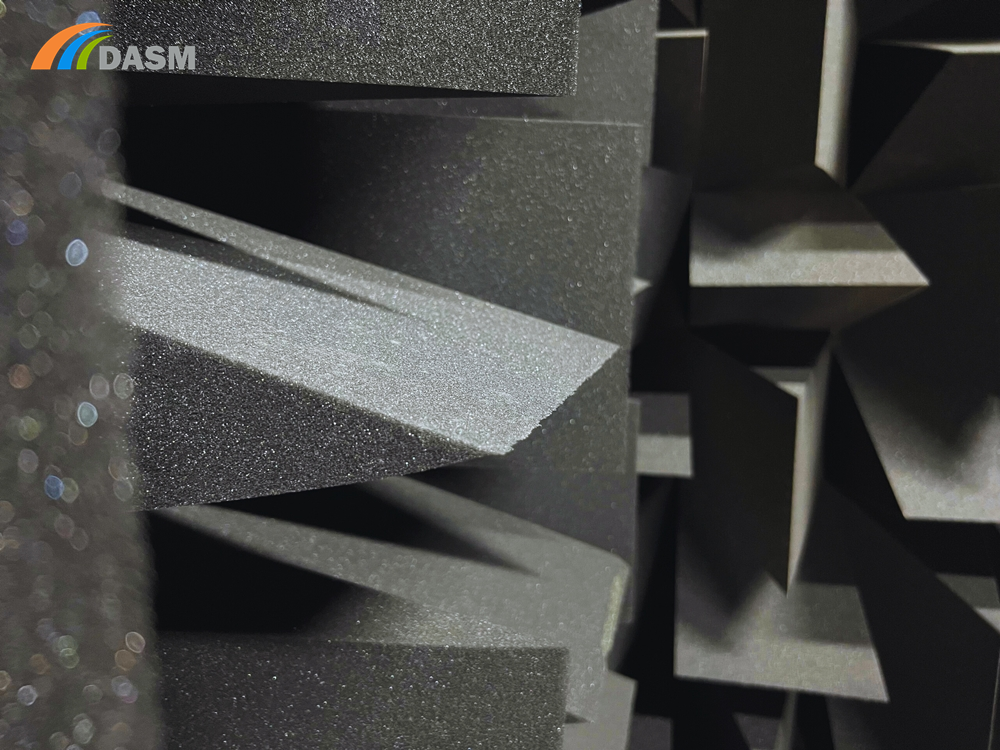
What is sound absorption?
Sound absorption, also known as acoustic absorption, is the process by which materials, structures, or objects absorb energy when encountering sound waves, as opposed to sound reflection.
When sound waves hit the surface of a material: a part is reflected; a part is transmitted through, and the remaining part is absorbed by the material itself.
Part of the absorbed energy is converted into heat and part is transmitted through the absorbing object. Energy converted to heat is considered to be "lost". (e.g., springs, dampers, etc.)
Sound absorption formula
The ratio between absorbed sound energy (E) and incident sound energy (Eo) is called the sound absorption coefficient (α). This ratio is the main index used to evaluate the sound absorption capacity of a material. A formula can be used to prove this.
α (sound absorption coefficient) = E (absorbed sound energy) / Eo (incident sound energy)
In this formula: α is the sound absorption coefficient;
+ E is the absorbed sound energy (including the transmitted part);
+ Eo is the incident sound energy.
Generally, the sound absorption coefficient of materials ranges from 0 to 1. The larger this index, the better the sound absorption capacity. The sound absorption coefficient of suspended panel sound-absorbing materials can be greater than 1 because its effective sound absorption area is larger than the calculated area.
Example: If a wall absorbs 63% of incident energy and 37% of reflected energy, the wall's absorption coefficient is 0.63.
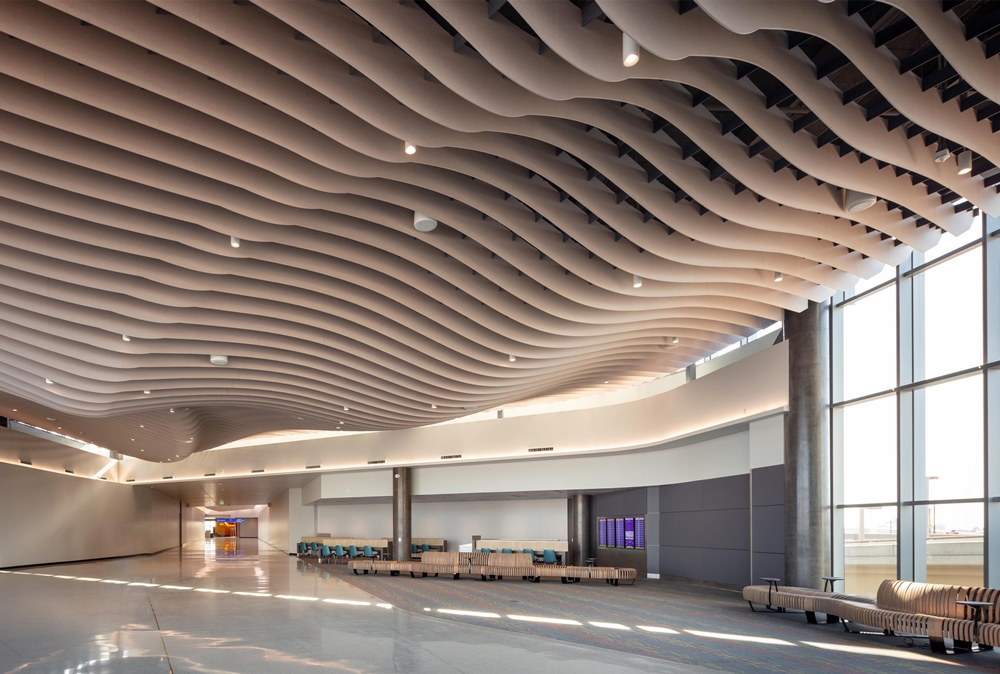
How to measure the sound absorption coefficient?
The absorption coefficient and impedance are determined by two different methods depending on the type of incident wave field.
+ Kundt tube (ISO 10534-2)
+ Reverberation room (ISO 354)
Kundt tube measurement method: (ISO 10543-2)
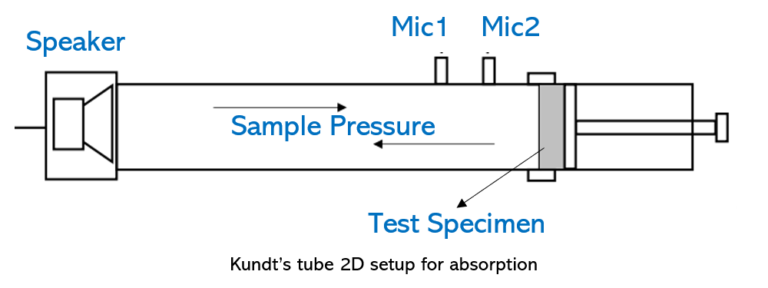
To measure small specimens, use a Kundt tube or impedance tube, also known as a standing wave tube. The results of measuring the sound absorption coefficient and acoustic impedance using the standing wave method clearly only make sense when assuming they are independent of the specimen's size, which is usually quite small. The absorption coefficient for normal incidence is determined by measuring the maximum and minimum pressure amplitudes in the standing wave generated by the loudspeaker in the tube.
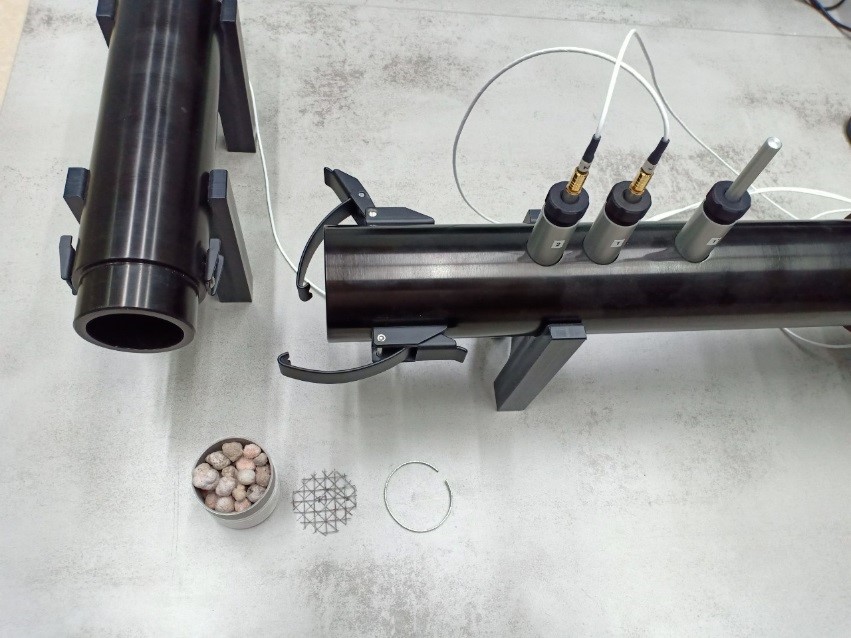
This basic technique, as mentioned in the introduction, is considered somewhat obsolete compared to more modern propagation-based methods, implemented relatively late (in 1993) in the international standard ISO 10534-1, after having been used for at least 50 years. Commercial equipment has also been available for decades.
ISO 10534-2, based on the use of broadband signals and the measurement of the pressure transfer function between different positions in the tube. ISO 10543-2 implies that the specified two-microphone method is extended to a spherical wave field.
Typically, the Placid impedance tube is used to measure the absorption coefficient and transmission loss.
Reverberation room / acoustic room: (ISO 354)
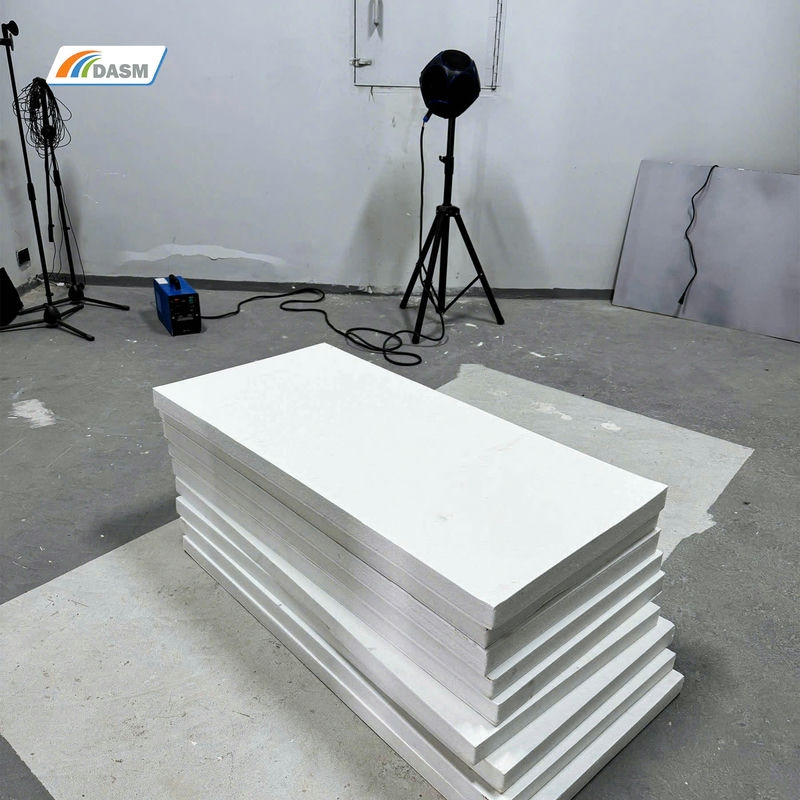
The reverberation room method is a traditional method; measurements of the absorption coefficient of larger specimens are performed in a reverberation room. Afterward, the average value over all angles of incidence under diffuse field conditions is determined. Product data usually provided by absorber manufacturers are determined according to the international standard ISO 354, with measurement requirements of 10-12 square meters and specifications regarding the shape of the area. The reason for these requirements is that the absorption coefficient determined by this method always includes an additional amount due to the edge effect, which is the diffraction phenomenon along the edge of the specimen. This effect makes the specimen acoustically larger than its geometric area, which can lead to obtaining absorption coefficients greater than 1.0. Certainly, this does not imply that the absorbed energy is greater than the incident energy.
Are the sound absorption coefficients of materials the same?
The sound absorption coefficients of different materials are not the same.
The sound absorption capacity of a material is not only related to other properties, thickness, and surface conditions (air layer and thickness), but also related to the angle of incidence and frequency of sound waves. The sound absorption coefficient will vary according to high, medium, and low frequencies. To comprehensively reflect the sound absorption characteristics of a material, six frequencies (125Hz, 250Hz, 500Hz, 1000Hz, 2000Hz, 4000Hz) are established to represent the variation of the sound absorption coefficient. If the average ratio of the six frequencies is greater than 0.2, the material can be classified as a sound-absorbing material.
|
|
Sound absorption coefficient at different frequencies |
||||||
|
Material type |
125 Hz |
250 Hz |
500 Hz |
1000 Hz |
2000 Hz |
4000 Hz |
|
|
Fixed sound absorbing panel |
0.20 |
0.40 |
0.70 |
0.80 |
0.60 |
0.40 |
|
|
Suspended sound absorbing panel |
0.50 |
0.70 |
0.60 |
0.7 |
0.7 |
0.50 |
|
|
Acoustic plaster |
0.10 |
0.20 |
0.50 |
0.60 |
0.70 |
0.70 |
|
|
Conventional plaster on lath/backing board |
0.2 |
0.15 |
0.10 |
0.05 |
0.04 |
0.05 |
|
|
12.7mm gypsum board on framing |
0.29 |
0.11 |
0.10 |
0.07 |
0.09 |
0.10 |
|
|
6.35mm plywood on framing |
0.60 |
0.22 |
0.17 |
0.09 |
0.10 |
0.11 |
|
|
Concrete block (unpainted) |
0.4 |
0.4 |
0.3 |
0.3 |
0.4 |
0.3 |
|
|
Concrete block (painted) |
0.10 |
0.05 |
0.06 |
0.07 |
0.1 |
0.1 |
|
|
Monolithic concrete |
0.01 |
0.01 |
0.02 |
0.02 |
0.02 |
0.03 |
|
|
Brickwork |
0.03 |
0.03 |
0.03 |
0.04 |
0.05 |
0.07 |
|
|
Vinyl floor tiles on concrete |
0.02 |
0.03 |
0.03 |
0.03 |
0.03 |
0.02 |
|
|
Heavy carpet on concrete |
0.02 |
0.06 |
0.15 |
0.4 |
0.6 |
0.6 |
|
|
Heavy carpet with felt underlay on concrete |
0.10 |
0.3 |
0.4 |
0.5 |
0.6 |
0.6 |
|
|
Wooden floor |
0.4 |
0.3 |
0.2 |
0.2 |
0.15 |
0.1 |
|
|
Standard window glass |
0.3 |
0.2 |
0.2 |
0.1 |
0.07 |
0.04 |
|
|
Heavy plate glass |
0.2 |
0.06 |
0.04 |
0.03 |
0.02 |
0.02 |
|
|
Medium velvet curtain |
0.07 |
0.3 |
0.5 |
0.7 |
0.70 |
0.6 |
|
|
Upholstered seat (unoccupied) |
0.2 |
0.4 |
0.6 |
0.7 |
0.6 |
0. 6 |
|
|
Upholstered seat (occupied) |
0.4 |
0.6 |
0.8 |
0.9 |
0.9 |
0.9 |
|
|
Wooden chair (unoccupied) |
0.02 |
0.03 |
0.03 |
0.06 |
0.06 |
0.05 |
|
|
Wooden church pew (occupied) |
0.40 |
0.4 |
0.70 |
0.70 |
0.80 |
0.7 |
|
Each type of material has a different sound absorption coefficient
Applications of sound absorbing materials
Sound absorbing materials, depending on their properties, high or low sound absorption coefficient, and customer requirements, are used in different categories as well as various projects
Sound absorbing materials can be used to control reverberation for walls, floors, and ceilings of concert halls, cinemas, auditoriums, and broadcasting studios. By using sound absorbing materials properly, indoor sound wave transmission can be improved, creating better acoustic effects.
Where to accurately measure the sound absorption coefficient of materials?
At the DASM Institute, a leading unit in acoustic services in Vietnam, we currently provide acoustic measurement and material testing services for sound absorption coefficients according to international standards ISO 10534-2 and ISO 354, meeting all customer requirements.
DASM possesses a modern VILAS-certified laboratory, advanced measuring equipment, and a team of experienced engineers, ensuring accurate – reliable – transparent results, trusted by design, production, and construction units.
Contact DASM today to:
+ Test and evaluate the sound absorption capacity of the materials you are using or about to use
+ Test and evaluate the sound absorption capacity of materials before mass production
+ Consult on optimal acoustic material solutions for projects.
+ Acoustic consulting and design for standard-compliant projects
+ Consult, design, and improve materials
+ Receive standardized measurement reports for certification and research purposes.
VILAS 1541 · ISO/IEC 17025
Need advice on SOUND DESIGN & SIMULATION SERVICES?
Acoustical design services, sound simulation using software for projects specializing in acoustics
Related Articles
Articles from the same category or related topics
- 6 min read
From Vietnamese Acoustic Knowledge to International Forums: DASM's Research Milestone in Acoustics Australia
A research paper on acoustic materials by DASM was published in Acoustics Australia, a world-renowned acoustic journal, marking a new step forward for DASM in the field of acoustics
Read more → - 3 min read
DASM Sound Absorption Testing for Noise Barriers According to ISO 354:2024 & EN ISO 11654:1997
DASM sound absorption testing for Noise Barriers in a reverberation room according to ISO 354:2024 and EN ISO 11654:1997 standards at a VILAS-certified laboratory
Read more → - 4 min read
DASM Participates in Long-Span Bridge Workshop for High-Speed Railways – Expanding Research Capabilities in Acoustics and Structural Vibration
DASM participates in the long-span bridge workshop for high-speed railways to update structural design trends, control structural vibration and acoustics, and prepare capabilities for projects
Read more →