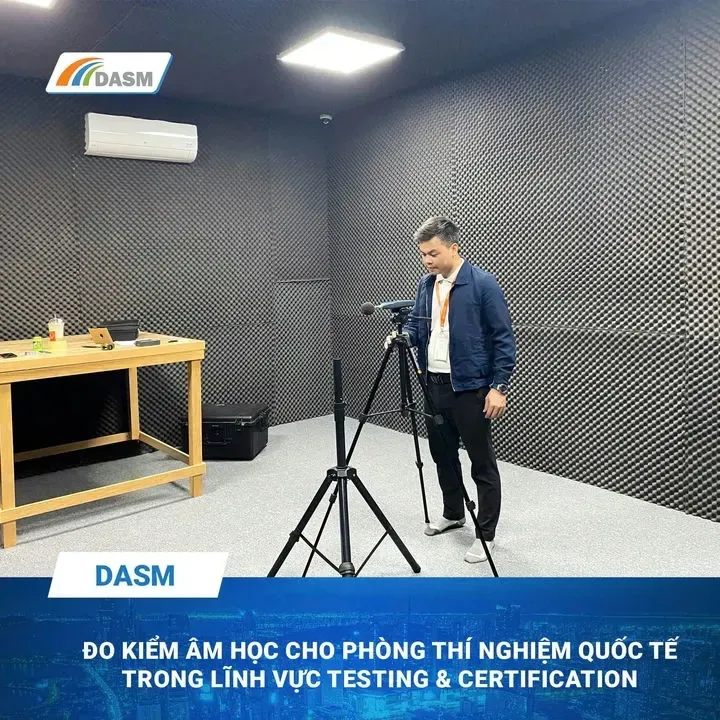
To achieve effective sound insulation and noise control, it is essential to understand some fundamental acoustic laws and rules. These are also the principles applied by DASM in material testing, assessment, and proposing noise control solutions for clients.
Making a space 50% quieter means sound insulation – reducing noise by 10 decibels (dB)
Many clients come to DASM Institute wishing to reduce noise in their spaces and often confuse decibels with loudness. In reality, every 10dB reduction cuts the noise in half. Therefore, when someone with an 80dB noise source states they want to cut the noise in half down to 40dB, the correct answer is to reduce the 80dB source down to 70dB to cut the noise in half.
Background Noise Level Testing for Studio S1 – A Key Project of Vietnam Television (VTV)
Room Acoustic Treatment: International Standard Solutions from DASM Institute
Doubling the mass of a noise barrier or sound transmission class (STC) layer increases the sound insulation capability by about 5dB.
It is well understood that a thicker and heavier noise barrier with appropriate sound insulation and sound absorption materials will block sound transmission. In fact, the Mass Law dictates that for every doubling of mass, the STC increases by 5dB. As mentioned above, a 10dB reduction corresponds to a 50% decrease in noise, so 5dB is half and very noticeable.
Breaking the straight-line transmission path, doubling the height and length of the noise barrier
When seeking to mitigate noise with barriers, the general rule of thumb is that the barrier should be as close to the noise source as possible and have twice the height and length of the noise source. This is especially important in projects outdoors such as construction and outdoor sports facilities. If you can see a loud noise source, chances are you will hear it. If your barrier has the same height and width as the noise source, the noise will diffract around it and you will still be able to hear it.
Sealing gaps and joints can significantly reduce noise
When clients contact us regarding noise issues originating from another space, one of the first things we look for is gaps and joints into the area to be treated. These gaps can appear in doors, ceilings, ductwork, etc. By sealing these gaps, we can minimize noise transmission into other spaces.
Every time you double the distance from a noise source, the sound level decreases by about 6 dB (under outdoor conditions, without reflection)
According to the Inverse Square Law of sound, in an outdoor test (an area without reflective surfaces or echoes), every time the distance from the noise source is doubled, the sound decreases by 6dB. This is a way to understand something we already know on a basic level: sound becomes quieter as we move away from the source.
Adding noise sources (dB) is logarithmic, not additive
Whenever you have two or more noise sources in an area, you might assume that 45dB + 45dB = 90dB. In reality, decibels are logarithmic rather than cumulative. In the previous example, the sound would be 250% louder!
The general rule is: you only add two noise sources at a time and then continue adding other noise sources. The addition of noise sources is as follows:
+ Difference of 0-1dB = +3dB compared to the higher source
+ Difference of 2-3dB = +2dB compared to the higher source
+ Difference of 4-9dB = +1dB compared to the higher source
+ Difference of 10dB or more = +0 compared to the higher source
In the example of 45dB + 45dB, the total sound will be 48dB.
Those are some basic principles in sound insulation and noise reduction. If you have any questions or need services supporting noise resolution and treatment, please contact DASM Institute!
VILAS 1541 · ISO/IEC 17025
Need advice on Noise Survey & Assessment Services?
Measuring ambient environmental, factory and residential noise to support environmental impact assessment (EIA).
Related Articles
Articles from the same category or related topics
- 6 min read
From Vietnamese Acoustic Knowledge to International Forums: DASM's Research Milestone in Acoustics Australia
A research paper on acoustic materials by DASM was published in Acoustics Australia, a world-renowned acoustic journal, marking a new step forward for DASM in the field of acoustics
Read more → - 3 min read
DASM Sound Absorption Testing for Noise Barriers According to ISO 354:2024 & EN ISO 11654:1997
DASM sound absorption testing for Noise Barriers in a reverberation room according to ISO 354:2024 and EN ISO 11654:1997 standards at a VILAS-certified laboratory
Read more → - 4 min read
DASM Participates in Long-Span Bridge Workshop for High-Speed Railways – Expanding Research Capabilities in Acoustics and Structural Vibration
DASM participates in the long-span bridge workshop for high-speed railways to update structural design trends, control structural vibration and acoustics, and prepare capabilities for projects
Read more →