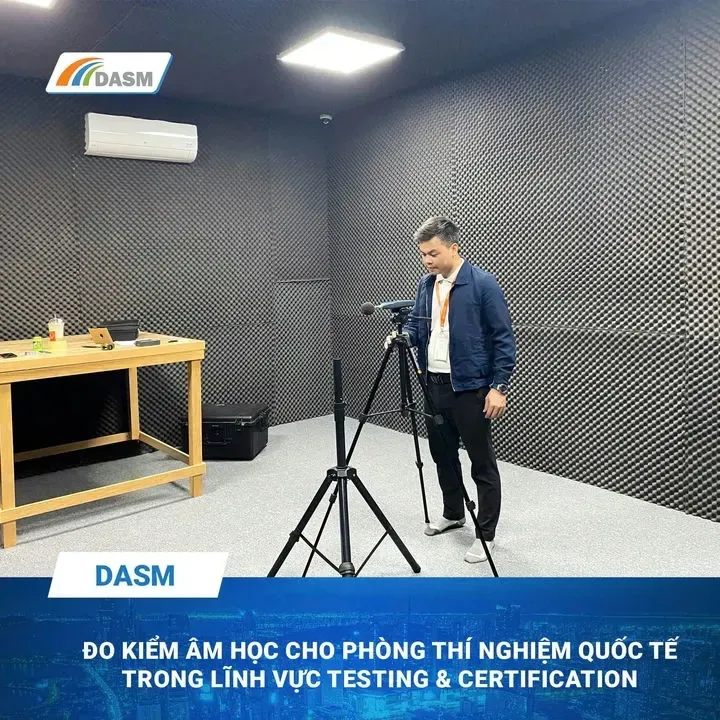
With DASM quick look up basic acoustic indicators, noise measurement standards, impact & reverberation time in building design according to international ISO standards through the following information.

Acoustic terminology
‘A’ FREQUENCY WEIGHTING: A-weighting is the frequency weighting most commonly used to evaluate occupational and environmental noise. However, for environmental noise evaluations, it is often necessary to adjust the characteristics of the sound.
Adapter Noise Measurement According To ISO 3745-2012 Standard – Quality Inspection At DASM Institute
‘F’(FAST) TIME WEIGHTING: The design goal of the sound level meter is a time constant of 0.125 seconds.
‘S’ (SLOW) TIME WEIGHTING: The design goal of the sound level meter is a time constant of 1 second.
‘Z’ FREQUENCY WEIGHTING: ‘Z’ (Zero) frequency weighting is 0 dB within the nominal 1/3 octave band frequency range centered from 10 Hz to 20 kHz. This is within the tolerance limits given in AS IEC 61672.1-2004.
1/3 OCTAVE BAND: Each octave band refers to a frequency band dividing the frequency band into 3, allowing for more detailed analysis and equal to 23% of the bandwidth center frequency.
ACOUSTICS: refers to the branch of science studying topics such as the generation and propagation of sound waves, sound sources, effects on hearing, measurement, control technology, and application research.
AIR-BORN SOUND INSULATION: refers to the value of the spectral or single-number sound insulation indicator, taking into account the acoustic conditions of the receiving room, obtained from the reduction in noise occurring when air is introduced behind the airborne element by a construction element.
AMBIENT NOISE: The ambient noise level at a specific location is the overall environmental noise level caused by all noise sources in the area, both near and far, including all forms of traffic, industry, lawnmowers, wind blowing through foliage, insects, animals, etc. Usually evaluated as the equivalent continuous sound pressure level over a given time interval ‘T’ (LAeq, T).
APPARENT SOUND REDUCTION INDEX (R’): ten times the common logarithm of the ratio of sound power, W1, to a test element compared to the total sound power radiated into the receiving room if, in addition to the sound power, W2, radiated by the test element, the sound power, W3, radiated by flanking elements or other components is significant.
AUDIBLE: is sound that can be heard. There are various degrees of audibility, ranging from “barely audible”, “just audible” to “clearly audible” and “prominent”.
A-WEIGHTED SOUND PRESSURE LEVEL (dBA): The A-weighted sound pressure level (dBA) obtained with the aid of the A-weighting network, determining the influence of noise on medium and high frequencies and most sensitive to low volume levels.
BACKGROUND NOISE (FOR BUILDINGS): is the total residual noise measured at the same location and conditions when the noise source under test in the environment or enclosure is not operating.
BUILDING ACOUSTICS: The area surrounding buildings, sound inside buildings within buildings, and noise issues caused by the mechanical and electrical systems of buildings with each other, referring to the sub-branch of acoustics , including the reverberation sphere, aimed at preventing harmful sounds.
C – WEIGHTED SOUND PRESSURE LEVEL (dBC): Indicates the single-number sound level obtained with the aid of the C-weighting network used to evaluate noise with low frequency sounds up to 35 Hz.
CORRECTION TO THE BACKGROUND NOISE: In an environment or indoor environment, refers to the process of finding ambient noise by logarithmic subtraction from the total measured value.
DAYTIME-EVENING-NIGHT LEVEL (Lgag or Lden): Indicates the external environmental noise level obtained from long-term A-weighted average sound.
ELEMENT-NORMALIZED LEVEL DIFFERENCE (D n,e): level difference corresponding to the reference value of the absorption area in the receiving room with sound transmission solely through the small element.
ENVIRONMENTAL NOISE OR EXTERNAL NOISE: May be caused by environmental noise or external noise: machinery, equipment used for transportation, road traffic, rail traffic, air traffic, waterway traffic, wind turbines, outdoor areas, industrial areas, workshops, and similar businesses referring to harmful air-borne sound that is harmful or unwanted generated in recreation areas, amusement parks, children's playgrounds, sports fields, and human activities.
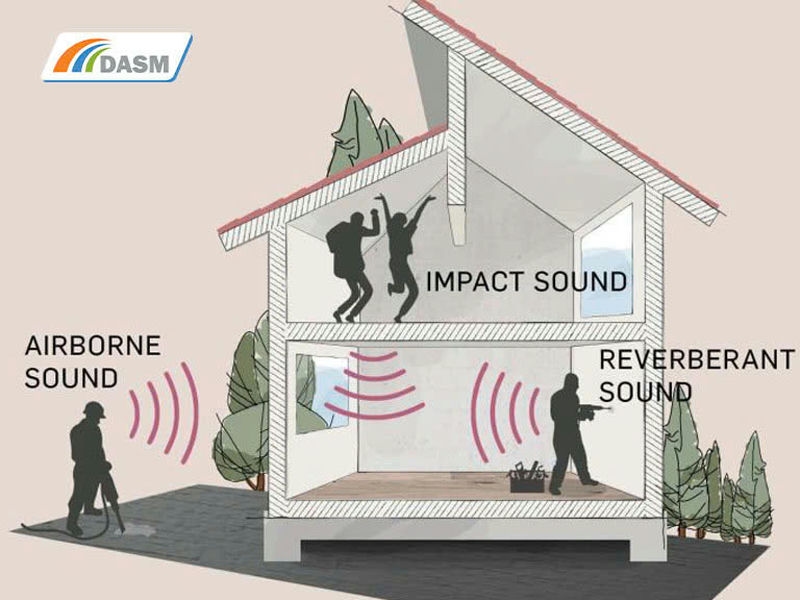
EQUIVALENT CONTINUOUS SOUND PRESSURE LEVEL (Leq): The continuous fluctuating sound pressure level with energy equal to a fluctuating sound level meter that varies the sound pressure level over a period of time. (Abbreviated as LAeq when measured according to volume A).
FREQUENCY SPECTRUM: is a graphical representation of the variation of sound pressure level with frequency in each octave and 1/3 octave noise band.
NOISE REDUCTION COEFFICIENT (usually abbreviated as NRC) is a single number value ranging from 0.0 to 1.0 describing the average sound absorption performance of a material. An NRC of 0.0 indicates that the object does not attenuate mid-frequency sound but reflects acoustic energy.
IMPACT ISOLATION CLASS (IIC): The IIC of a floor/ceiling assembly shall be determined by operating the ISO 140 Standard Tapping Machine on the floor and measuring the noise generated in the room below. The IIC is a single-number rating found by fitting a reference contour to the measured octave-band levels and then subtracting the sound pressure level at 500 Hz from 110 decibels. Therefore, the higher the IIC, the better the impact sound insulation.
IMPACT SOUND INSULATION (LnT,w): The ISO 717.2 – 2004 standard specifies that the impact sound insulation of a floor/ceiling assembly must be quantified by operating the ISO 140 Standard Tapping Machine on the floor and measuring the noise generated in the room below. The weighted standardized impact sound pressure level (LnT,w) is the sound pressure level at 500 Hz relative to the reference curve fitted to the measured one-third octave band levels. Therefore, the lower the LnT,w, the better the impact sound insulation.
IMPACT SOUND PRESSURE LEVEL (Li): the energy-average sound pressure level in a one-third octave band in the receiving room when the floor under test is excited by a standardized impact source.
IMPULSE SOUND INSULATION: In cases where a standard impulse sound source modeling stepwise sound is placed upside down, it indicates the value of the single-number quantity rating of sound insulation, taking into account the acoustical conditions of the receiving room, obtained from the sound pressure level measured in the room below.
IMPULSE SOUND PRESSURE LEVEL (Li): Impulse sound insulation is the energy-average sound pressure level corresponding to different microphone positions in one of the one-third octave bands in the receiving room during excitation by a standard impulse sound source for measuring impulse sound insulation.
IMPULSE SOUND: is sound caused by two masses colliding with each other or generating solid-borne noise that is transmitted directly to the building support system and building components, such as door slamming, footsteps, and cargo hoisting.
INDOORS NOISE OR INNER NOISE: Mechanical and electrical installation noise within a building and ambient noise from the immediate surroundings refer to all unwanted and harmful sounds that adversely affect humans in the environment.
LOUDNESS: The auditory sensation of sound intensity perceived by a listener is a subjective term known as loudness. Humans generally perceive loudness to double when the sound level increases by approximately 10 dB and to halve when the sound level decreases by approximately 10 dB.
MAXIMUM SOUND PRESSURE LEVEL (LF, max): represents the maximum value of sound pressure levels measured using fast time-weighting in each octave band during a given measurement. (LAF, referred to as maximum when measured with frequency weighting).
NOISE CRITERION OR NC LEVELS: is a set of different values developed for the same purpose; the Noise Criterion (NC) is primarily used in North America.
NOISE RATING LEVELS OR NR LEVEL CURVES: developed by the International Organization for Standardization (ISO) to specify indoor acoustic environments for various requirements regarding hearing protection, speech communication, and annoyance in different applications.
NOISE REDUCTION INDEX (R): Ten times the common logarithm of the ratio of the sound power W1 incident on a building element to the sound power W2 transmitted from that element, used to indicate the noise reduction performance of the element.
NOISE: Noise is unwanted, harmful, or discordant sound. Sound is wave motion in matter, which can be gaseous, liquid, or solid. Noise generally comprises both vibration and sound.
NORMALIZED IMPACT SOUND PRESSURE LEVEL (Ln): the impact sound pressure level, Li, plus a correction term expressed in decibels, equal to ten times the common logarithm of the ratio of the measured equivalent absorption area, A, of the receiving room to the reference equivalent absorption area, A0.
OCTAVE BAND: is a frequency band used to express the variation of sound pressure level with frequency, with the upper and lower frequency limits having a ratio of two to one and a center frequency bandwidth of approximately 70%.
PINK NOISE: is broadband noise with equal energy per octave or one-third octave bandwidth. Therefore, pink noise contains more low-frequency energy than white noise and is widely used for sound transmission loss testing.
RECEIVER ROOM: refers to the room where sound is transmitted in a sound insulation measurement and where the receiver microphone is located.
REVERBERATION OR REVERBERATION TIME (T): The time required for the sound pressure level to decrease by 60 dB after the sound source has ceased operation. It refers to a parameter used to evaluate sound insulation and determine frequency-based acoustic characteristics.
SOUND POWER LEVEL (Lw): A value expressed in dB, found by multiplying the base-10 logarithm of the ratio of the sound power of a source to a reference sound power of 10 to the -12 watts, with the lowest audible sound power, 10.
SOUND PRESSURE LEVEL (Lp): refers to the value found in dB, calculated by multiplying the base-10 logarithm of the ratio of the measured sound pressure at a given point in the environment to a reference sound pressure of 20×10-6 Pa or 20 μPa, multiplied by 20.
SOUND TRANSMISSION CLASS (or STC): is an integer rating of how well a building partition attenuates airborne sound.
SOUND TRANSMISSION LOSS (STL): is a measure of the ability of a material or structure to reduce sound transmission from one side to the other, expressed in decibels (dB).
SOURCE ROOM: is the room containing the noise source in a sound insulation measurement.
SPECTRUM ADAPTATION TERMS (Ctr, C, CI, Ctr, 50-3150, C50-3150, CI, 50-2500): To obtain single-number quantities for octave or one-third octave bands using specific standard frequency curves, referring to terms calculated in accordance with EN ISO 717-1 and TS EN ISO 717-2.
WEIGHTED IMPULSE NOISE ISOLATION IMPROVEMENT INDEX (ΔLw): Expresses the weighted value of the impact sound insulation improvement index ΔL determined in one-third octave bands using reference curves.
WEIGHTED NOISE REDUCTION INDICES (Rw, R’w): Express the weighted airborne sound insulation indices obtained using reference curves from sound reduction index or apparent sound reduction index values of an element to represent the acoustic insulation performance of building elements.
WEIGHTED SOUND ABSORPTION COEFFICIENT (αw): Expresses the weighted value of the sound absorption capability determined using a reference curve.
WEIGHTED SOUND REDUCTION ENHANCEMENT INDEX (ΔRw): Expresses the weighted value of the sound reduction enhancement index ΔR, determined in one-third octave bands using a reference curve.
WEIGHTED STANDARDIZED FAÇADE LEVEL DIFFERENCE (D2m, nT, w): The difference between the outdoor sound pressure level due to traffic or a special sound source at 2 meters in front of the façade and the sound pressure level in the receiving room, determined with reference to a reference reverberation time, representing the weighted sound insulation index obtained using a reference curve.
WEIGHTED STANDARDIZED IMPULSE SOUND PRESSURE LEVEL (L nT, w): Expresses the weighted impulse response measured in the receiving room during field measurements, obtained using a reference curve from the spectrum values reduced by applying a correction based on the reverberation time of the receiving room.
WEIGHTED STANDARDIZED LEVEL DIFFERENCE (DnT, w): The difference between the spatial and temporal average of sound pressure levels generated by one or more sound sources in a source room and the airborne sound in the receiving rooms, derived from the spectrum values obtained by correcting for the reverberation time of the receiving room, referring to the weighted sound isolation index obtained using a reference curve.
WHITE NOISE: White noise is a broadband random noise with a constant power spectral density across its entire frequency range. The acoustic power is equal for equal bandwidths from low to high frequencies. Because higher octave bands cover a broader spectrum, white noise contains more energy at higher frequencies and sounds like a hiss.
DASM – A pioneering unit in noise measurement, material testing, and acoustic consulting in Vietnam.
Possessing a team of acoustic engineers and experts with deep expertise along with a modern machinery and measuring equipment system meeting international standards, DASM provides services professional acoustics and comprehensive measurement – analysis – acoustic design consulting solutions for all types of projects.
Acoustic services at DASM include:
- Acoustic material testing, on-site acoustic measurement: noise, reverberation, impact sound… according to ISO, TCVN, BS EN standards.
- Noise survey and assessment
- Noise and vibration control.
- Sound design and simulation.
- Consulting, design, and material improvement.
- Architectural acoustic consulting and design: auditoriums, theaters, recording studios, factories, offices, hospitals, schools…
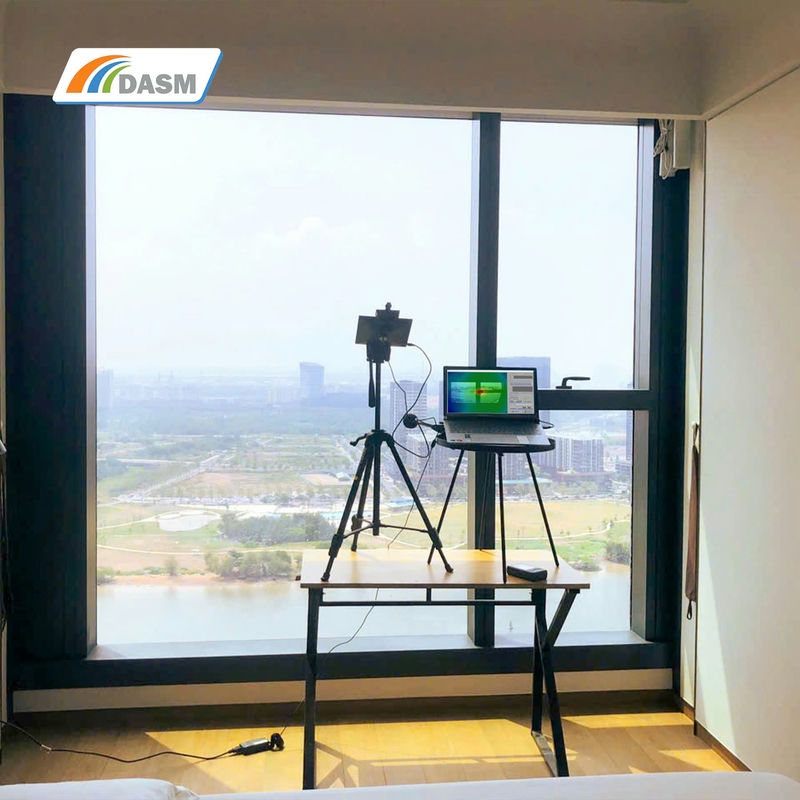
From cultural, healthcare, and educational facilities to industrial factories and key infrastructure projects , DASM has accompanied hundreds of investors and consulting units in creating standard – safe – sustainable acoustic spaces.
Contact DASM Institute for expert acoustic solutions according to international standards right in Vietnam.
VILAS 1541 · ISO/IEC 17025
Need advice on Materials Acoustic Testing?
Services of testing, measuring and analyzing acoustic properties of equipment, products, vehicles, acoustic materials, etc.
Related Articles
Articles from the same category or related topics
- 6 min read
From Vietnamese Acoustic Knowledge to International Forums: DASM's Research Milestone in Acoustics Australia
A research paper on acoustic materials by DASM was published in Acoustics Australia, a world-renowned acoustic journal, marking a new step forward for DASM in the field of acoustics
Read more → - 3 min read
DASM Sound Absorption Testing for Noise Barriers According to ISO 354:2024 & EN ISO 11654:1997
DASM sound absorption testing for Noise Barriers in a reverberation room according to ISO 354:2024 and EN ISO 11654:1997 standards at a VILAS-certified laboratory
Read more → - 4 min read
DASM Participates in Long-Span Bridge Workshop for High-Speed Railways – Expanding Research Capabilities in Acoustics and Structural Vibration
DASM participates in the long-span bridge workshop for high-speed railways to update structural design trends, control structural vibration and acoustics, and prepare capabilities for projects
Read more →