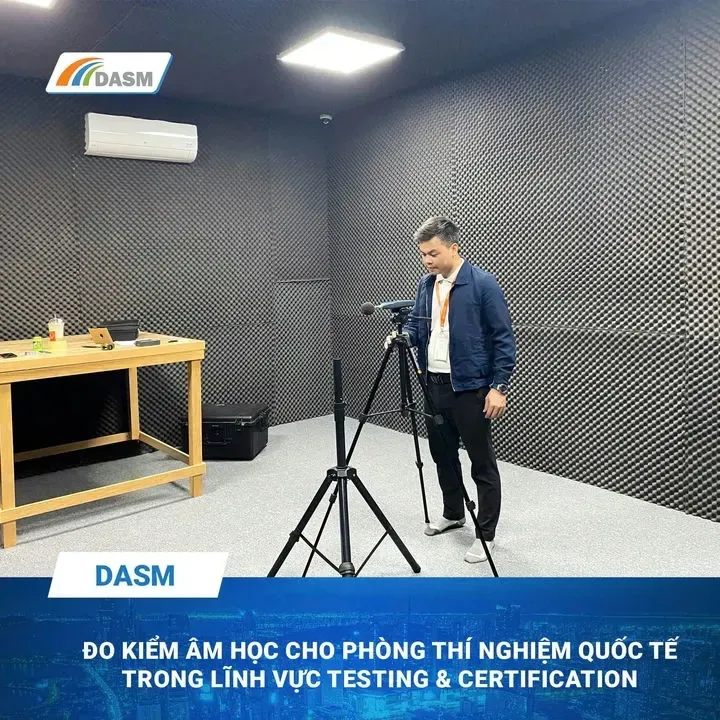
Acoustic comfort is extremely valuable and important in buildings. That is why projects need acoustic consulting, architectural acoustic design, and sound insulation in building structures to ensure the isolation or complete minimization of airborne sound and structure-borne sound transmission. Join DASM Institute to learn all the necessary information about these 2 types of sound through the article below.
What is sound?
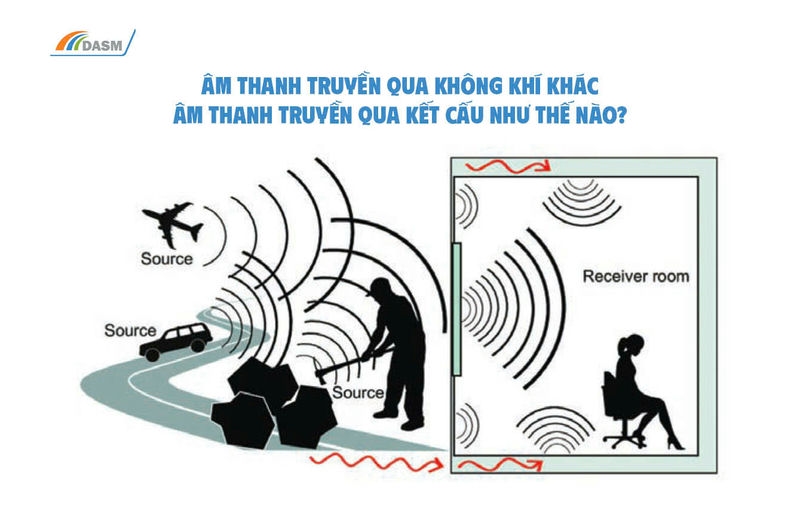
Sound is a general term for mechanical vibrations in an elastic medium, which can be gas, liquid, or solid. These vibrations propagate through the medium in the form of sound waves. Sound waves in the air are variations in pressure and density.
In common parlance, sound is what we perceive through the auditory system—consisting of the ears and the brain. Beneficial sound is pleasant sound that we perceive as music or speech in conversation. Conversely, noise—such as traffic noise or construction noise—is often considered annoying or troublesome.
What is the difference between Airborne Sound and Impact Sound?
When does sound become noise?
When sound has a disturbing, stressful, or harmful impact on the environment, it is called noise. Generally, the factor that makes people perceive sound as noise is its volume level.
Whether a sound is considered noise largely depends on the listener's perception and evaluation. Noise can disrupt the day/night cycle, reduce concentration, and cause sleep disturbances. Although the body may gradually adapt with repeated exposure, noise can still pose potential risks to physical and mental health.
Direct sound
Direct sound is the first sound that reaches the listener's ear in an enclosed space—meaning it is unreflected sound. Environmental sound or diffused sound travels in an indirect direction, through reflective or deflected surfaces, before reaching the ear.
Direct sound helps the ear locate the sound source—that is, the direction from which the sound is emitted. Meanwhile, environmental sound contributes to reverberation or speech intelligibility in the space. For example: if the time lag between the direct sound and the first reflection is 30 milliseconds, the listener will feel as if they are in a large room.
Types of sound
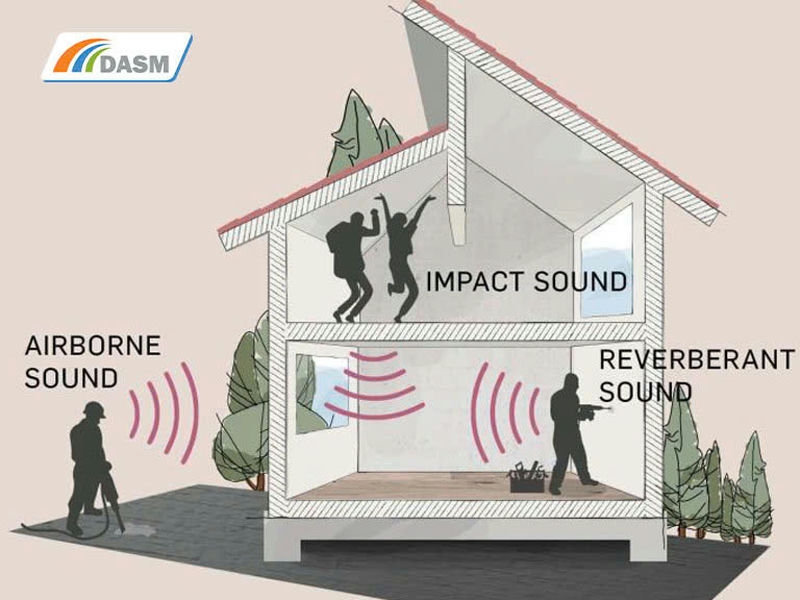
When a solid medium (such as a wall) is excited by sound waves, it is called structure-borne sound. Conversely, when air—a gaseous medium—is excited, it is airborne sound.
These two types can convert back and forth at the boundary between solid objects and air. Structure-borne sound can travel at a speed of about 330 m/s, and in concrete, it can be about 10 times faster—around 3,400 m/s.
What is structure-borne sound?
Structure-borne sound in walls, floors, or other solid objects can be generated in various ways:
- Direct structure-borne sound: caused by direct force impact on a solid object—such as when drilling a wall with a drill. Impact sound also falls into this category—for example, footsteps on a floor.
- Indirect structure-borne sound: formed when sound from an airborne source (such as loud speakers) is powerful enough to make solid objects vibrate.
We cannot hear structure-borne sound directly, but we can feel it—for example, heavy bass from techno music making the body vibrate. For the ear to hear structure-borne sound, it must convert back into airborne sound upon reaching a surface.
How to measure structure-borne sound?
Measured using structure-borne sound transducers—devices that convert mechanical vibrations into analog electrical signals. Commonly measured parameters are: vibration amplitude, vibration velocity, and vibration acceleration.
How to reduce structure-borne sound?
Reducing structure-borne sound is not easy, as it travels through walls, ceilings, floors—generally hard materials like stone, concrete, steel... But do not worry, below are extremely effective ways to reduce it:
1. Decoupling
- Using isolation materials between structural parts to prevent the transmission of vibrations.
- Example: Using rubber pads, specialized foam layers, or sound-insulating ceiling suspension systems.
- In house construction or recording studio design, double stud walls are often used—each wall side is separate, so sound cannot travel through.
2. Damping layers
- Materials such as damping membranes or anti-vibration boards are sandwiched between two layers of hard materials (such as gypsum board).
- They absorb vibration energy and reduce transmitted sound.
3. Mass-adding
Heavier materials transmit sound poorly (in theory). Therefore, you can:
- Glue additional gypsum boards, cement boards, or specialized sound insulation boards.
- Use brick walls or heavy concrete instead of lightweight walls if possible.
4. Isolating MEP systems
Water pipes, air conditioners, and ventilation fans often cause vibrations and transmit sound. Solution:
- Attach with flexible joints, acoustic sealants, or use isolation hangers.
- Do not let them touch the building structure directly.
5. Limiting flanking paths
- Structure-borne sound can find ways around, passing through technical openings, door gaps, vent gaps, electrical conduits...
- Solution:
- Seal all gaps with specialized sealants.
- Install door seals, sound-insulated doors, and seal electrical boxes if they penetrate walls.
6. Floor and ceiling vibration control
If sound transmits through the ceiling or floor, then:
- Use a floating floor for sound insulation.
- Install a suspended ceiling with rubber or spring isolation frames.
- Avoid mounting bass speakers on walls or floors, as they transmit sound very strongly.
To effectively treat structure-borne sound transmission, multiple methods must be combined: isolation, mass enhancement, and vibration damping. Especially when the project is in the design phase, potential noise issues must be calculated and appropriate treatment solutions should be planned right from the drawing stage to optimize effectiveness and construction costs.
What is airborne sound transmission??
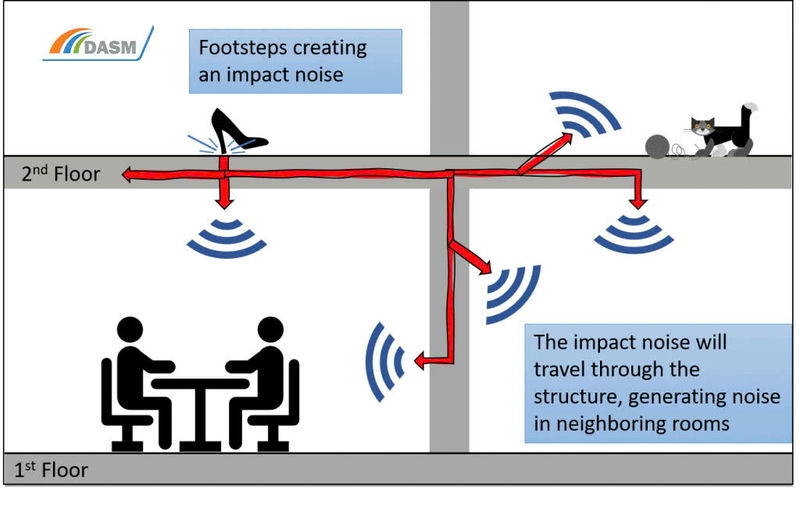
Airborne sound, also known as airborne noise, is sound that travels through the air from the source in the form of sound waves. The human ear can hear within the range of 20 – 20,000 Hz.
How to measure airborne noise?
- Measured in decibels (dB) – representing sound pressure level.
- 0 dB is the lowest audible threshold; 140 dB is the pain threshold.
- The scale is logarithmic, so an increase or decrease of 10 dB is perceived as doubling or halving.
- The dB(A) index is an adjusted scale to remove low-frequency energy to which the ear is less sensitive.
How to reduce airborne noise?
- Based on the sound absorption phenomenon.
- Soft, porous materials absorb better than hard, flat surfaces.
- Thick and heavy walls (clay brick, concrete, limestone, etc.) provide better sound insulation.
- For lightweight walls, a second sound-insulating wall layer can be built.
- Avoid gaps or small holes in the walls so as not to reduce the sound insulation performance.
Sound absorption classes are categorized from Class A to E, according to the absorption level:
- Class A: sound absorption coefficient from 0.9 to 1.0 – highest sound absorption.
- Class E: sound absorption coefficient from 0.15 to 0.25 – lowest sound absorption.
The difference between airborne sound and structure-borne sound
The fundamental difference between these two types of sound is the different sound transmission medium:
Airborne sound travels through the air. While Structure-borne sound travels through solid objects such as stone, concrete, and wood.
Structure-borne sound such as footsteps and machinery in buildings are typical examples.
Structure-borne sound can convert back into airborne sound when reaching a surface, at which point it is heard by the ear.
Professional acoustic treatment solutions from DASM
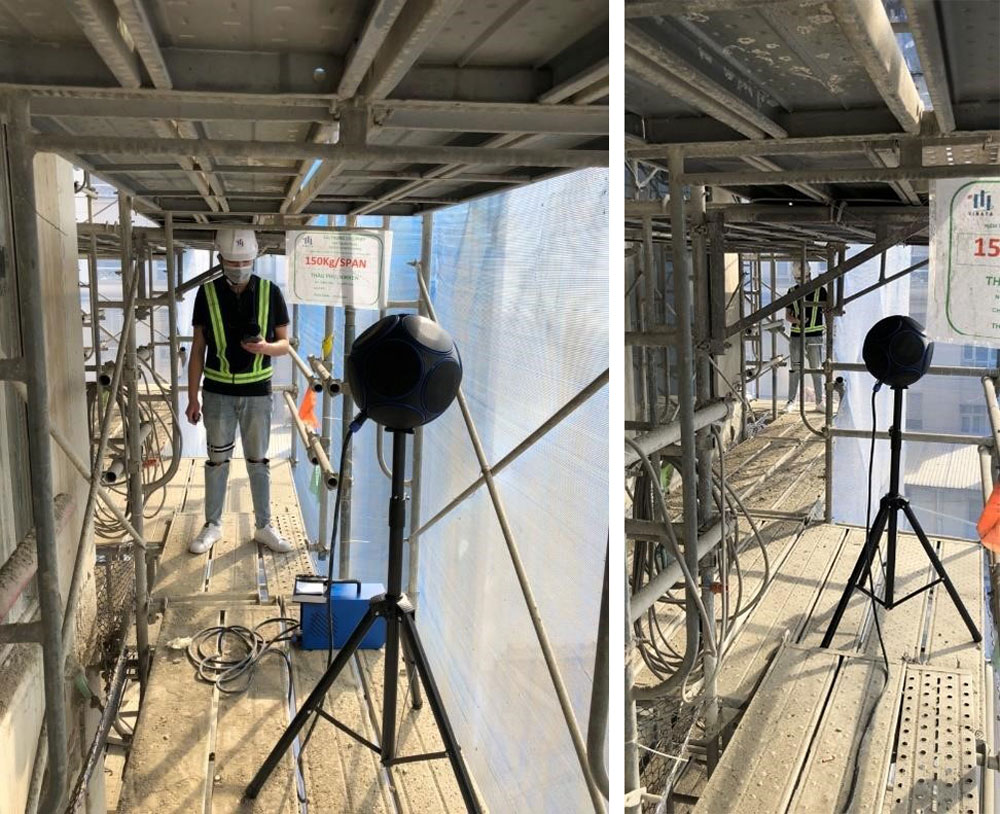
Right from the design stage, issues related to sound and acoustics must be thoroughly analyzed. Identifying the correct type of sound, material testing, and selecting appropriate solutions is the key to minimizing airborne sound transmission, delivering a quiet, comfortable space and superior living quality.
DASM Institute is always ready to accompany enterprises, architects, and construction engineers in the process of controlling sound, vibration, and shock in structures.
Contact DASM Institute immediately to receive in-depth consultation and optimal sound insulation and noise blocking solutions for your project!
VILAS 1541 · ISO/IEC 17025
Need advice on SOUND DESIGN & SIMULATION SERVICES?
Acoustical design services, sound simulation using software for projects specializing in acoustics
Related Articles
Articles from the same category or related topics
- 6 min read
From Vietnamese Acoustic Knowledge to International Forums: DASM's Research Milestone in Acoustics Australia
A research paper on acoustic materials by DASM was published in Acoustics Australia, a world-renowned acoustic journal, marking a new step forward for DASM in the field of acoustics
Read more → - 3 min read
DASM Sound Absorption Testing for Noise Barriers According to ISO 354:2024 & EN ISO 11654:1997
DASM sound absorption testing for Noise Barriers in a reverberation room according to ISO 354:2024 and EN ISO 11654:1997 standards at a VILAS-certified laboratory
Read more → - 4 min read
DASM Participates in Long-Span Bridge Workshop for High-Speed Railways – Expanding Research Capabilities in Acoustics and Structural Vibration
DASM participates in the long-span bridge workshop for high-speed railways to update structural design trends, control structural vibration and acoustics, and prepare capabilities for projects
Read more →